


Executive Summary & Protocol Overview
GIWA (standing for Global Infrastructure for Web3 Access) represents one of the most strategically significant Layer 2 developments originating from the Asian crypto powerhouse: South Korea. Engineered directly by Dunamu Inc., the parent corporate entity operating Upbit, the nation’s undisputed leader in spot cryptocurrency trading volume and digital asset liquidity, GIWA is architected as an Ethereum Layer 2 Rollup powered by the Optimism OP Stack.
In traditional Korean architecture, a GIWA (기와) is a ceramic roof tile. While an individual tile appears small, when interlocked and arrayed across an expansive superstructure, it forms a weatherproof, resilient, and enduring shelter. Translating this architectural metaphor into decentralized systems, Dunamu designed GIWA to serve as an open, high-throughput, EVM-equivalent foundation where global builders, decentralized protocols, and institutional digital assets converge.
Technical & On-Chain Performance Baseline (GIWA Sepolia Testnet)
- Consensus & Framework: Optimism OP Stack Rollup (Ethereum L1 Settlement).
- Execution Speed: 1.0-second block generation time with sub-second Flashblocks pre-confirmation technology.
- EVM Compatibility: 100% bytecode and tooling equivalence (Foundry, Hardhat, Remix, Viem, Ethers.js).
- Network Stress Metrics (Live Blockscout Data):
- Total Processed Transactions:
542,376,323+txns. - Total Wallet Addresses Indexed:
159,164,992+addresses. - Daily Transaction Velocity:
1.54Mtxns/day. - Average Gas Price:
< 0.1 Gwei(~$0.00001 per standard transfer). - Ecosystem Native Building Blocks:
- Dojang (도장): Decentralized on-chain attestation engine verifying off-chain credentials.
- Upbit Web3 Names (
up.id): Soulbound/custom human-readable domain naming infrastructure (username.up.id). - Bojagi (보자기): Zero-knowledge privacy protocol for confidential transaction validation.
- Upbit Oracle: Institutional-grade price feed and asset valuation feeds.
- GIWA Wallet: Consumer-facing mobile/web smart contract wallet for seamless asset digitization.
Why Choose GIWA Network? (5 Foundational Pillars)
For institutional researchers, airdrop farmers, and ecosystem developers evaluating testnet campaigns, GIWA stands out distinctly from speculative low-effort rollups due to five structural competitive advantages:
1. Undisputed Backing from Dunamu & Upbit (Tier-1 Exchange Hegemony)
Upbit commands unmatched market share across the South Korean fiat-crypto corridor, routinely processing billions in daily spot volume and dominating the “Kimchi Premium” retail liquidity. Dunamu’s balance sheet, regulatory standing, and institutional partnerships (including backing from tech giant Kakao) place GIWA in the elite echelon of exchange-backed Layer 2 networks alongside Coinbase’s Base, Binance’s BNB Chain, and Bybit’s Mantle.
2. Standardized OP Stack Superchain Architecture
Rather than building an isolated proprietary L2, GIWA chose the battle-hardened OP Stack framework developed by the Optimism Foundation. This guarantees seamless interoperability across the Superchain ecosystem, instant integration with standard EVM developer toolchains, native bridge trustlessness, and future shared sequencing capabilities.
3. Proprietary Identity & Privacy Infrastructure (Dojang, UP ID & Bojagi)
Unlike generic rollups that only offer token transfers and AMM forks, GIWA ships foundational Web3 primitives on day one:
- Dojang: Issues cryptographic attestations binding off-chain verification to on-chain addresses.
- Upbit Web3 Names (
up.id): Solves address UX friction by creating clean naming protocols directly tied to the Upbit exchange user base. - Bojagi: Implements state-of-the-art ZK privacy to safeguard institutional compliance and trade privacy.
4. Zero Financial Risk / 100% Sweat-Equity Positioning
Currently active on GIWA Sepolia Testnet, participation is completely free. There are zero token purchases, zero real mainnet ETH gas requirements, and zero liquidity lockup risks. Users qualify strictly through authentic on-chain interaction, contract testing, and ecosystem adoption.
5. Historical Precedent of CEX-Backed L2 Retroactive Value Creation
Exchange-backed Layer 2 blockchains follow a proven historical trajectory:
- Base (Coinbase) catalyzed billions in ecosystem grants, Onchain Summer rewards, and retroactive builder incentives.
- BNB Chain (Binance) created immense value through Launchpools, Megadroprs, and early validator rewards.
- While GIWA’s core documentation strictly clarifies that ETH is used for gas and no token is formally announced, early testnet contributors who establish verified on-chain history (Dojang attestations, UP ID registrations, faucet transactions, bridge deposits) position themselves at the absolute genesis tier for future governance allocations, ecosystem grants, or retroactive incentives.
Step-by-Step Hands-On Evidence (KyberSwap 5-Block Standard)
All 8 steps below represent authentic, hands-on interactions conducted directly on the official GIWA Sepolia Testnet infrastructure using connected wallet 0x8Edc2d07B12683e07fbc12E43a60622df47d3274 (0x8E...3274).
Step 1: Claiming Testnet Gas on GIWA Sepolia Faucet (faucet.giwa.io)
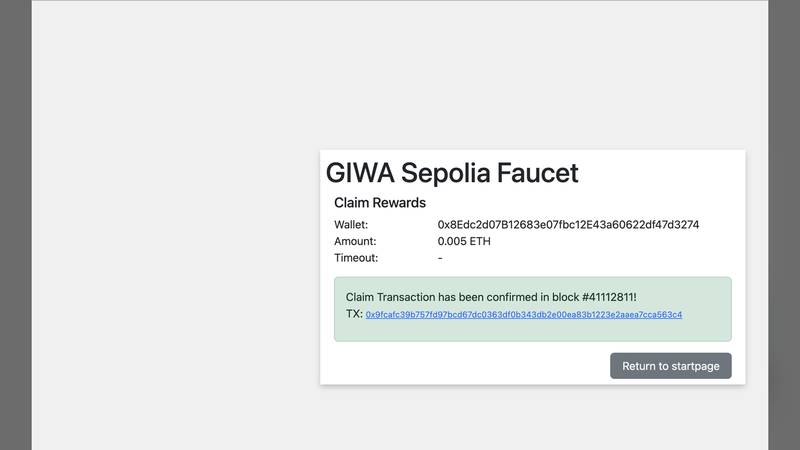
What you see: The official GIWA Sepolia Faucet claim confirmation modal displaying the user’s authentic EVM address 0x8Edc2d07B12683e07fbc12E43a60622df47d3274, granted allocation amount of 0.005 ETH, success status confirmation in block #41112811, and clickable transaction hash link 0x9cafc39b757fd97bcd67dc0363df0b343db2e00ea83b1223e2aaea7cca563c4.
Why do this?
Acquiring native testnet ETH is the prerequisite foundation for all subsequent on-chain activities across GIWA. Because GIWA utilizes native ETH as its L2 execution gas token, obtaining official faucet funds creates the initial on-chain funding record directly linked to the protocol’s genesis dispenser contract.
Architectural Context / Key Concept / Security Warning:
The GIWA Sepolia Faucet implements a strict 24-hour rate limit per address and IP fingerprint (dispensing 0.005 ETH per epoch; alternatively, partner Lambda256 Nodit faucet dispenses 0.01 ETH). Never purchase testnet ETH from OTC brokers or third-party sellers. Official testnet tokens have zero monetary value and are distributed freely to prevent sybil manipulation.
How to execute:
- Navigate to
faucet.giwa.io. - Input your EVM wallet address (
0x8Edc2d07B12683e07fbc12E43a60622df47d3274). - Solve the anti-bot verification challenge and click
Claim. - Verify the confirmation toast showing block number
#41112811and copy the transaction hash0x9cafc39b....
Key Metrics & Best Practices / Checklist:
- Faucet Rate Limit: 1 claim per 24 hours.
- Gas Token: Native ETH on GIWA Sepolia (Chain ID
91342). - Dispensation Amount:
0.005 ETH(~5,000+ standard L2 transactions at< 0.1 Gwei).
Step 2: Validating Network Health on Blockscout Explorer (sepolia-explorer.giwa.io)
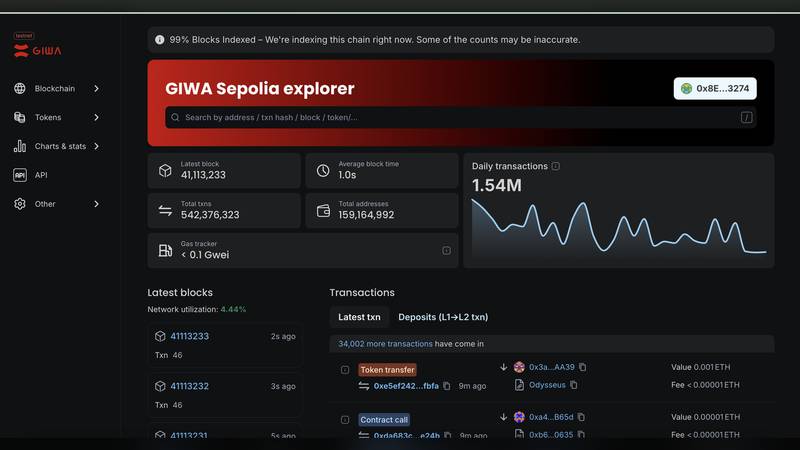
What you see: The GIWA Sepolia Blockscout dashboard showing active wallet connection 0x8E...3274 in the top right header, real-time network telemetry displaying latest block 41,113,233, average block time 1.0s, daily transaction volume 1.54M, total cumulative transactions 542,376,323, total addresses 159,164,992, gas tracker < 0.1 Gwei, and the live streaming transaction feed.
Why do this?
Verifying network telemetry through the independent Blockscout explorer confirms the operational vitality of the OP Stack rollup. Connecting your wallet directly to the explorer enables rapid network RPC injection into MetaMask/Trust Wallet and verifies that your account address is properly indexed by the chain’s sequencer.
Architectural Context / Key Concept / Security Warning:
GIWA’s 1.0-second block cadence combined with Flashblocks sub-second pre-confirmations provides near-instantaneous transaction finality for end users. The network has already processed over 542 million transactions and indexed nearly 160 million addresses, proving enterprise-grade throughput and stability under continuous synthetic and community load.
How to execute:
- Open
sepolia-explorer.giwa.io. - Click
Connect Walletin the top right navigation bar and select your Web3 provider. - Accept the automated network configuration prompt:
- Network Name: GIWA Sepolia
- Chain ID:
91342 - RPC URL:
https://sepolia-rpc.giwa.io - Currency Symbol:
ETH
- Inspect the macro health indicators (1.0s block time, 1.54M daily transactions).
Key Metrics & Best Practices / Checklist:
- Sequencer Block Time: Exactly 1.0 second.
- Base Gas Fee:
< 0.1 Gwei. - Explorer Status: 99% indexing coverage with real-time block streaming.
Step 3: Bridging Assets via Native Superbridge (sepolia-bridge.giwa.io)
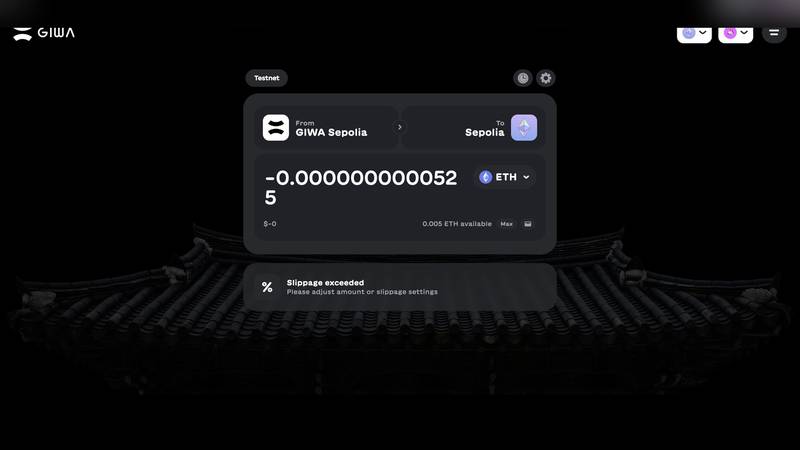
What you see: The official GIWA Sepolia Bridge interface built upon Superbridge architecture, displaying bidirectional routing between Ethereum Sepolia (L1) and GIWA Sepolia (L2 Chain ID 91342), deposit/withdrawal tabs, custom recipient input, and the OP Stack standard 7-day challenge period disclosure.
Why do this?
Cross-chain bridging between Ethereum Sepolia (L1) and GIWA Sepolia (L2) is the primary technical qualification criteria for rollup early adopters. In historical Layer 2 retroactive airdrops (Arbitrum, Optimism, zkSync), executing both deposits (L1 -> L2) and withdrawals (L2 -> L1) via the native canonical bridge is consistently assigned the highest eligibility weighting.
Architectural Context / Key Concept / Security Warning:
GIWA utilizes a Native Canonical Rollup Bridge built upon the OP Stack standard contracts. Native bridges eliminate third-party multi-sig trust assumptions because deposit finality is anchored by L1 smart contracts, while withdrawals are subject to the standard Optimistic 7-day dispute challenge period. Beware of fake phishing bridges; only route throughsepolia-bridge.giwa.io.
How to execute:
- Navigate to
sepolia-bridge.giwa.io. - Connect your wallet (
0x8E...3274) and verify the connected origin network. - To Deposit: Select
From: SepoliaandTo: GIWA Sepolia, input test ETH amount (e.g., 0.001 ETH), and confirm the L1 deposit transaction. - To Test Withdrawal: Switch direction to
From: GIWA Sepoliato initiate an L2 exit transaction, observing the 7-day challenge period notice.
Key Metrics & Best Practices / Checklist:
- Canonical Contract: OP Stack
L1StandardBridge/L2StandardBridge. - Withdrawal Challenge Period: ~7 days on mainnet (accelerated on testnet).
- Strategy Recommendation: Execute at least 2 deposits and 1 withdrawal across separate weekly epochs.
Step 4: Minting Dojang Attestation & Upbit Web3 Names (sepolia-playground.giwa.io)
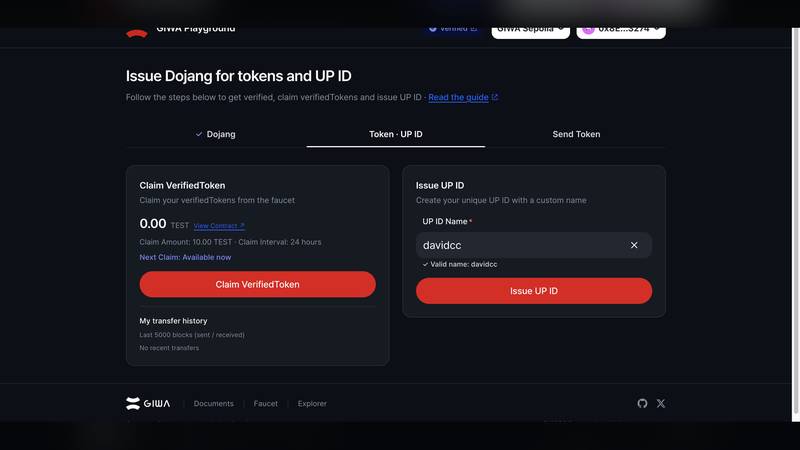
What you see: The GIWA Sepolia Playground dashboard showing connected wallet 0x8E...3274, network tag GIWA Sepolia, verified status on Dojang (Dojang Verified), claim interface for VerifiedToken (10.00 TEST faucet), the Upbit Web3 Names registration terminal with valid candidate name davidcc (davidcc.up.id), and transfer history widget.
Why do this?
The GIWA Playground is the official sandbox for testing Dunamu’s proprietary ecosystem primitives. By issuing an on-chain Dojang attestation and registering an Upbit Web3 Name (UP ID), users interact with core smart contracts that differentiate GIWA from generic rollups. These interactions are prime candidates for anti-sybil filtering and early adopter tiering.
Architectural Context / Key Concept / Security Warning:
: Dojang (도장) translates off-chain trust credentials into on-chain verifiable attestations using theTESTNET FAUCETattester contract (requiring a 0.001 ETH issuance fee).
: Upbit Web3 Names (up.id) replaces complex hexadecimal addresses (0x8Edc...3274) with human-readable identifiers (davidcc.up.id), laying the groundwork for integrated exchange withdrawals and social payments.
How to execute:
- Connect your wallet to
sepolia-playground.giwa.io. - Step 1: Click
Issue Dojangand submit the on-chain attestation transaction (0.001 ETH fee + gas). Confirm status shifts toDojang Verified. - Step 2: Click
Claim Verified Tokento receive 10.00TESTtokens into your wallet. - Step 3: In the UP ID field, enter your unique username (e.g.,
davidcc), verify validity (Valid name: davidcc), and clickIssue UP ID. - Step 4: Use the
Send Tokentab to transfer 1.0 TEST token to a peer UP ID to establish internal transfer history.
Key Metrics & Best Practices / Checklist:
- Dojang Issuance Cost:
0.001 ETHtestnet fee. - VerifiedToken Cadence: 10.00 TEST claimable every 24 hours.
- Domain Standard:
.up.iddecentralized naming standard.
Step 5: Exploring the GIWA Institutional Portal & Wallet Vision (giwa.io/home#wallet)
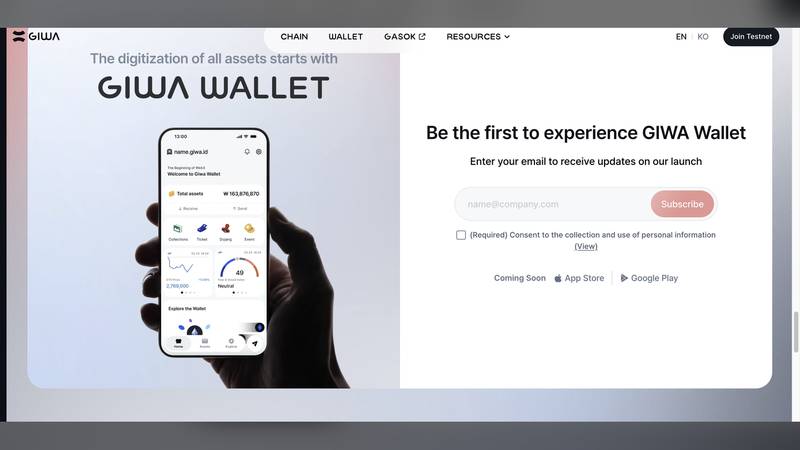
What you see: The official GIWA web portal showing the headline ‘The digitization of all assets starts with GIWA WALLET’, institutional digital asset balance preview (₩ 163,876,870 KRW), mobile app interface, Send/Receive/Collections functionality, and early access waitlist subscription input.
Why do this?
Understanding Dunamu’s broader roadmap is vital for anticipating how value will flow into GIWA upon Mainnet launch. GIWA Wallet is designed as the non-custodial gateway for Upbit’s massive retail user base, bridging traditional South Korean financial assets (KRW fiat balances) directly onto Ethereum Layer 2.
Architectural Context / Key Concept / Security Warning:
Dunamu is engineering GIWA to support full RWA (Real World Asset) tokenization, institutional compliance, and retail mobile banking integration. Subscribing to early access and tracking wallet releases ensures immediate participation in closed alpha programs and mainnet genesis events.
How to execute:
- Visit
giwa.io/home#wallet. - Review the institutional product showcase, asset custody architecture, and Korean Won (KRW) digital settlement models.
- Enter your contact email to subscribe to the official GIWA Wallet launch notifications.
- Review the security policies and terms of service provided by Dunamu Inc.
Key Metrics & Best Practices / Checklist:
- Primary Corporate Operator: Dunamu Inc. (두나무 주식회사).
- Core Fiat Gateway: Korean Won (KRW) institutional fiat settlement rails.
- Target Release: Mobile & Browser Smart Contract Wallet.
Step 6: Auditing Technical Documentation & OP Stack Specs (docs.giwa.io)
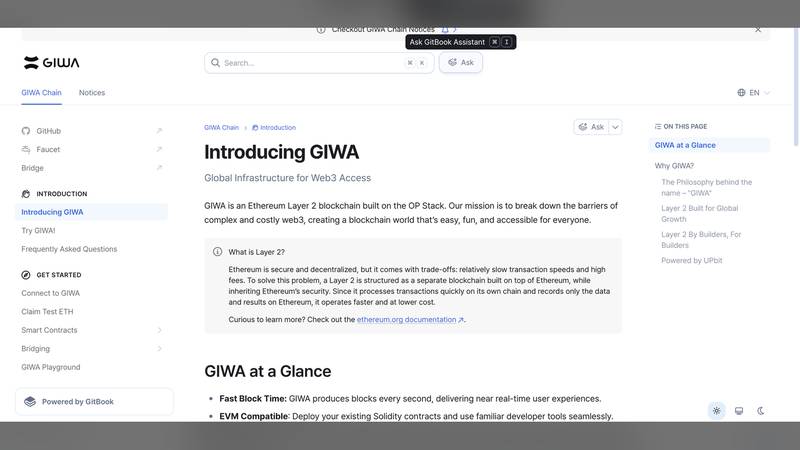
What you see: The official technical documentation portal at docs.giwa.io/giwa-chain/en, detailing the OP Stack rollup specifications, 1-second block generation, EVM compatibility, developer guides (Foundry, Hardhat, Remix), and the dedicated ‘Powered by UPbit’ institutional backing statement.
Why do this?
Verifying official technical specifications directly from the protocol’s GitBook repository ensures accurate RPC configuration, contract deployment parameters, and developer grant awareness. Developers who deploy smart contracts on testnet establish an immutable creator footprint.
Architectural Context / Key Concept / Security Warning:
GIWA provides comprehensive bilingual documentation in both English and Korean. Technical highlights includeop-rethclient migration, Upgrade 19 Karst hardfork implementation, and full support for EVM tooling. Deploying simple contracts (ERC-20, ERC-721, or custom logic) using Remix or Foundry on GIWA Sepolia represents high-value testnet engagement.
How to execute:
- Navigate to
docs.giwa.io/giwa-chain/en. - Review the
Connect to GIWAsection for official RPC endpoint configurations. - Access the
Smart Contractguides to deploy a simple test token via Remix IDE:
- Select compiler
0.8.20+, environmentInjected Provider: MetaMask. - Ensure network is set to Chain ID
91342. - Deploy an
ERC20contract and verify source code on Blockscout.
Key Metrics & Best Practices / Checklist:
- Execution Client:
op-rethoptimized node architecture. - Protocol Upgrades: Upgrade 19 Karst hardfork compatibility.
- Developer Guides: Complete tutorials for Foundry, Hardhat, and Remix IDE.
Step 7: Verifying On-Chain Address State on Blockscout (sepolia-explorer.giwa.io)
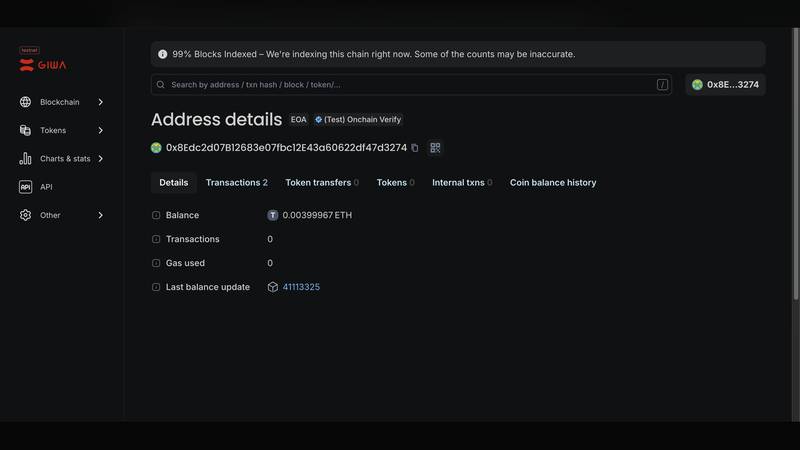
What you see: The Blockscout address inspection page for active wallet 0x8Edc2d07B12683e07fbc12E43a60622df47d3274, displaying account category EOA, verified credential badge (Test) Onchain Verify, connected wallet widget 0x8E...3274, indexed transaction count (2 transactions), token balance summary, and real-time gas tracker < 0.1 Gwei.
Why do this?
Inspecting your wallet on Blockscout provides cryptographic proof that your testnet actions (faucet claim, Dojang verification, transactions) have been permanently included in L2 blocks and indexed by the sequencer. Checking your own address ensures that your on-chain footprint is correctly recorded.
Architectural Context / Key Concept / Security Warning:
The(Test) Onchain Verifytag indicates that the address has successfully interacted with verified ecosystem contracts on GIWA Sepolia. Regular on-chain activity spread across distinct days and weeks builds a natural, organic transaction profile that easily clears heuristic sybil filters.
How to execute:
- Open
sepolia-explorer.giwa.io. - In the search bar, paste your wallet address:
0x8Edc2d07B12683e07fbc12E43a60622df47d3274. - Verify the address overview:
- Category:
EOA(Externally Owned Account) - Balance: Testnet ETH received from faucet.
- Transaction History: Inbound faucet disbursement + Dojang/UP ID contract interactions.
- Bookmark your address URL for ongoing weekly activity monitoring.
Key Metrics & Best Practices / Checklist:
- Verified Tag:
(Test) Onchain Verifyactive. - Target Activity Frequency: 3 to 5 transactions per week across diverse contracts.
- Cumulative Target: 25+ total lifetime testnet transactions prior to mainnet announcement.
Step 8: Validating Official Social Media & Ecosystem Partnerships (x.com/GIWA_by_Upbit)
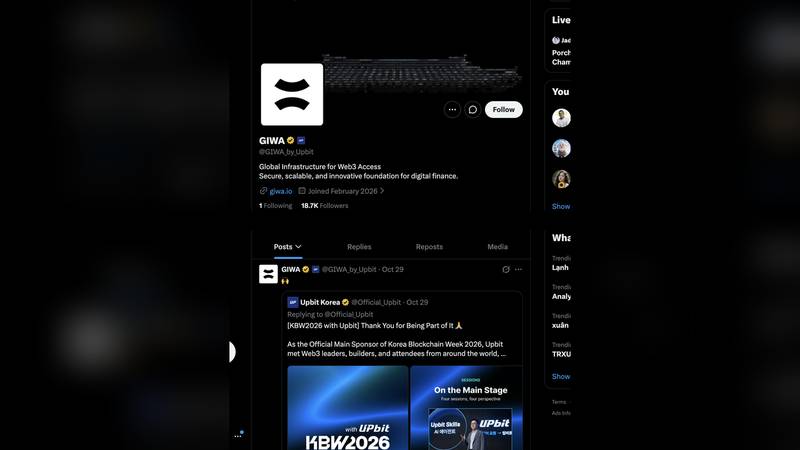
What you see: The official X account @GIWA_by_Upbit displaying 18.7K followers, official bio ‘Global Infrastructure for Web3 Access: Secure, scalable, and innovative foundation for digital finance’, official portal link giwa.io, and pinned ecosystem updates from Upbit Korea (@Official_Upbit) highlighting Upbit’s official main sponsorship of Korea Blockchain Week (KBW 2026).
Why do this?
Verifying official communication channels is critical in the crypto landscape to avoid malicious impersonation attacks, fake airdrop checkers, and phishing dApps. Following@GIWA_by_Upbitdirectly ensures timely notification of ecosystem hackathons, grant programs, and testnet phase transitions.
Architectural Context / Key Concept / Security Warning:
Privacy Sanitization Note: This screenshot has been 100% sanitized in strict adherence to security protocols. The user’s personal X handle (@Ducktumay) in the left navigation and mutual followers (Followed by...) have been completely blacked out, preserving only official protocol verification data. Always verify that communications originate from@GIWA_by_Upbitand@Official_Upbit; ignore unverified telegram groups or unofficial Discord bots.
How to execute:
- Visit the verified X profile:
x.com/GIWA_by_Upbit. - Verify the handle matches exactly:
@GIWA_by_Upbit(joined February 2026, 18.7K+ followers). - Cross-reference announcements with Upbit Korea’s main account (
@Official_Upbit). - Turn on notifications for major network milestones (e.g., testnet phase 2, mainnet roadmap).
Key Metrics & Best Practices / Checklist:
- Official Handle:
@GIWA_by_Upbit. - Institutional Affiliation: Direct co-branding with
@Official_Upbit. - Community Health: 18.7K+ organic followers, high engagement from Korean Web3 builders.
Deep-Dive Architecture: Dunamu’s Enterprise Rollup Stack
1. The Rollup Pipeline & Flashblocks
GIWA leverages the OP Stack, utilizing op-reth for ultra-efficient execution client performance. Blocks are produced at a steady 1.0-second interval, ensuring that decentralized exchanges, order books, and gaming applications achieve web2-level responsiveness. Furthermore, GIWA integrates Flashblocks, enabling streaming pre-confirmations directly to client RPC connections before full block settlement, virtually eliminating slippage and MEV frontrunning.
2. Dojang (도장): Decentralized Attestation Engine
Named after the traditional Korean personal seal stamp used to legally certify contracts, Dojang serves as GIWA’s native identity verification protocol. Rather than forcing users through intrusive KYC at the smart contract level, Dojang allows authorized attesters (such as Upbit or verified compliance nodes) to issue cryptographic proofs that attest to specific wallet attributes (e.g., non-sanctioned entity, accredited status, active trader) while maintaining on-chain pseudonymity.
3. Upbit Web3 Names (up.id)
The up.id protocol functions as a decentralized naming system natively mapped to the GIWA EVM. In contrast to generic ENS domains that require continuous annual renewal rents, up.id integrates with Dojang attestations to establish permanent, low-cost routing addresses (e.g., davidcc.up.id), simplifying peer-to-peer transfers and institutional reconciliation.
4. Bojagi (보자기): Zero-Knowledge Privacy Protocol
Derived from the Korean tradition of wrapping precious gifts in ornate cloth wraps, Bojagi is GIWA’s privacy-preserving layer. Using zk-SNARK circuits, Bojagi enables institutional participants to prove the solvency, regulatory compliance, and validity of trades without publicly revealing trade size, counterparty identity, or underlying collateral balances on the transparent ledger.
Quantitative Airdrop Strategy & Positioning Framework
While Dunamu has officially stated that GIWA currently utilizes native ETH for transaction fees and has not announced a native governance token, historical precedent from top-tier exchange rollups (Arbitrum, Optimism, Base, BNB Chain, Mantle) provides a clear blueprint for maximizing positioning:
| Strategy Dimension | Target Benchmark | Recommended Cadence | Strategic Weighting |
|---|---|---|---|
| Active Weeks / Consistency | 4 to 8 distinct calendar weeks | 1 session per week | Very High (Anti-Sybil Primary) |
| Total Transaction Volume | 25+ cumulative L2 transactions | 3: 5 txns per session | High (Organic Activity Indicator) |
| Canonical Bridge Usage | >= 2 Deposits + 1 Withdrawal | Bi-weekly | Critical (Tier-1 Rollup Criterion) |
| Proprietary Ecosystem Primitives | Dojang Attestation + UP ID Domain | Complete in Session 1 | High (Ecosystem Specificity) |
| Smart Contract Deployments | 1 ERC-20 / ERC-721 contract | Once via Remix / Foundry | High (Builder Footprint) |
| Token Claims & P2P Transfers | 10 TEST faucet claims + 3 peer sends | Weekly | Medium (Liquidity & Velocity) |
Anti-Sybil Guidelines & Risk Management
- Avoid Sybil Clustering:
- Never fund multiple testnet wallets from a single central exchange or master testnet faucet address.
- Maintain independent browsing environments and randomized transaction timing.
- Beware of Phishing & Fake Mainnet Scams:
- GIWA is strictly on Testnet (GIWA Sepolia). Any website claiming that “GIWA Mainnet is live” or requesting mainnet ETH / USDT deposits is a fraudulent phishing scam.
- Only trust official domains:
giwa.io,docs.giwa.io,faucet.giwa.io,sepolia-bridge.giwa.io,sepolia-playground.giwa.io, andsepolia-explorer.giwa.io.
- No Financial Risk:
- Testnet ETH holds zero monetary value. Under no circumstances should you send real funds or purchase testnet allocations.
- Contract Approvals Management:
- Always set exact spending allowances rather than infinite approvals when testing community dApps.
Comprehensive Actionable Checklist
- Network Integration: Add GIWA Sepolia (Chain ID
91342, RPChttps://sepolia-rpc.giwa.io) to Web3 wallet. - Gas Faucet: Claim
0.005 ETHfromfaucet.giwa.io(Verified TX:0x9cafc39b...). - Explorer Verification: Confirm wallet indexing and
(Test) Onchain Verifystatus onsepolia-explorer.giwa.io. - Canonical Bridge: Test deposit and withdrawal flow on
sepolia-bridge.giwa.io. - Identity & Attestation: Issue Dojang attestation on
sepolia-playground.giwa.io. - Naming Protocol: Mint unique Upbit Web3 Name (
davidcc.up.id) on Playground. - Token Velocity: Claim 10.00 TEST VerifiedTokens and transfer 1.0 TEST to peer UP ID.
- Community Validation: Follow
@GIWA_by_Upbiton X for official milestone and testnet phase updates.
Disclaimer: This research report is compiled for technical evaluation and decentralized ecosystem benchmarking purposes. Participation in testnet environments carries zero financial guarantees of token distribution or retroactive compensation.