



Jupiter started as a Solana swap aggregator and now bundles spot swaps, limit and DCA orders, perps, lending, a mobile wallet and a developer API on one website, with no account needed to browse. This review covers what I could see and verify on 9 November 2026, and where the evidence stops.
Quick verdict: Jupiter is the sensible default for swapping on Solana, and its security paperwork is deeper than most DeFi apps. The weak spots are small platform fees on most pairs, thin-liquidity execution on size, and a token story that is still being negotiated by governance.
| Item | Detail |
|---|---|
| Best for | Solana swaps, DCA, limit orders, one-stop DeFi |
| Fees | 0 to 10 bps platform fee depending on pair, plus network fees |
| Custody | Non-custodial, you connect your own wallet |
| Audits | Multiple firms across Swap, Lend, Perps and Limit Order |
| Editorial score | 4.3 / 5 |
What I tested, and what I did not
I opened jup.ag on desktop (1440px), tablet (1024px) and phone (430px) and captured the swap, perps and lend pages. I then connected a throwaway MetaMask wallet that holds no funds, looked at the quote flow and the perps risk prompt, and read the official docs, the audit list and the support hub. I did not execute a trade, so anything about live fill quality below comes from documentation and community reports, not from my own swaps.
What Jupiter actually is
Jupiter describes itself as the everything exchange on Solana. The homepage sidebar shows the scope: Spot, Stocks, Perps, YOLO (beta), Predict, Bridge Agg (beta), Lend, Offerbook (beta), staking for SOL and JUP, plus Portfolio, Send, Deposit and Mobile.
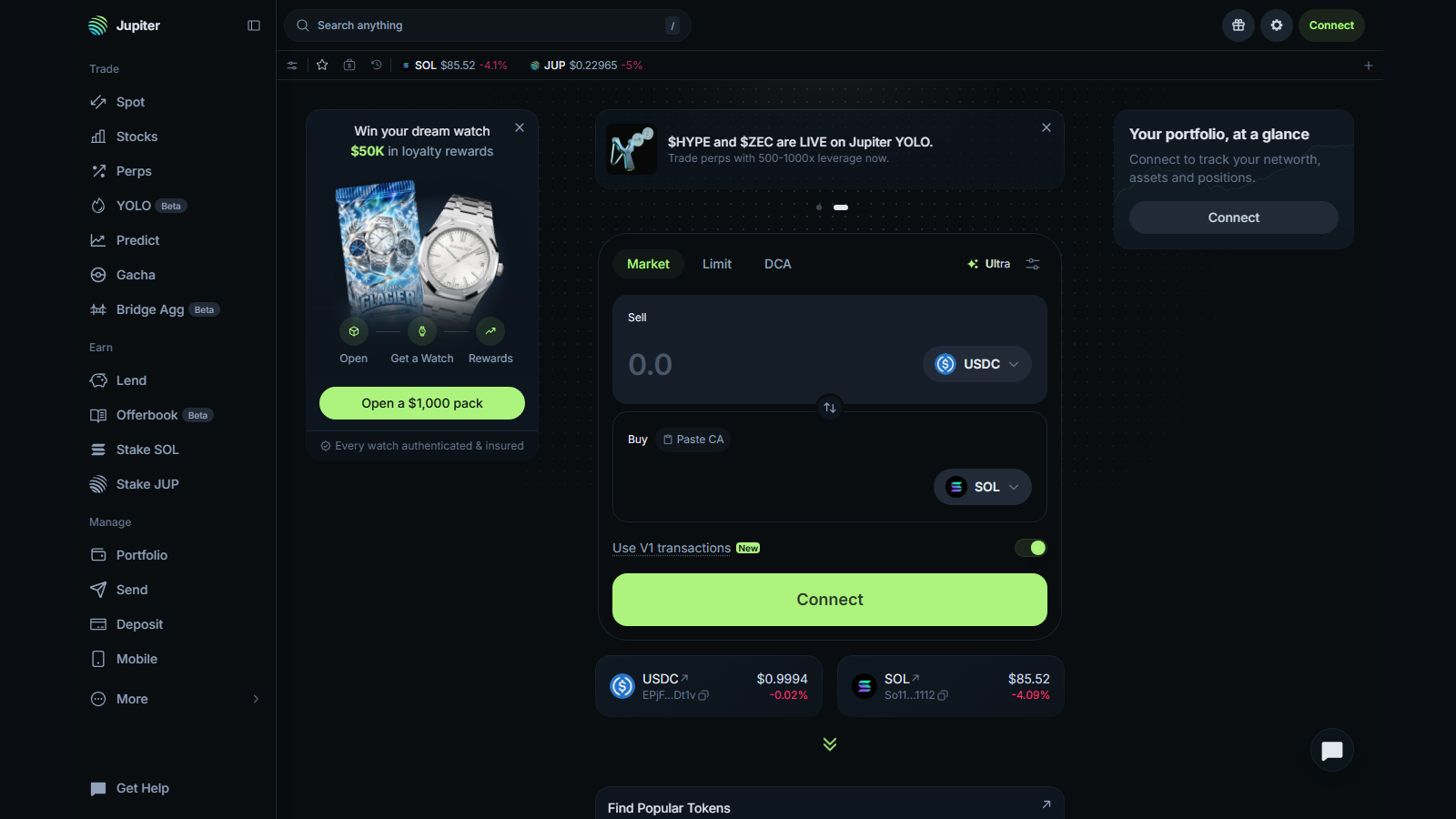
The core idea is simple. You pick two tokens, Jupiter routes the trade across many sources, and your wallet signs. The Swap API docs say the Meta-Aggregator makes Metis, JupiterZ market makers, Dflow and OKX compete on each request, and that RFQ market makers often beat onchain routing by 5 to 20 bps on major pairs.
Swapping on desktop, tablet and phone
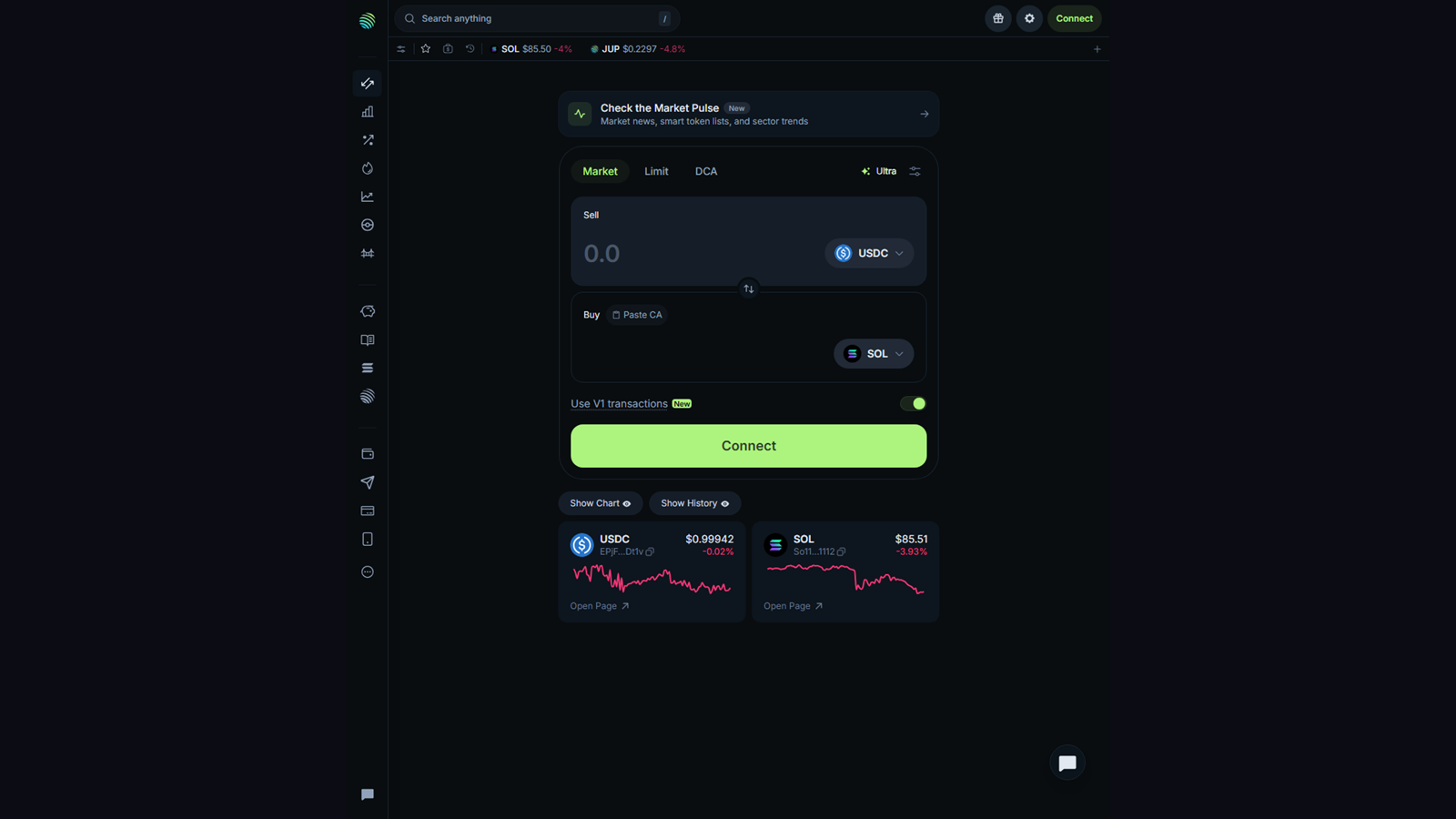
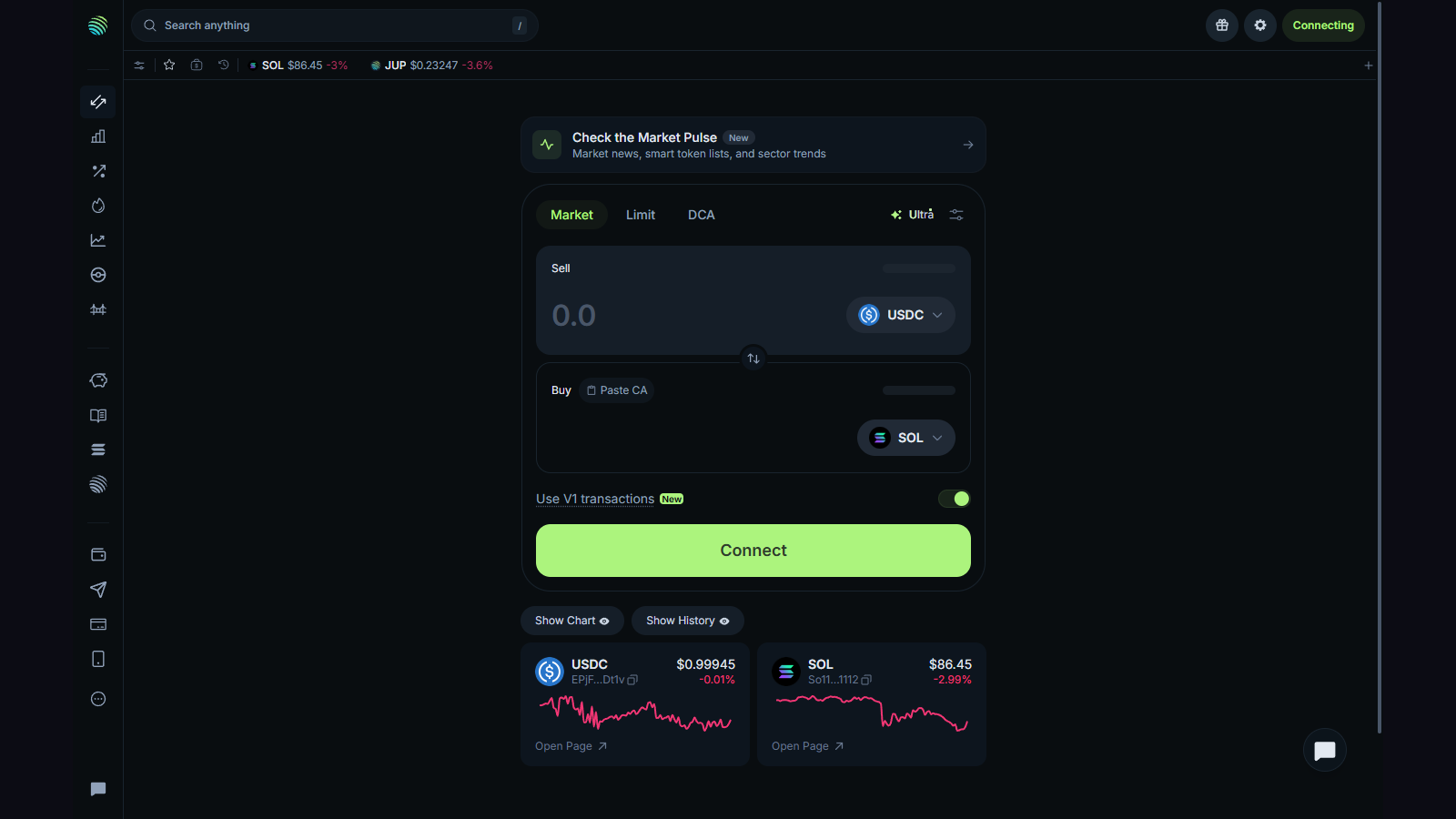
The swap page is deliberately plain: Market, Limit and DCA tabs, an Ultra toggle, and a big Connect button. Chart and history are hidden until you click them, which keeps the first screen calm.
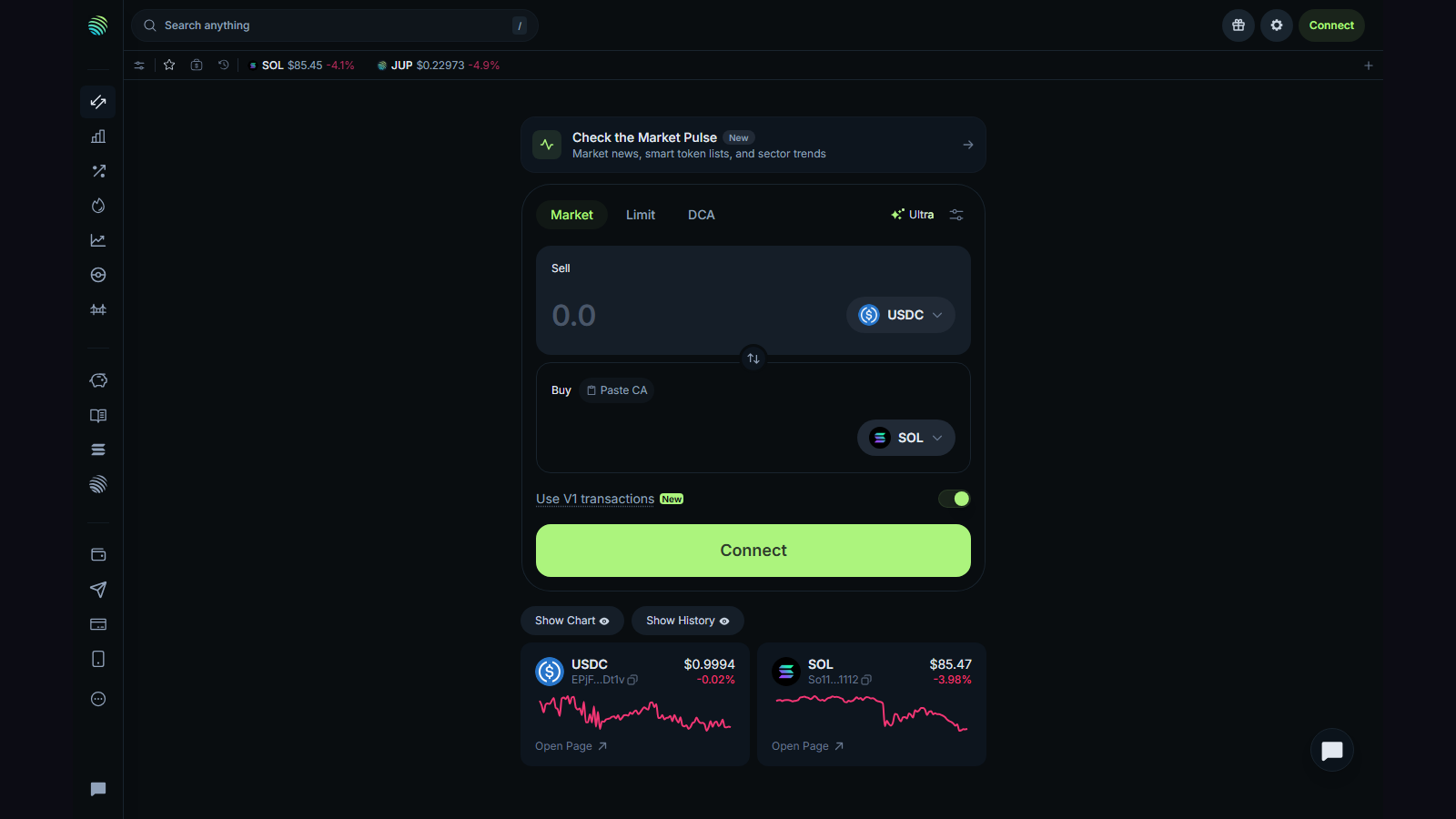
On tablet the layout keeps the icon sidebar and centers the swap card.
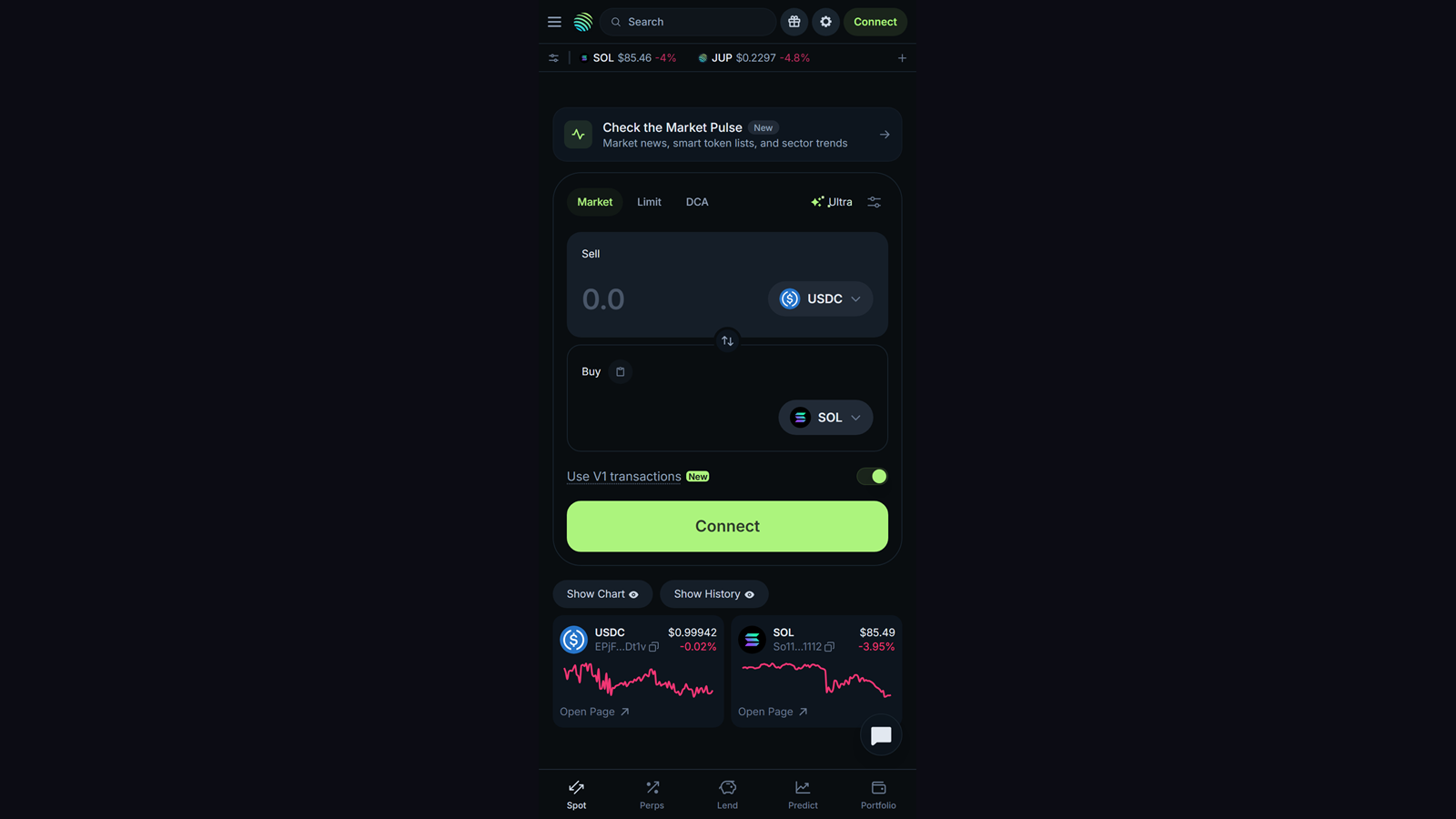
On phone the sidebar becomes a bottom bar with Spot, Perps, Lend, Predict and Portfolio, which is easy to reach with a thumb.
Best for: quick swaps on any device without installing anything.
Connecting a wallet
Clicking Connect opens a side panel with Jupiter Wallet marked as recommended, Jupiter Mobile via QR code, and any browser wallet it detects under Installed. My throwaway MetaMask showed up there.
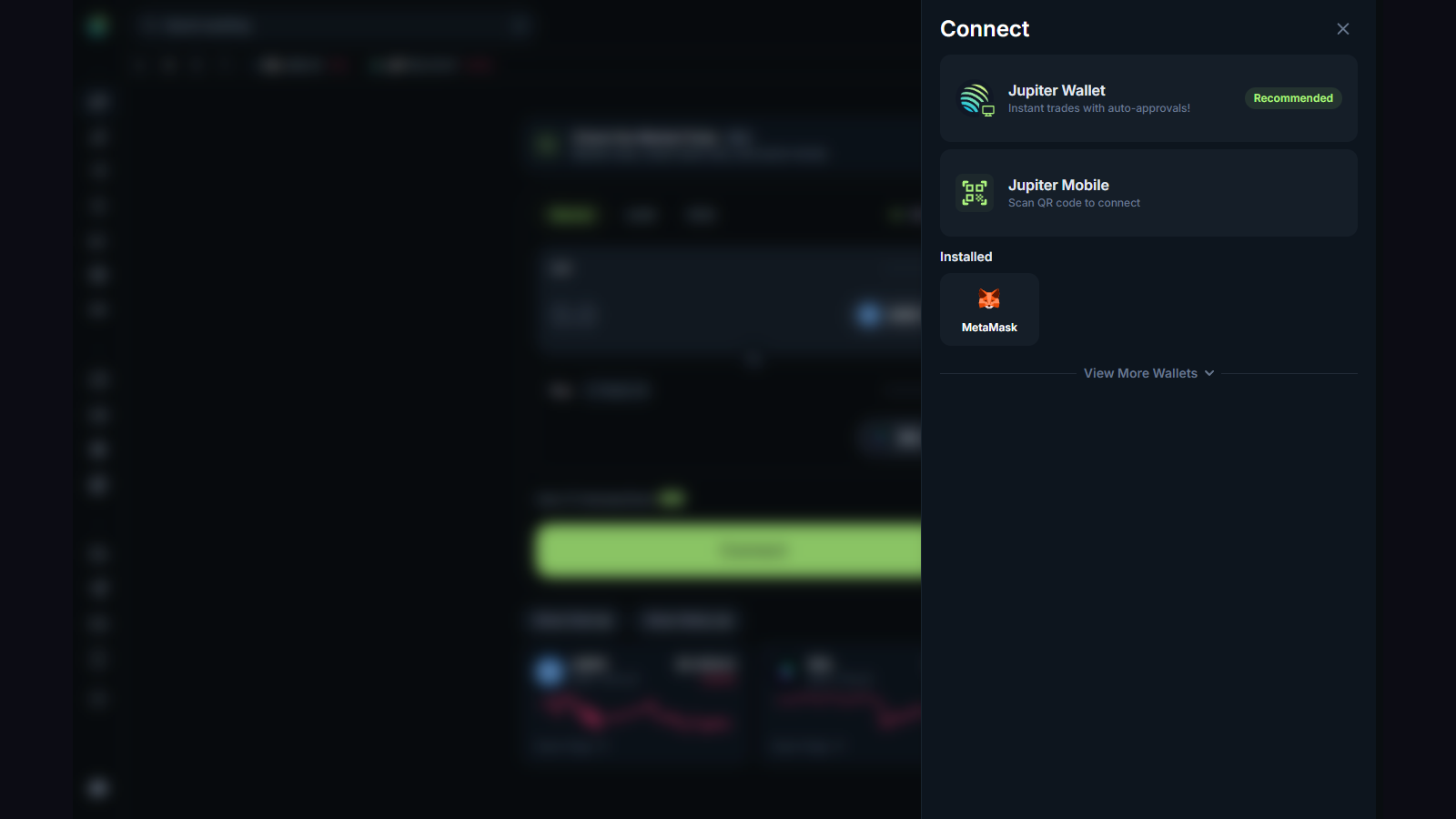
Choosing MetaMask first shows a pop-up that pushes Jupiter Wallet again, with a “Continue to MetaMask” button underneath. It is a nudge, not a block, but a newcomer could easily click the wrong one.
After connecting, the header shows a shortened Solana address and the swap box shows my 0.00 balances. Typing 100 USDC returned a quote of about 1.158 SOL at roughly 0.01158 SOL per USDC, with a “Guaranteed Price” tag. The button read “Insufficient USDC”, which is expected because the wallet is empty, so I stopped there.
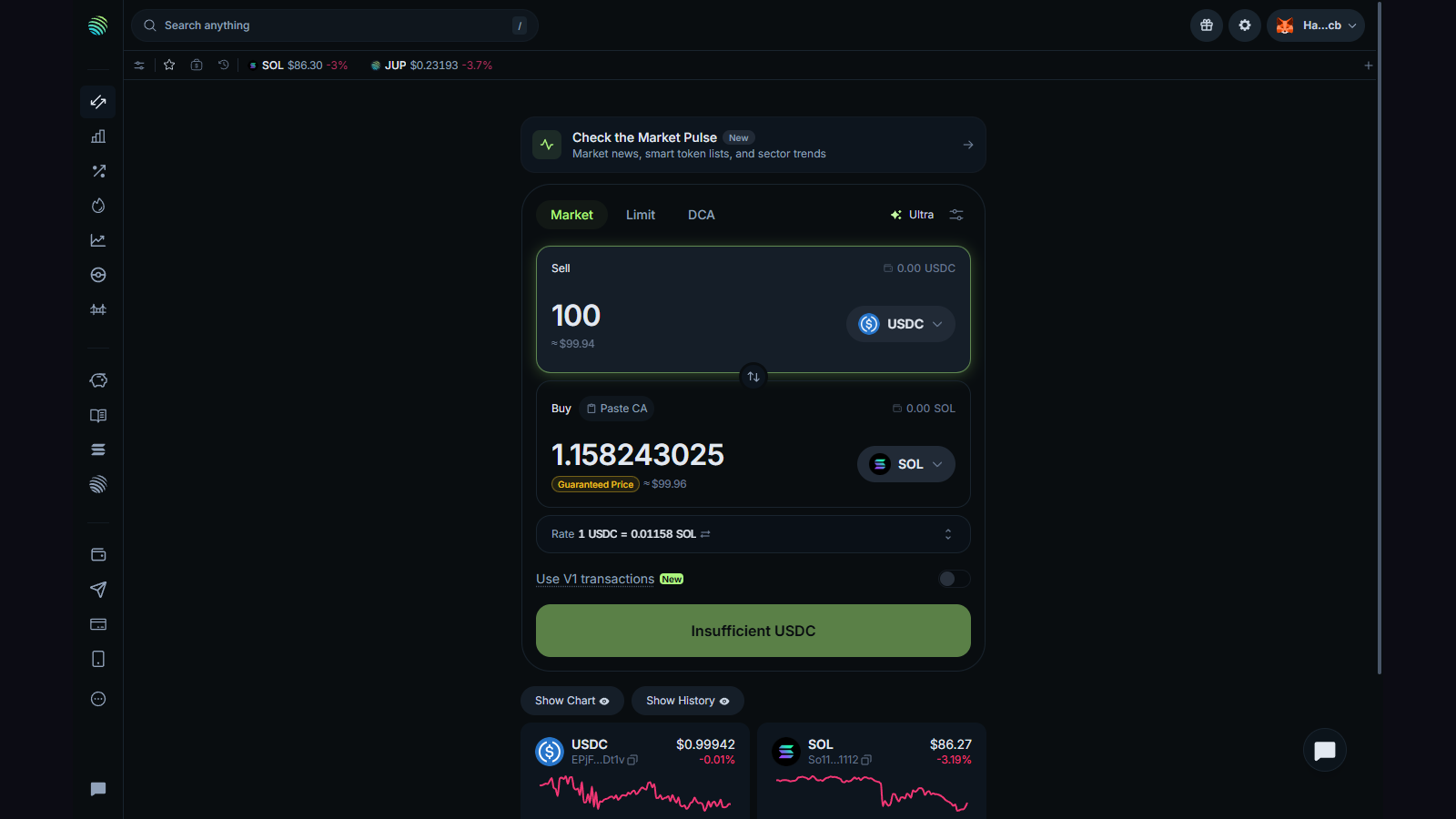
Quote with a connected, unfunded wallet. No transaction was sent.
Note: the quote is a snapshot at capture time, and I cannot say how it compares with other aggregators because I did not run a side-by-side test.
Fees: small, but not zero
Fees are the first thing to check, because Reddit is split on them. In an r/solana thread asking if Jupiter is the best aggregator, one commenter said Jupiter charges no fees, while another warned that it used to be the best protocol before the token and fees and advised using manual mode.
The docs settle most of it. The Swap V2 page says the platform fee depends on the pair, from 0 bps on pegged assets and Jupiter tokens up to 10 bps on most pairs, and every order response shows the exact feeBps. The Ultra page lists a 5 to 10 bps swap fee. The raw Router path has no Jupiter swap fee, but that is a developer option, not the normal website flow.
Practical tip: Read the fee line in the quote before you sign. On a $1,000 swap, 10 bps is $1, which is small but not nothing for frequent traders.
Execution quality: where the debate is
The same thread has a fair caution from a commenter, who said it is usually the default for a reason but quotes are worth verifying on thin meme coins or large size. Another noted rates can be slightly worse on less liquid pairs. The Jupiter founder replied in the thread that the team focuses on executed price, not just quoted price. I cannot confirm either side from my own trades, so treat it as a reason to compare, not a verdict.
Jupiter’s Ultra docs back this up with design claims: predictive execution that simulates executed prices, slippage-aware routing, a Real-Time Slippage Estimator, and its own landing engine, Jupiter Beam. They also say 95% of swaps execute in under 2 seconds. That is the project’s own claim, not independent measurement.
For large trades, quote a second aggregator and compare the final amount received after fees and slippage.
Perps and Lend
Perps open on a full trading screen with SOL, ETH, BTC and other markets. At capture time the market list showed up to 250x on SOL, ETH and BTC, and lower caps on newer beta markets. High leverage can wipe out a position fast, so treat it as an advanced product. With a wallet connected, Jupiter shows a terms prompt before you can trade perps. It says Jupiter will not compensate losses caused by network congestion, suggests setting take-profit and stop-loss, and warns that limit orders on perps are not first-in, first-out.
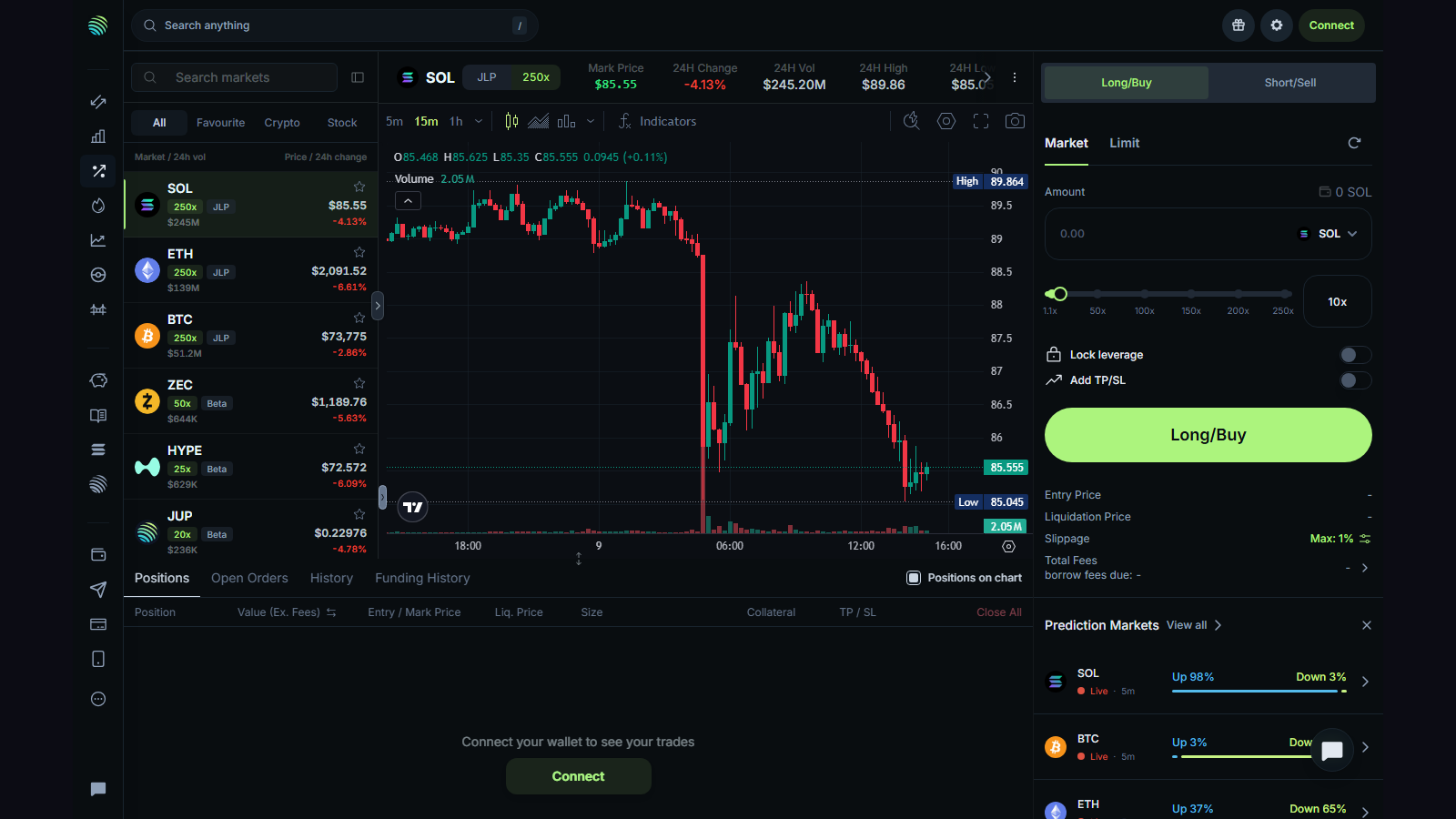
Perps screen with the market list, chart and long/short panel. Logged out, so no positions are shown.
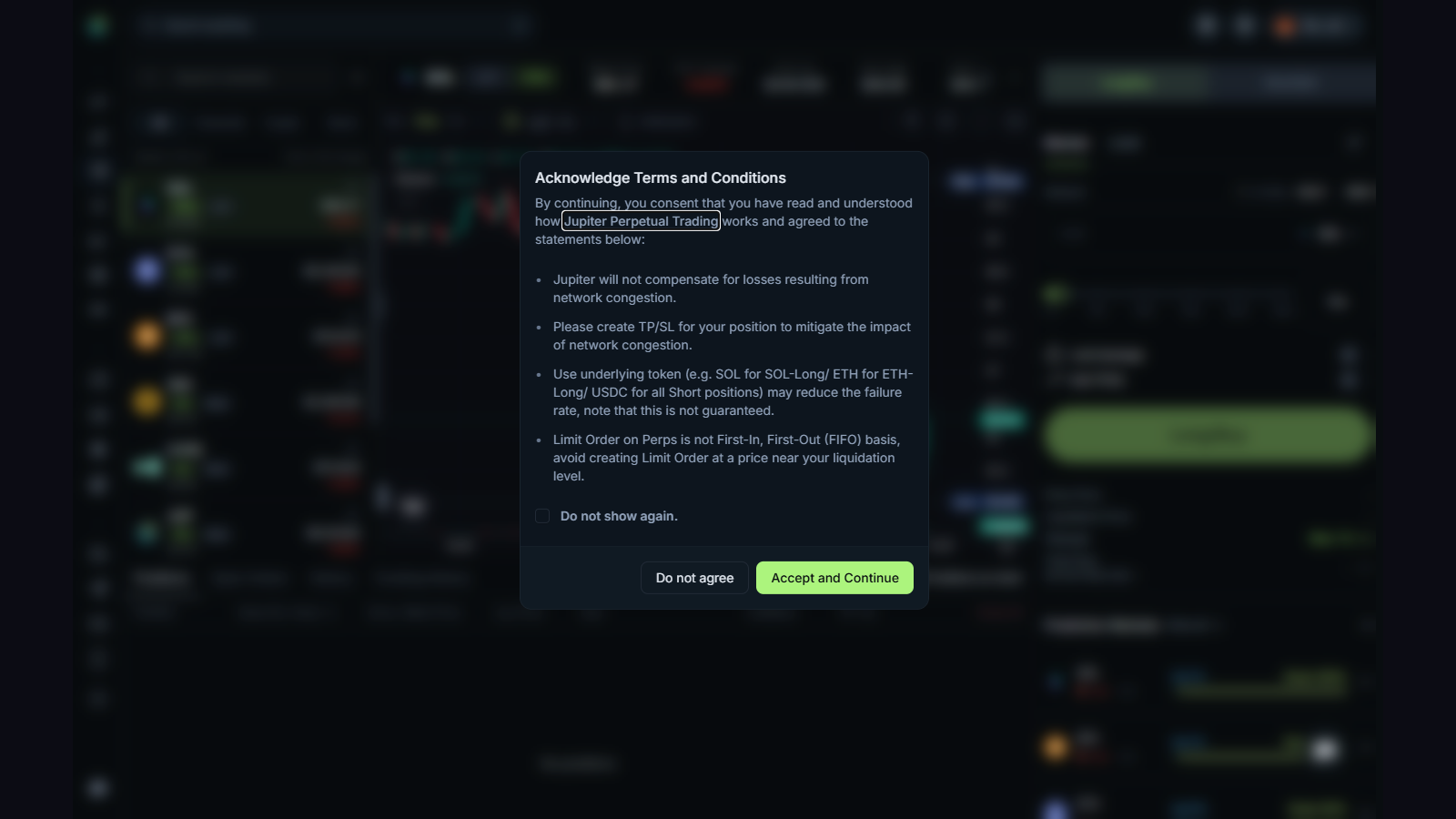
Risk prompt shown after connecting a wallet and opening Perps.
Jupiter Lend shows an Earn tab and borrowing vaults. On the day of capture, the page displayed about $2.16B total supplied and about $914M borrowed, with the Powered by FLUID badge at the bottom. APYs on the page ranged from roughly 3.8% to 5.9% across the assets I could see.
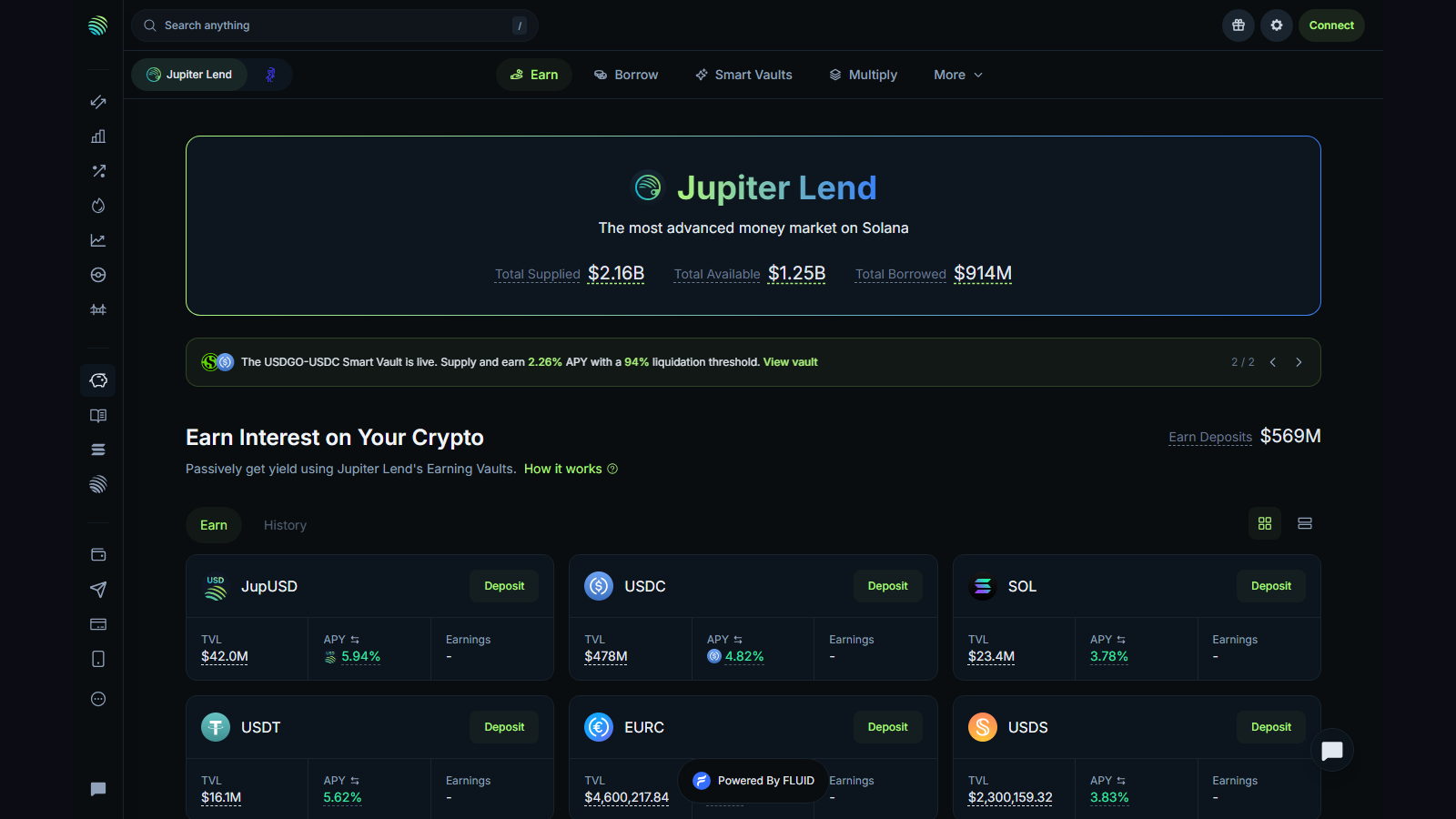
Jupiter Lend Earn tab. Rates and TVL change constantly, so treat these as a snapshot.
The Earn docs say there are no fees to use Earn and no supply limits, and they warn that Lend is a novel protocol with smart contract and market risk.
Security and audits
Jupiter publishes an audit page covering several products. Jupiter Swap lists Offside Labs (October 2025 and April 2024) and Sec3. Jupiter Lend lists many reports, including Certora formal verification, OtterSec, Zenith, Mixbytes, Offside Labs and a Code4rena contest. Lend AMM and Limit Order are covered too.
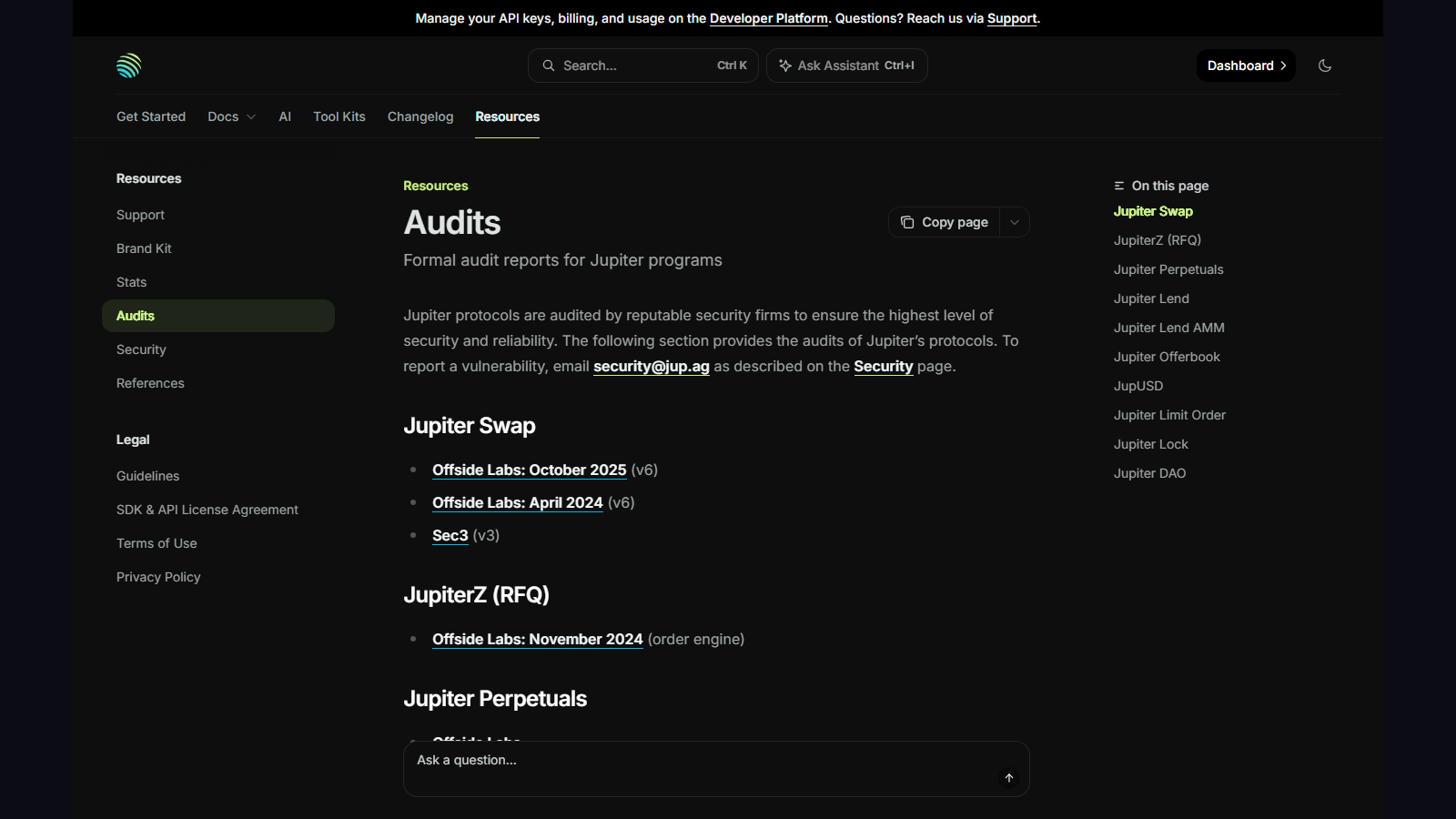
Official audit list in the developer docs, with a vulnerability contact at [email protected].
Audits reduce risk, they do not remove it. The support hub also says compensation is only considered for Ultra Mode users in cases like bad routing or repeated failed trades, and never covers potential P&L. Read that before relying on any “guarantee”.
A 2024 r/solana thread shows the trust gap newcomers feel: the poster had heard mixed experiences and complaints about slow support. I only read the post, not independent proof, so I treat it as sentiment, not fact. Using small test trades first is the safer habit.
The JUP token
JUP governance is active. A community proposal on the Jupiter forum says that since the Net-Zero Emissions vote in February 2026, 50% of protocol fees go to the Litterbox Trust for buybacks, and suggests raising it to 70%. The post itself says it is a feedback request before an official vote, so it is not a decided change. Check the current governance status before you cite it.
Who should use Jupiter
Good fit:
- Solana users who want one site for swaps, DCA, limit orders and lending
- Mobile users who prefer an app-like layout in the browser
- Developers who want a single API for swaps and more
Think twice:
- Anyone trading very large size in thin pools without comparing quotes
- Beginners tempted by 250x leverage
- People who want zero fees on every swap
FAQ
Is Jupiter safe?
It is non-custodial and publishes multiple audits across its products, but audits do not guarantee safety. Start with a small trade and keep only what you need in the connected wallet.
Does Jupiter charge fees?
Per its docs, the platform fee ranges from 0 bps on pegged assets and Jupiter tokens to 10 bps on most pairs, plus network fees. Check the quote before signing.
Do I need an account?
No. You connect a Solana wallet. I connected an empty MetaMask wallet and saw balances and quotes without creating any account.
Is Jupiter better than other Solana aggregators?
Community opinions differ. Compare quotes on large or illiquid trades.
Disclaimer: This article is for informational purposes only and does not constitute financial or investment advice. Cryptocurrency and digital asset markets carry significant risk. Always do your own research before making decisions.