


Retium Network (@RetiumChain): Comprehensive Hands-On Review, Proof-of-Math (PoM) Layer 1 Architecture, Whisk DEX, Retium Money & Testnet Airdrop Playbook
Retium Network review: Proof of Math layer 1, Whisk DEX, RTM and RTD assets, testnet airdrop steps we tried on devnet, plus the risks and open questions.
Author: Web3 Quantitative Research & Ecosystem Strategy Group
Target Protocol: Retium Network (@RetiumChain| retium.org | wallet.retium.org | retium.money | whisk.exchange | nft.retium.org | docs.retium.org)
Core Category: Prime-Number Mathematical Layer 1 / 3D Transaction Mesh / Proof of Math (PoM) Consensus / Weight-Based Fee Economics / Dual Native Assets ($RTM & $RTD)
Date of Audit & Interaction: 17 November 2026
Live Testnet Credentials Verified:
: Connected Wallet Address:retedd226073c99a0b347f0c0c7d8e452c027ed7a6887cf14583642894b19dde40fe6d4c(Display:retedd2...6d4c)
: Active Network: Retium Devnet / Public Testnet
: Native Ecosystem Assets: $RTM (Utility & Staking Coin), $RTD (1:1 USD Stablecoin), $WSK (Whisk DEX Protocol Token)
: Client Application: Retium Wallet Extension v0.1.11 (Chrome, Brave, Edge, Opera)
: Official Documentation: Whitepaper version 2.0.1 (October 2026)
Executive Summary & Protocol Overview
The blockchain landscape has long been constrained by monolithic serial execution bottlenecks, memory-pool congestion, and rampant MEV extraction. Retium (@RetiumChain) represents an audacious break from standard EVM rollup consensus, architected from first principles as an independent multi-dimensional Layer 1 blockchain built completely from scratch in Rust. Rejecting both linear blockchains and flattened Directed Acyclic Graphs (DAGs), Retium employs the immutable mathematical properties of prime numbers to govern block linkages, unlocking true multi-dimensional parallel processing.
Rather than relying on energy-intensive Proof-of-Work or centralizing Proof-of-Stake delegations, Retium introduces Proof of Math (PoM). Transactions are confirmed with independent mathematical finality and sealed into a 3D transaction mesh. Because blocks expand across multiple dimensions governed by prime-number rules, the network eliminates linear state locks, achieving extreme throughput with predictable, deterministic performance.
Dual-Token Architecture & Economic Foundation
- $RTM (Retium Coin): The primary native utility, staking, and governance coin. Staked by validators to secure the Proof of Math consensus and power smart contract computation. Maximum supply capped at 1,000,000,000 $RTM.
- $RTD (Retium Dollar): The native decentralized stablecoin, fully backed 1:1 by audited USD reserves. Operates natively across Retium and bridged cross-chain to Ethereum, Solana, and Tron.
- Weight-Based Fee Engine: Retium permanently discards gas price auctions. Every fee is strictly calculated from the mathematical byte weight of the transaction and can be settled flexibly in either $RTM or $RTD, preventing MEV sandwiching and priority bidding wars.
- Regulatory Roadmap: Pursuing formal Australian Financial Services Licence (AFSL) compliance to support regulated real-world asset (RWA) tokenization, merchant debit card integration (Apple Pay & Google Pay), and institutional custody.
Why Choose Retium? (5 Foundational Pillars)
For quantitative analysts, node operators, and early testnet airdrop farmers, Retium delivers an exceptional, asymmetric positioning profile rooted in five structural pillars:
1. 100% Original Codebase in Rust (No EVM Forks, No Imitation)
Retium is not an Optimism OP Stack fork, an Arbitrum Orbit rollup, or a repackaged Geth client. The entire Layer 1 node implementation is written from the ground up in Rust. This foundational independence removes legacy EVM technical debt, avoids memory bloat, and provides hardened security against reentrancy and common Solidity execution vulnerabilities.
2. Multi-Dimensional 3D Mesh & Proof of Math (PoM) Consensus
Traditional blockchains process blocks sequentially in a 1D chain; DAGs collapse transactions into single-layer graphs. Retium's prime-number geometry links blocks across multi-dimensional coordinate vectors. Many blocks are validated and committed concurrently with instant mathematical finality, transforming linear throughput into a scalable 3D lattice.
3. Mempool-Free Execution & Transparent Weight-Based Fees
By eliminating the public mempool, Retium solves the existential threat of Maximal Extractable Value (MEV). Malicious searchers cannot frontrun, backrun, or sandwich user transactions. Fees are deterministic and derived solely from transaction size, allowing users and automated agents to pay predictably using either native $RTM or stable $RTD.
4. Integrated Financial Infrastructure (Retium Money & RTM Safehouse)
Unlike blockchains that launch as empty execution shells reliant on third-party liquidity, Retium provides native financial rails at genesis. Through Retium Money (retium.money) and the RTM Safehouse, users can access 1:1 USD-backed stablecoin minting, swap between RTM and RTD with zero slippage and no orderbook dependency, and prepare for debit card tap-to-pay functionality.
5. 100% Free Tester Recognition & Early Positioning
The Retium Public Testnet operates with zero financial capital requirements. Participants acquire testnet USD, interact with the RTM Safehouse, trade on Whisk DEX, and mint NFTs across the launchpad entirely for free. Early testers establish verified on-chain history across multiple native dApps prior to the validator production network launch.
Step-by-Step Hands-On Evidence
All 8 steps below represent authentic, hands-on interactions conducted directly within the live Retium ecosystem, displaying verified wallet authentication across every single dApp interface with address retedd226073c99a0b347f0c0c7d8e452c027ed7a6887cf14583642894b19dde40fe6d4c.
Step 1: Initializing Retium Devnet Wallet & Dual-Fee Configuration (wallet.retium.org)
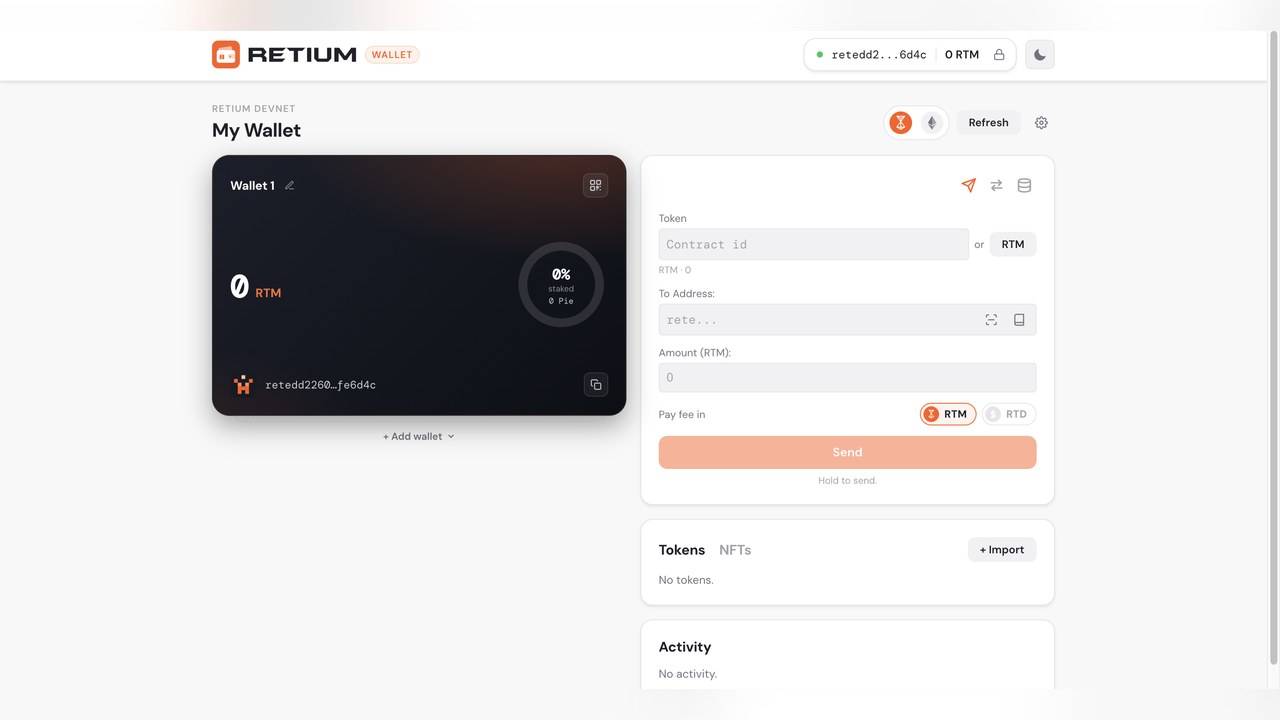
What you see: The official Retium Devnet Wallet interface with the active connected wallet prominently visible in the header (retedd2...6d4c | 0 RTM) and account card Wallet 1 (retedd2260...fe6d4c). Staking status displays 0% staked, 0 Pie, alongside navigational tabs for Tokens, NFTs, and Activity. The transfer console highlights the native dual-fee selector (Pay fee in RTM or RTD) and the security-enforced Hold to send broadcast button.
Why do this?
Initializing the native Retium Wallet is the foundational entry point for participating in the Retium ecosystem. Establishing your cryptographic keypair on Retium Devnet ensures your address is recognized across all native smart contracts, allowing seamless interaction with Retium Money, Whisk DEX, and the NFT Launchpad.
Architectural Context / Key Concept / Security Warning:
Retium's fee architecture introduces multi-asset fee flexibility. Unlike Ethereum where transactions strictly require ETH for gas, Retium's weight-based fee engine calculates costs based on computational byte weight and permits settlement in either native $RTM or stable $RTD. TheHold to sendmechanism prevents accidental double-spending and ensures user intent verification on the client side.
How to execute:
- Navigate to
wallet.retium.org. - Create a new wallet or restore an existing seed phrase, securing your password.
- Install the Retium Wallet Extension (v0.1.11) for Chrome or Brave if utilizing desktop dApp injection.
- Verify your wallet reflects connected status on
RETIUM DEVNETwith address prefixrete...and header badgeretedd2...6d4c.
Key Metrics & Best Practices / Checklist:
- Network: Retium Devnet.
- Address Format:
reteprefix (e.g.,retedd2260...fe6d4c). - Fee Options: Native $RTM or Stable $RTD.
- Cost: $0.00 (Testnet).
Step 2: Accessing On-Chain Liquidity via Retium Money Gateway (retium.money)
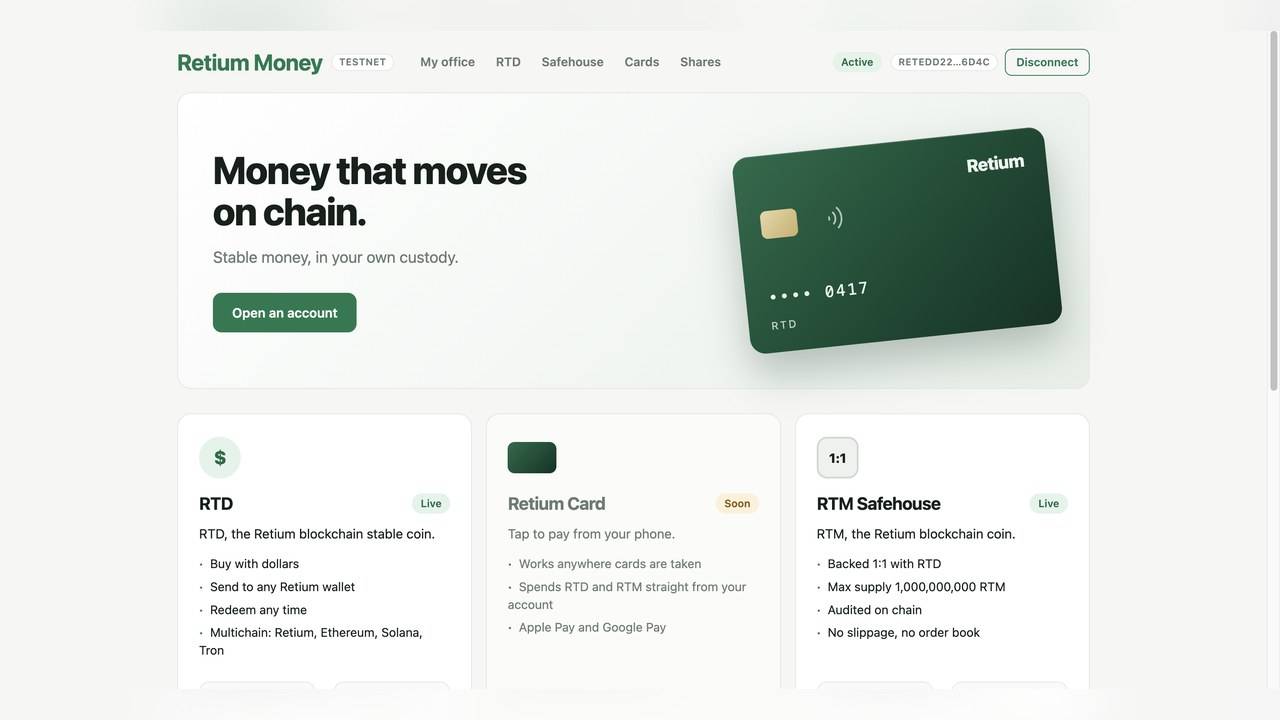
What you see: The Retium Money financial hub displaying verified authentication at the top right: Active: RETEDD22...6D4C | Disconnect. The banner reads 'Money that moves on chain. Stable money, in your own custody.' Navigation links highlight My office, RTD, Safehouse, Cards, and Shares. Core metrics show 941,394+ RTD in circulation backed 1:1 by USD reserves, Retium Card integration, and the live RTM Safehouse.
Why do this?
Retium Money is the central banking and liquidity issuance gateway for the Retium blockchain. Claiming test USD and understanding the RTD stablecoin mechanics is mandatory for funding downstream trading activities on Whisk DEX, acquiring NFTs, and testing cross-chain multi-asset transfers.
Architectural Context / Key Concept / Security Warning:
RTD operates as an algorithmic and reserve-backed stablecoin designed to serve as the predictable pricing denominator for the 3D transaction mesh. By maintaining 1:1 dollar parity, Retium decouples commerce from native token volatility, allowing enterprise payments and real-world asset settlements to execute with instant mathematical finality.
How to execute:
- Open
retium.money. - Confirm your authenticated wallet address reflects
Active: RETEDD22...6D4C. - Access
Open an accountor the testnet faucet section to claim initial test USD liquidity. - Review circulating RTD supply and reserve attestation statistics.
Key Metrics & Best Practices / Checklist:
- Protocol Asset: $RTD (Retium Dollar).
- Peg: 1:1 USD Reserve Parity.
- Multichain Deployment: Retium, Ethereum, Solana, Tron.
- Status: Live Testnet Issuance.
Step 3: Executing Slippage-Free Swaps in the RTM Safehouse (retium.money/safehouse)
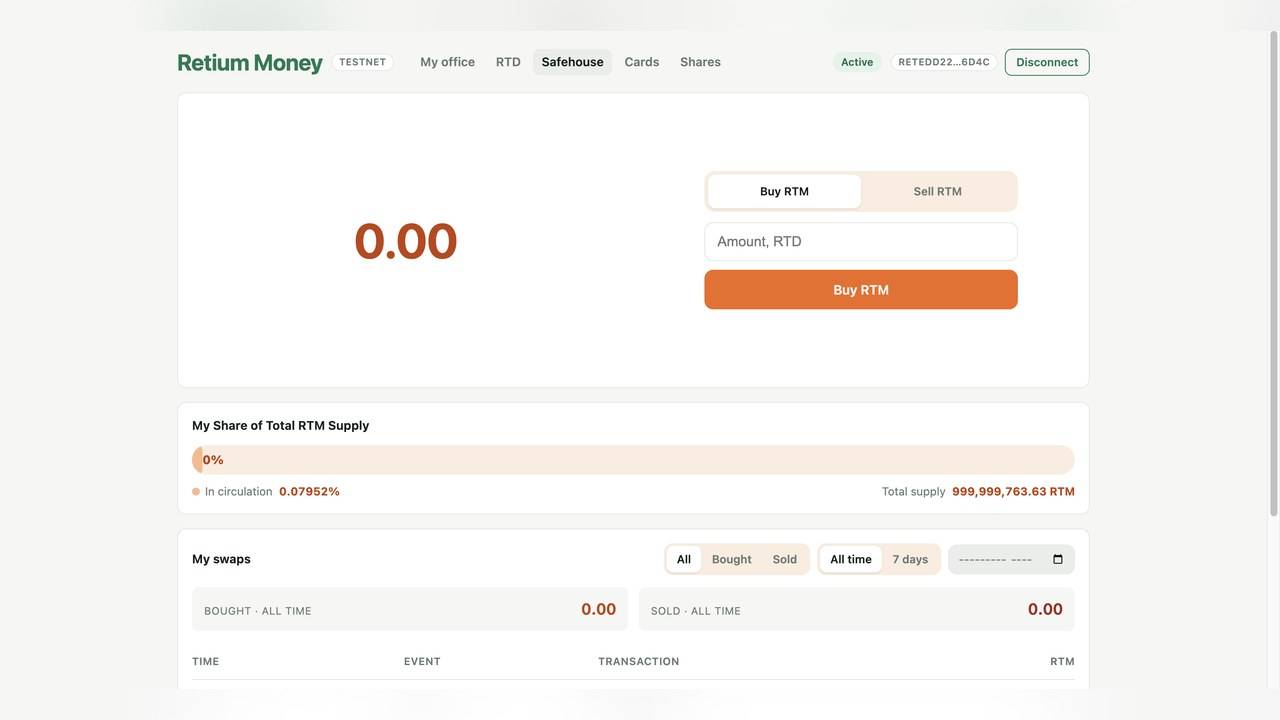
What you see: The dedicated RTM Safehouse terminal on Retium Money, displaying connected account Active: RETEDD22...6D4C at the top right. The interface features: Buy/Sell RTM modules, Amount, RTD input box with Buy RTM action trigger, supply distribution statistics ('My Share of Total RTM Supply: 0% – In circulation 0.07952%'), total network supply tracking (999,999,763 RTM), and real-time transaction event logs.
Why do this?
Interacting with the Safehouse is a crucial positioning activity for airdrop qualification. The Safehouse operates as the primary automated issuance and conversion pool between RTD and RTM. Testing conversions ensures your wallet holds both gas/governance tokens ($RTM) and stable currency ($RTD) for comprehensive ecosystem participation.
Architectural Context / Key Concept / Security Warning:
Unlike traditional Constant Product Automated Market Makers (CPMMs) that incur quadratic price slippage on large orders, the RTM Safehouse operates as a protocol-governed liquidity vault backed 1:1 by RTD reserves. It executes swaps without orderbook friction or slippage, providing institutional-grade conversion efficiency at the base protocol layer.
How to execute:
- Navigate to
retium.money/safehouse. - Ensure your connected wallet reflects
Active: RETEDD22...6D4C. - Enter your desired RTD amount in the input field.
- Click
Buy RTMto convert stable assets into native Retium coins, monitoring your share of circulating supply.
Key Metrics & Best Practices / Checklist:
- Max Supply: 1,000,000,000 $RTM.
- Conversion Mechanism: 1:1 RTD Reserve Backing.
- Slippage: 0.00% (Protocol Vault).
- Execution Speed: Instant Finality.
Step 4: Trading on Whisk DEX Orderbook & Liquidity Pools (whisk.exchange)
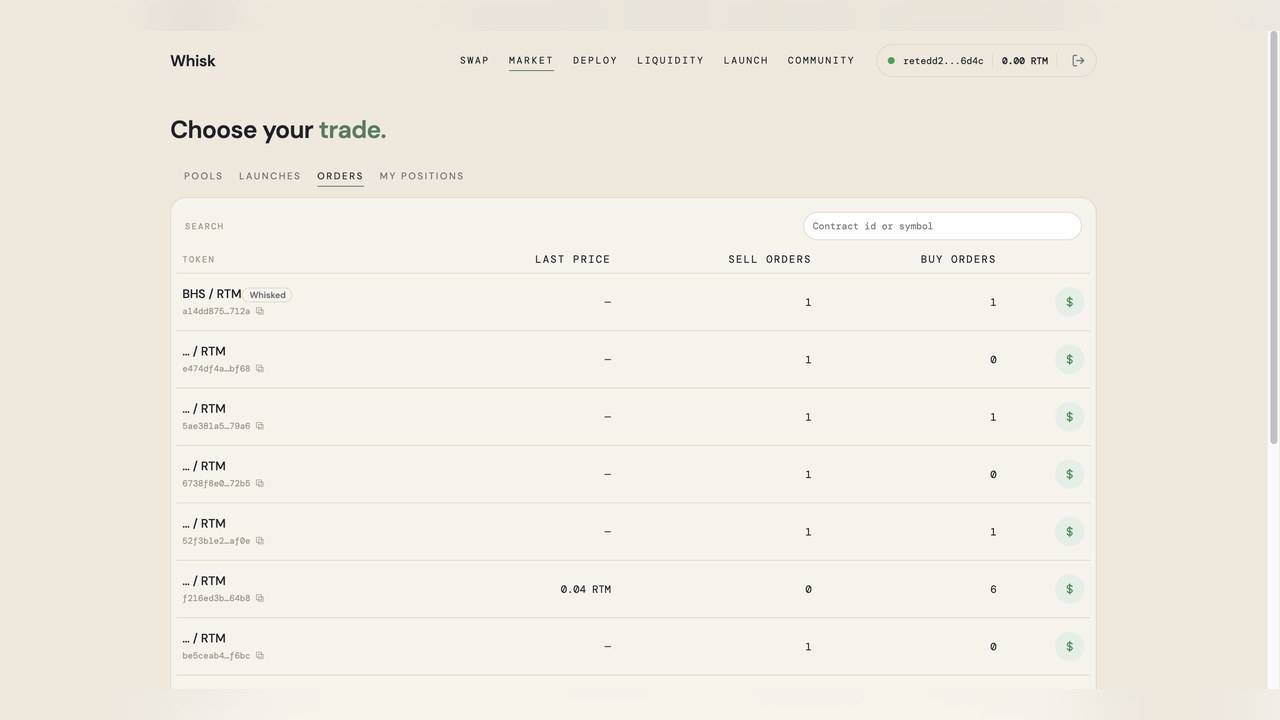
What you see: The Whisk decentralized exchange terminal (whisk.exchange/pools?view=market) with active wallet connection displayed at the top right: - retedd2... 6d4c | 0.00 RTM. The navigation bar features SWAP, MARKET, DEPLOY, LIQUIDITY, LAUNCH, and COMMUNITY. The central market panel displays live trading pairs (such as BHS / RTM Whisked and active token contracts), accompanied by on-chain Sell Orders, Buy Orders, and real-time contract ID search.
Why do this?
Whisk is the flagship DEX and Central Limit Order Book (CLOB) engine for the Retium blockchain. Executing spot swaps, placing limit orders, and providing liquidity on Whisk generates vital smart contract execution volume, establishing your wallet as an active decentralized finance participant.
Architectural Context / Key Concept / Security Warning:
Whisk leverages Retium's mempool-free 3D mesh architecture to eliminate toxic frontrunning and MEV bot sandwiching. Order matching occurs with deterministic weight-based execution, allowing micro-trades and high-frequency swaps to settle without unpredictable gas spikes. Whisk also integrates its native protocol token,$WSK.
How to execute:
- Open
whisk.exchangeand connect via Retium Wallet (retedd2...6d4c). - Navigate to
SWAPto trade between $RTM and ecosystem tokens. - Switch to
MARKETto inspect on-chain depth charts, buy/sell limit orders, and pool contracts. - Test token deployment under
DEPLOYor explore new launches underLAUNCH.
Key Metrics & Best Practices / Checklist:
- DEX Protocol: Whisk Exchange.
- Native Token:
$WSK. - Features: AMM Swaps, CLOB Market Orderbook, Token Deployment, Liquidity Pools.
- Connected Address:
retedd2...6d4c.
Step 5: Exploring & Minting on Retium NFT Launchpad (nft.retium.org)
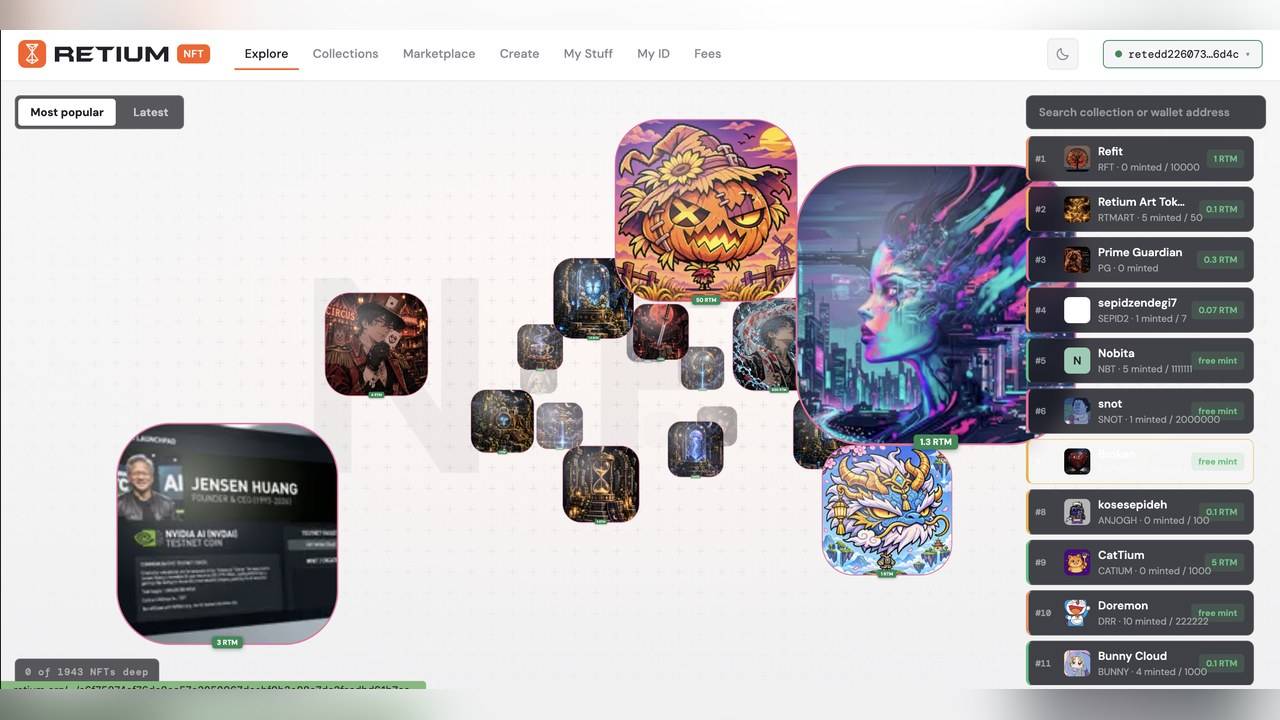
What you see: The official Retium NFT Launchpad dashboard (nft.retium.org) displaying verified user authentication at the top right: retedd226073...6d4c v. Navigational tabs include Explore, Collections, Marketplace, Create, My Stuff, My ID, and Fees. The showcase features trending digital asset collections: Refit (1 RTM), Retium Art Token (0.1 RTM), Prime Guardian (0.3 RTM), and free-mint community collections (Nobita, snot, Broken, Doremon).
Why do this?
Interacting with the Retium NFT Launchpad tests the network's non-fungible token standards and decentralized storage metadata pipelines. Minting active testnet collections (including free mints) leaves permanent contract creation and ownership proofs associated with your wallet, satisfying multi-contract interaction criteria for future airdrops.
Architectural Context / Key Concept / Security Warning:
Non-fungible tokens on Retium leverage the blockchain's instant finality to make digital assets fluid and real-time capable. Unlike congested legacy chains where NFT minting wars drive gas fees to astronomical levels, Retium's weight-based fee engine guarantees that minting costs remain microscopic and predictable, regardless of concurrent minting traffic.
How to execute:
- Visit
nft.retium.org. - Confirm your wallet reflects connected status at
retedd226073...6d4c. - Browse the
ExploreorCollectionstab to identify available testnet mints. - Execute a test mint (e.g., free mints or low-cost RTM collections) and verify the asset appears in
My Stuff.
Key Metrics & Best Practices / Checklist:
- Platform: Retium NFT Launchpad.
- Featured Mints: Nobita, snot, Doremon (Free Mints), Retium Art Token (0.1 RTM).
- Total Collections Indexed: 1,940+ NFTs deep.
- Gas Experience: Zero gas spikes during concurrent mints.
Step 6: Auditing Prime-Number Geometry & Proof-of-Math Architecture (retium.org)
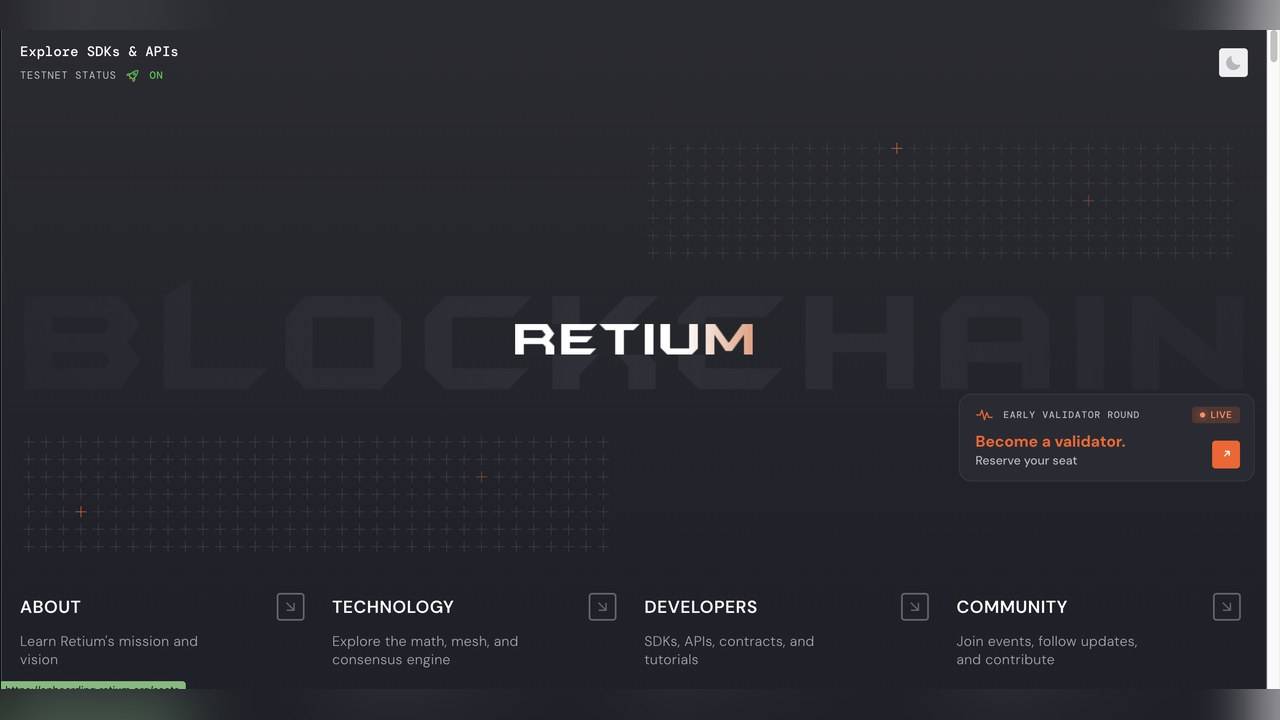
What you see: The Retium Layer 1 core portal banner: 'Retium, A blockchain built on mathematical principles'. Status indicators confirm TESTNET STATUS: ON and announce the EARLY VALIDATOR ROUND: Become a validator. Reserve your seat: LIVE. Structural navigation cards link directly to ABOUT, TECHNOLOGY, DEVELOPERS, and COMMUNITY.
Why do this?
Auditing the core protocol portal confirms the foundational technological legitimacy of Retium. Understanding the Proof of Math (PoM) validation model and seat reservation mechanics allows prospective node operators and validators to prepare for Phase 3 and Phase 4 validator onboarding.
Architectural Context / Key Concept / Security Warning:
Retium's breakthrough architecture relies on prime-number linking rules that allow blocks to expand into a multi-dimensional lattice rather than a flat linear chain. This multi-vector mesh structure enables concurrent transaction processing across independent mathematical coordinates, removing throughput bottlenecks without compromising decentralized verification integrity.
How to execute:
- Navigate to
retium.org. - Verify testnet operational status is confirmed
ON. - Review the Early Validator Round specifications and seat reservation tiers (Worker vs. Suit tiers).
- Inspect the architectural pillars: Logic-Driven, Integrity, Multi-Vector Mesh, and Validator-Optimized.
Key Metrics & Best Practices / Checklist:
- Consensus Model: Proof of Math (PoM).
- Network Structure: Multi-Vector 3D Transaction Mesh.
- Codebase Origin: 100% Original Rust Implementation.
- Status: Public Testnet Live.
Step 7: Inspecting Developer Tooling & Whitepaper 2.0.1 Specifications (docs.retium.org)
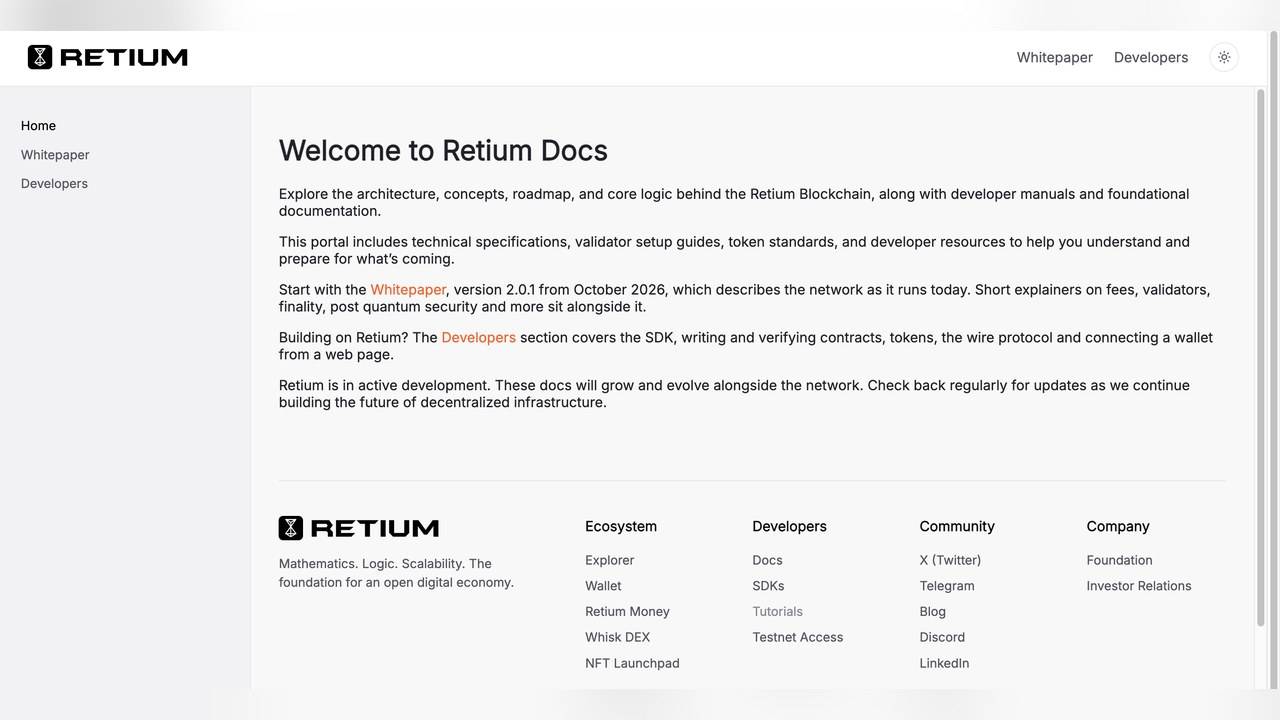
What you see: The official Retium technical documentation hub (docs.retium.org), highlighting the October 2026 release of Whitepaper version 2.0.1. Technical manuals cover: core mathematical logic, multi-role validator networks (separating computation, finality, and storage), post-quantum security specifications, developer SDKs, token standards, and wire protocol integrations.
Why do this?
Verifying formal technical documentation ensures that an early Layer 1 project has verifiable engineering substance rather than marketing hype. Whitepaper 2.0.1 outlines Retium's formal multi-role validator topology and post-quantum cryptographic primitives, confirming a structured path toward mainnet readiness.
Architectural Context / Key Concept / Security Warning:
Retium decouples validator duties into a multi-role topology: computation nodes process state transitions, finality nodes commit prime-linked consensus proofs, and storage nodes archive mesh history. This separation of concerns ensures that lightweight consumer hardware can participate in validation without demanding enterprise storage arrays.
How to execute:
- Open
docs.retium.org. - Access and review Whitepaper version 2.0.1.
- Study the developer manuals covering SDK integration, contract verification, and web wallet connection protocols.
- Review the regulatory timeline detailing Australian Financial Services Licence (AFSL) compliance.
Key Metrics & Best Practices / Checklist:
- Whitepaper Version: 2.0.1 (October 2026 Edition).
- Core Security: Post-Quantum Cryptographic Readiness.
- Validator Architecture: Multi-Role (Computation, Finality, Storage).
- Compliance Roadmap: AFSL Licence Submission.
Step 8: Validating Official Social Media & Validator Roadmap (x.com/RetiumChain)
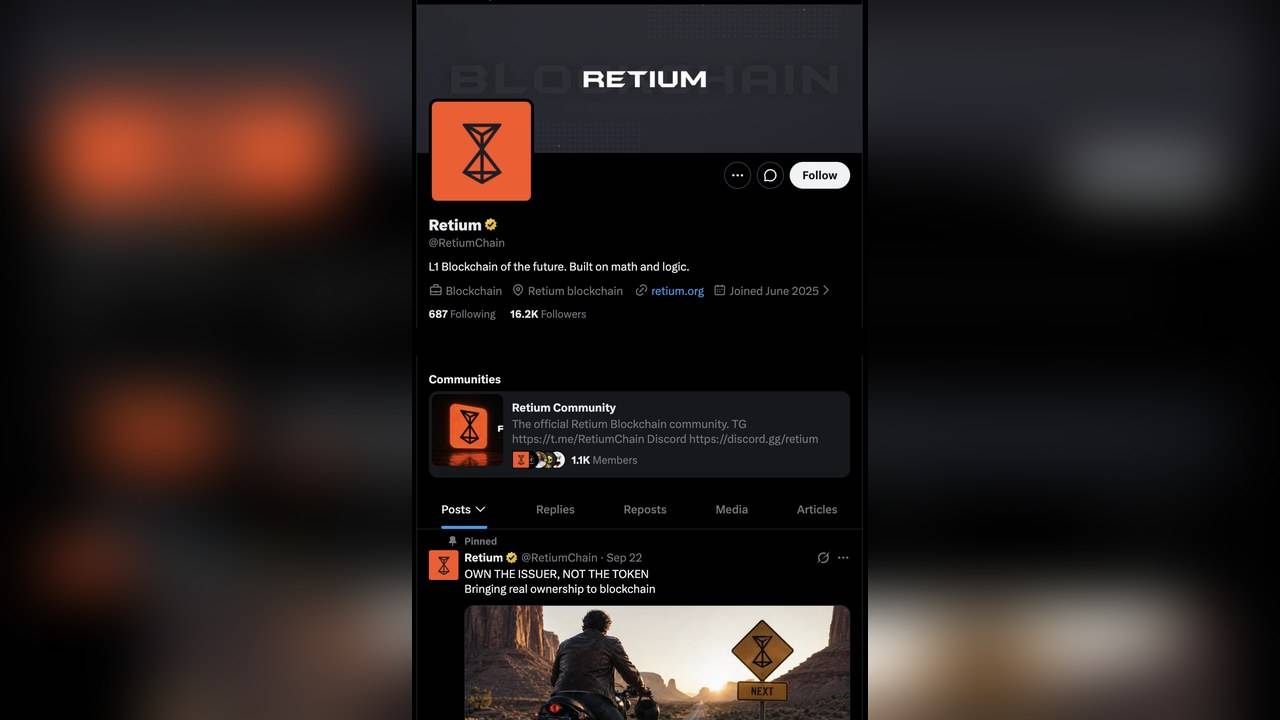
What you see: The verified official X profile @RetiumChain showcasing 16.2K followers, community bio: 'L1 Blockchain of the future. Built on math and logic. Retium blockchain @retium.org', official Telegram/Discord community hub links (1.1K members), and featured milestone post: 'OWN THE ISSUER, NOT THE TOKEN: Bringing real ownership to blockchain'.
Why do this?
Synchronizing with official social channels protects users from malicious phishing clones, fraudulent token generation scams, and unauthorized bridge contracts. Official announcements from@RetiumChainprovide verified updates regarding daily testnet limits, faucet replenishments, and airdrop snapshot parameters.
Architectural Context / Key Concept / Security Warning:
Retium emphasizes the principle of 'Own the issuer, not just the token', reflecting its regulatory-first ethos and real-world asset licensing ambition. All official testnet upgrades, validator rounds, and ecosystem announcements are published strictly through verified links listed on@RetiumChain. Never share your private keys or seed phrase.
How to execute:
- Navigate to
x.com/RetiumChain. - Follow the account and activate notifications for testnet updates.
- Join the verified Retium Community on Telegram and Discord via links in bio.
- Maintain consistent daily or weekly interactions across Retium Money, Whisk, and NFT Launchpad to satisfy retention metrics.
Key Metrics & Best Practices / Checklist:
- Official Handle:
@RetiumChain(16.2K Followers). - Community Hubs: Telegram & Discord (1.1K Members).
- Milestone: Early Validator Round & Public Testnet Phase.
- Safety Rule: Zero unverified bridge transactions.
Comparative Matrix: Retium vs. Legacy L1s & EVM Rollups
| Architecture Dimension | Retium Network (@RetiumChain) | Monolithic L1s (Solana, Sui) | EVM Layer 2 Rollups (Arbitrum, Base) |
|---|---|---|---|
| Codebase Origin | 100% Original Rust Codebase | Proprietary Rust / Move | Geth / Reth / Erigon EVM forks |
| Consensus Model | Proof of Math (PoM) Multi-Vector Mesh | Proof of History / Narwhal DAG | Centralized Sequencer + Fraud/ZK Proofs |
| Mempool Structure | Zero Mempool (MEV Eliminated) | Public Mempool (Jito Bundles) | Private Sequencer Mempool |
| Fee Model | Weight-Based (Pay in $RTM or $RTD) | Dynamic Priority Gas Auctions | L1 Data Availability + Execution Gas |
| Native Stablecoin | Built-in 1:1 USD-Backed $RTD | Third-party issued (USDC/USDT) | Bridged ERC-20 stablecoins |
| Slippage Mechanics | RTM Safehouse (0% Slippage Vault) | AMM Constant Product Slippage | AMM Constant Product Slippage |
| Airdrop Entry Cost | $0.00 (100% Free Public Testnet) | High capital deposit requirements | Gas fees & liquidity lockups |
Strategic Retium Testnet Airdrop Playbook & Farming Routine
To maximize tester recognition and optimize positioning for potential future retroactive rewards, implement this disciplined routine:
Action Checklist
- Wallet Setup: Create your wallet on
wallet.retium.org, back up your seed phrase, and configure the Chrome extension. - Liquidity Inflow: Claim test USD daily on
retium.moneywithin daily allocation limits. - Safehouse Usage: Convert a portion of RTD to RTM using the RTM Safehouse to secure native gas and governance tokens.
- Whisk DEX Interactions: Conduct at least 2-3 swaps weekly on
whisk.exchange, testing pairs such as BHS/RTM and exploring market orderbooks. - NFT Minting: Mint at least 1-2 testnet collections (e.g., Nobita, snot, Retium Art Token) on
nft.retium.org. - Social Synchronization: Join the official Discord and Telegram channels to ensure your active address is linked to community verification roles.
Editorial credits
Checked by TokenTopNews QC Team before publishing on November 20, 2026 for metadata: our AI review system checks every article before it goes live, and our editor monitors it after publication. Report an error.
TokenTopNews uses AI for research, drafting and review. Our editorial team is responsible for every article and corrects or withdraws articles when needed. How we review.