Bitcoin has been declared dead 472 times since 2010, according to the obituary tracker Bitcoin Is Dead. A hypothetical investor who bought $1,000 worth of Bitcoin after each death call would now be sitting on a portfolio worth more than $75 million, a striking illustration of how contrarian buying into peak pessimism has historically compounded.
The claim circulating on social media uses a $1,000-per-obituary figure, but the original dataset on Bitcoin Is Dead models a $100 buy on each of the 472 obituaries, which it says would have accumulated 1,043.48 BTC. At Bitcoin’s current spot price near $71,079, that stack is worth roughly $74.2 million. Scaling the experiment to $1,000 per obituary would put the hypothetical total closer to $742 million, not $75 million.
The discrepancy matters. The viral framing overstates the per-buy amount while understating the result, making the headline directionally correct but mathematically imprecise.
What Qualifies as a Bitcoin “Death” Declaration
Bitcoin Is Dead tracks public statements from media outlets, economists, and investors that explicitly declare Bitcoin finished, worthless, or doomed to zero. The database spans 322 unique critics across 211 publications, cataloging each entry with a date, source, and the Bitcoin price at the time.
The tally measures sentiment and commentary, not protocol failures. Bitcoin’s network has never suffered a consensus-breaking bug or permanent chain halt. Every one of the 472 entries reflects a human judgment call, not a technical event.
The Biggest Spike Years
Death calls cluster around drawdowns. The peak obituary year was 2017 with 93 entries, coinciding with Bitcoin’s run to $20,000 and the subsequent crash that saw it lose more than 80% of its value into 2018.
Peter Schiff leads the individual leaderboard with 22 death calls logged by the tracker, making the gold advocate the most persistent Bitcoin critic in the dataset.
A competing tracker, 99Bitcoins, currently displays a higher count of 477 obituaries. The two databases do not publish identical inclusion criteria, which accounts for the five-entry gap. Neither tracker has publicly reconciled the difference.
How $1,000 on Every Obituary Reaches Eight Figures
Total Capital Deployed
At $1,000 per obituary across 472 entries, the total capital outlay would be $472,000. The strategy’s power comes not from the size of each buy but from the timing: obituaries tend to cluster during crashes, when prices are low and sentiment is worst.
Average Entry Logic
Because death calls spike during bear markets, the strategy mechanically overweights low prices. A disproportionate share of the 472 buys would have executed below $1,000, during 2011, 2014, and early 2015, when Bitcoin was trading in the hundreds or low thousands. Those early, cheap entries drive the bulk of the compounding.
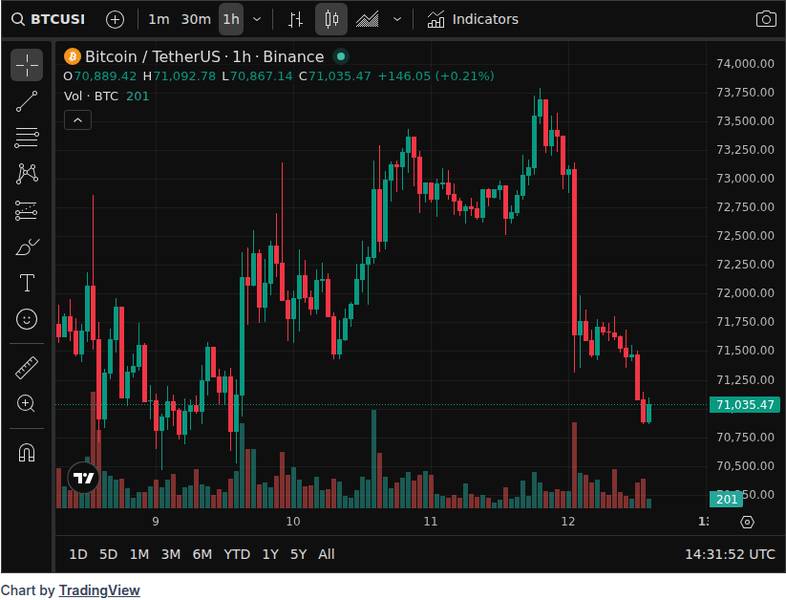
Bitcoin currently trades near $71,079 with a market cap above $1.42 trillion, down roughly 2.3% over the past 24 hours.
End-Value Calculation
The source page’s $100-per-obituary model yields 1,043.48 BTC. At $71,079 per coin, that is approximately $74.2 million on a $47,200 outlay. The $1,000 version, according to unconfirmed social media claims, would be roughly $742 million, not the $75 million stated in the viral post.
This is a hypothetical signal-based strategy, not a claim about practical execution. Many of the earliest obituaries preceded liquid exchanges, and slippage on a $1,000 market buy during a 2011 crash would have been severe.
Why Bitcoin Keeps Getting Pronounced Dead
Bitcoin’s annualized volatility has historically ranged from 50% to over 100%, producing drawdowns of 50% or more in nearly every market cycle. Each crash triggers a wave of commentary predicting permanent decline, which the obituary trackers then log.
Cycle Psychology and Recurring Capitulation
The pattern follows a predictable arc: price surges attract mainstream attention, the correction triggers panic selling, and commentators extrapolate the drawdown to zero. When prices recover months or years later, the cycle resets with a new cohort of critics.
The current Fear & Greed Index reads 16, classified as Extreme Fear. That reading fits the historical pattern: obituary trackers continue to log anti-Bitcoin calls even as the broader market sits in deep risk-off territory.
The obituary dataset does not prove that buying every dip is a reliable forward-looking strategy. It does show that the most confident bearish calls in Bitcoin’s history have, so far, been followed by higher prices. Whether that pattern holds through the next 472 death calls is a different question entirely.
Disclaimer: This article is for informational purposes only and does not constitute financial or investment advice. Cryptocurrency and digital asset markets carry significant risk. Always do your own research before making decisions.