
In 2010, a website called The Bitcoin Faucet handed out 5 BTC to anyone who solved a captcha and entered a wallet address. At Bitcoin’s April 3, 2026 price of $66,866, that single visit would be worth roughly $334,330.
The claim, recently recirculated by Bitcoin Magazine, is not internet folklore. It is backed by archived web pages and the original announcement from the developer who built the site.
The 2010 Bitcoin Faucet Really Did Give Away 5 BTC Per Visitor
Developer Gavin Andresen announced the faucet on Bitcointalk on June 11, 2010, describing it as his first Bitcoin coding project. He wrote that the site, hosted at freebitcoins.appspot.com, would give away 5 BTC per visitor.
Andresen noted he had stocked the faucet with 1,100 BTC at launch. The mechanic was simple: visit the page, complete a captcha, paste a Bitcoin receiving address, and collect 5 BTC.
Archived Proof From the Faucet Itself
The Bitcointalk post is not the only evidence. A July 3, 2010 snapshot on the Wayback Machine captures freebitcoins.appspot.com identifying itself as “The Bitcoin Faucet.” The archived page confirms the 5 BTC giveaway and shows 750 BTC still available in the pool at that date.
That means roughly 350 BTC had already been distributed in fewer than three weeks since the June 11 launch, enough to supply at least 70 visitors with 5 BTC each.
Why That 5 BTC Giveaway Equals About $334,330 on April 3, 2026
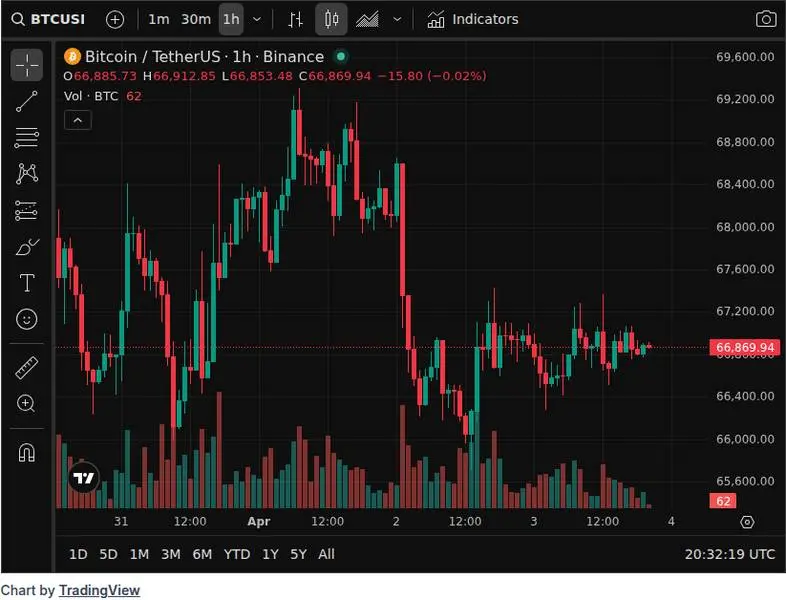
Bitcoin traded at $66,866 on April 3, 2026. At that price, a single 5 BTC faucet payout would be worth approximately $334,330.
How the Math Works
The calculation is straightforward: 5 BTC multiplied by $66,866 per coin equals $334,330. That figure is a snapshot, not a guaranteed value. It reflects the spot price on a single day and would shift with any market movement.
The contrast is still striking. In mid-2010, Bitcoin had almost no market price. The faucet existed precisely because the coins had negligible monetary value and Andresen wanted to put them into as many hands as possible.
The 750 BTC still sitting in the faucet on July 3, 2010, as shown by the archived page, would be worth over $50 million at the same April 2026 price. The entire 1,100 BTC initial stock would exceed $73.5 million.
What the Faucet Says About Bitcoin’s Early Distribution Era
Andresen built the faucet as an onboarding tool, not a promotion. In 2010, Bitcoin had no exchanges with meaningful liquidity, no mobile wallets, and almost no public awareness. Getting coins into new wallets was a prerequisite for the network to function.
The faucet required nothing beyond a captcha and a receiving address. There was no KYC, no email signup, no minimum holding period. That level of frictionless access is almost unimaginable in today’s environment, where institutions like Charles Schwab are building dedicated verticals just to let customers buy Bitcoin through regulated channels.
Why Early Faucets Mattered Before Bitcoin Had Mainstream Awareness
Before mining pools, before exchanges, and before any media coverage, faucets were one of the only ways a non-technical person could obtain Bitcoin. The faucet turned curious visitors into wallet holders, each one a new node in Bitcoin’s economic network.
Andresen’s project also demonstrated something about early Bitcoin culture: contributors were willing to spend real resources, in this case over a thousand BTC, to bootstrap adoption rather than hoard supply. That ethos predated the era of compliance-driven institutional frameworks and government-level crypto enforcement by more than a decade.
The faucet eventually reduced its payout as Bitcoin’s price rose and demand for free coins grew. But its original 5 BTC offer remains one of the most vivid illustrations of how far Bitcoin’s value has traveled since the network’s earliest days.
Disclaimer: This article is for informational purposes only and does not constitute financial or investment advice. Cryptocurrency and digital asset markets carry significant risk. Always do your own research before making decisions.


