
BTC Shorts Win: Trader 0x2fc3 Closes a Losing Long and Flips Short
BTC shorts won this round after a closely watched Hyperliquid account exited a losing long and flipped to a short of roughly two hundred eighty-eight bitcoin, marking a fast conviction reversal in the same market regime.
What Happened: 0x2fc3 Closed a Losing BTC Long
Lookonchain wrote that wallet 0x2fc3 closed a long at a loss and then reversed into a short on 288.69 BTC.
An earlier update said the same wallet had opened a 30x long sized at 325.88 BTC before the reversal.
In the research snapshot tied to the account’s perps view, the address was net -288.6916 BTC with 30x leverage, a listed liquidation level of $72,783.2707132285, and position value near $20,483,823.7864000015.
The same brief reports 443 BTC close-long fills over the last 3 days with aggregate closed PnL of -$24,934.242450000005, and it states each recorded close-long fill was negative.
One social post also said the short was up $209K and near $20.4M notional, according to unconfirmed reports that were not independently replayed at the exact post timestamp.
Why the Flip to Short Matters for Bitcoin Sentiment
In the same market snapshot, bitcoin traded near $70,977, with -0.4336616067911895% performance over 24 hours, market cap around $1,420,240,422,072.408, and volume around $40,286,086,083.844475.
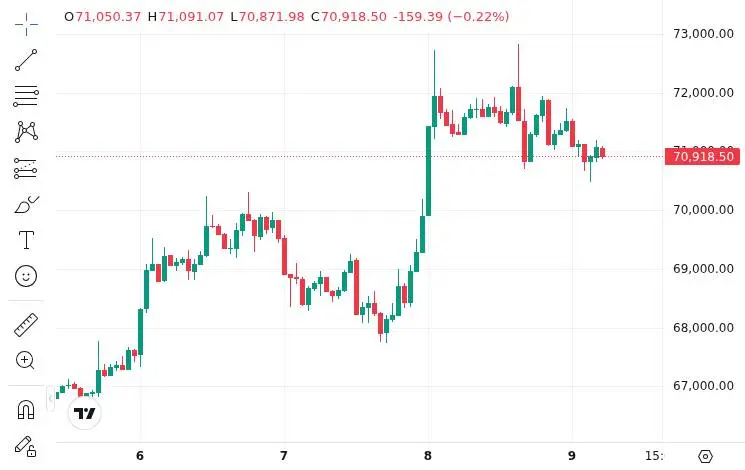
The gap between spot near $70,977 and the listed liquidation level at $72,783.2707132285 is about $1,806, so this position can be invalidated quickly if price squeezes upward.
Sentiment data was also stressed, with the Fear & Greed Index at 14 (Extreme Fear), which supports treating this flip as a high-volatility setup rather than a stand-alone trend signal.
What Traders Should Watch Next After the Position Reversal
For confirmation instead of headline-following, traders can watch whether BTC reclaims $72,783.2707132285 to invalidate the short thesis, or breaks $70,000 to keep downside momentum in control.
Liquidation follow-through also matters, so monitoring the CoinGlass liquidations dashboard alongside wallet-level positioning helps separate a one-account reversal from broader derivatives stress.
This remains a trader-specific signal, not market-wide proof, and long-cycle context still matters as shown in Bitcoin’s multi-cycle run from early single digits to five-figure pricing.
Cross-market speculation can still spill into BTC positioning, which is why context from recent meme-coin risk-on bursts is relevant when reading sudden flips by large leveraged accounts.
At the same time, adoption narratives such as the first official Bitcoin Rubik’s Cube launch can keep long-horizon attention intact even during fear-heavy derivatives phases.
No direct regulatory filing is central to this event; this is a leveraged perpetuals positioning story centered on execution data and risk management.
Copying a 30x setup without a defined invalidation plan is materially riskier than tracking it as market structure data, especially after the same account’s reported unwind near -$24,934.242450000005.
Disclaimer: This content is for informational purposes only and is not investment advice.
Disclaimer: This article is for informational purposes only and does not constitute financial or investment advice. Cryptocurrency and digital asset markets carry significant risk. Always do your own research before making decisions.


