The Canadian government has tabled Bill C-25, legislation that would ban political donations made using cryptocurrencies, money orders, and prepaid payment products across the entire federal election system. The bill, introduced on March 26, 2026, marks Canada’s second attempt at closing what regulators view as an anonymity loophole in election finance law.
What Bill C-25 Proposes: Crypto and Money Orders Out of Election Finance
Bill C-25, formally titled the “Strong and Free Elections Act,” was introduced at first reading by Steven MacKinnon, the Liberal Minister of Transport and Leader of the Government in the House of Commons. The legislation amends the Canada Elections Act to prohibit the acceptance of cryptoassets, defined in the bill as “digital assets protected by cryptographic measures,” alongside money orders and prepaid payment products.
The ban covers the full scope of federal political activity: registered parties, eligible parties, riding associations, candidates, nomination contestants, leadership contestants, and third parties engaged in partisan activities, election advertising, or election surveys.
Recipients of prohibited contributions face a strict 30-day compliance window. They must return the unused contribution, destroy it, or convert it to currency and forward the proceeds to the Chief Electoral Officer.
Penalties are substantial. Individuals who violate the ban face fines of up to $25,000 plus twice the contribution amount. Corporations and other entities face up to $100,000 plus twice the contribution amount. Enhanced penalties apply when violations involve foreign entities.
Why Canada Is Tightening Political Donation Rules Around Crypto
The bill’s stated rationale centers on prohibiting contributions from anonymous sources. Canada’s Chief Electoral Officer shifted position in 2024, moving from favouring tighter regulation to recommending an outright prohibition, citing cryptocurrency’s pseudo-anonymity and the fundamental difficulty of verifying contributor identities.
The practical reality underscores the pre-emptive nature of the legislation. Crypto donations have been permitted in Canadian federal elections since 2019, but have seen virtually no use. Bill C-25 is closing a theoretical vulnerability rather than responding to documented abuse.
This is also not the first time Ottawa has pursued this ban. Bill C-65, which contained identical crypto donation provisions, was introduced in the previous parliamentary session but died when Parliament was prorogued in January 2025. Bill C-25 represents a renewed push under a fresh legislative vehicle, raising the question of whether this second attempt will clear Parliament before any future prorogation or dissolution.
Canada Joins a Growing Wave of Crypto Election-Finance Restrictions
Canada’s move follows closely behind the United Kingdom, which announced an immediate moratorium on cryptocurrency donations to political parties on March 25, 2026, just one day before Bill C-25 was tabled. The UK cited concerns that digital assets could be used to hide the origins of foreign money.
The back-to-back moves suggest a coordinated regulatory direction among Commonwealth nations. Both governments frame crypto donation bans as anti-foreign-interference measures rather than broadly anti-crypto policy, a distinction that matters for how the industry interprets the legislative intent.
Bill C-25 is currently at second reading in the House of Commons. It must still pass through committee review, a third reading, Senate approval, and Royal Assent before becoming law. Given that its predecessor died during prorogation, the bill’s path to enactment is far from guaranteed.
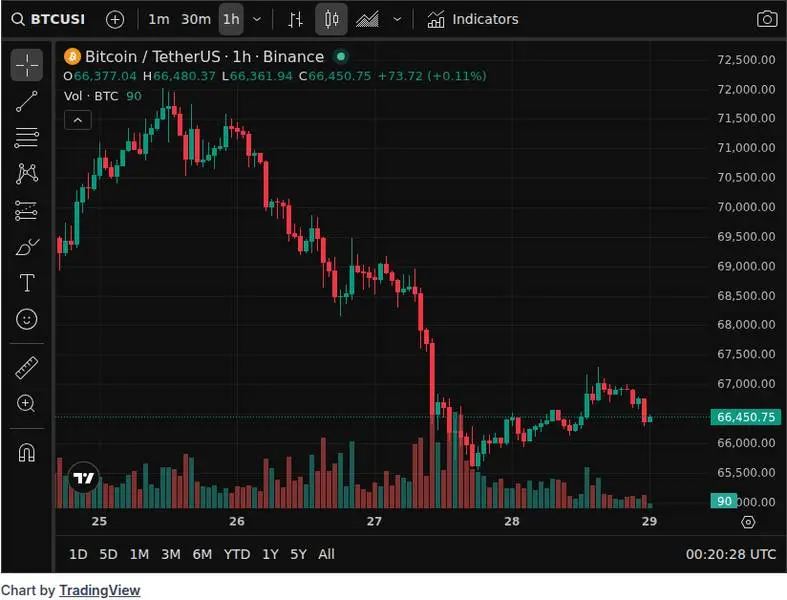
Bitcoin traded near $66,370 at the time of the bill’s introduction, with minimal 24-hour price movement of roughly 0.08%.
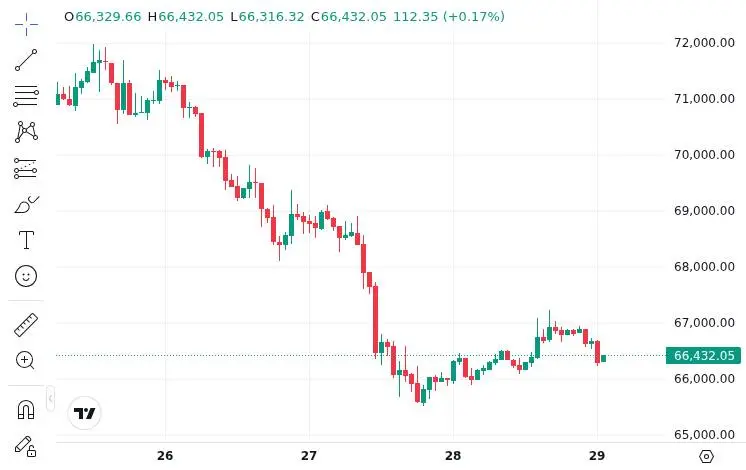
The broader crypto market reflected extreme fear, with the Fear & Greed Index sitting at 9 out of 100. No notable social backlash against Bill C-25 has emerged from the crypto community, likely because the ban addresses a mechanism that was never meaningfully adopted in Canadian politics.
The bill is part of a broader legislative package targeting deepfakes, foreign interference, and internet safety in elections. Whether it passes will depend on parliamentary appetite for election reform and whether the current session runs long enough to see it through committee and the Senate.
Disclaimer: This article is for informational purposes only and does not constitute financial or investment advice. Cryptocurrency and digital asset markets carry significant risk. Always do your own research before making decisions.