
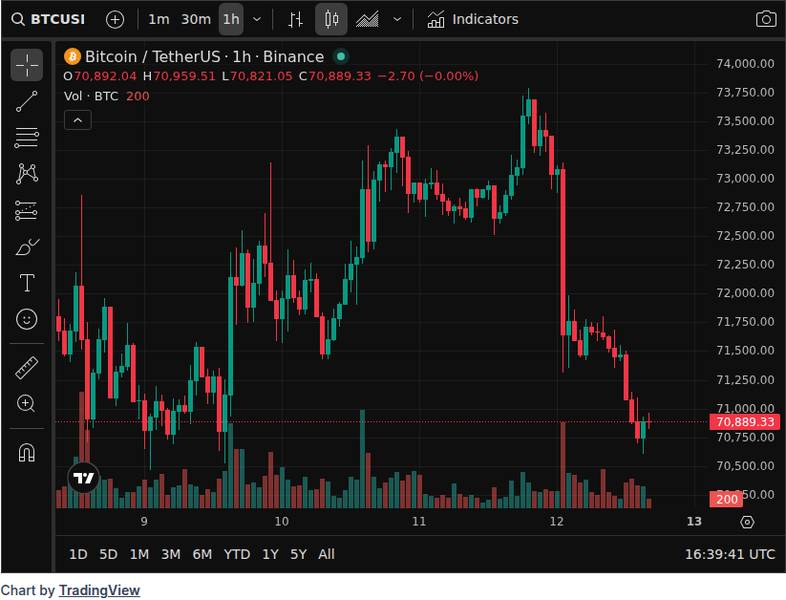
Bitcoin is trading near $70,953 as negative funding rates in perpetual futures markets raise the probability of a short squeeze if BTC can reclaim the $73,750-$74,400 resistance corridor, a zone where analysts say trapped short positions could amplify any upward move.
The Fear & Greed Index sits at 16, classified as Extreme Fear, reflecting broad risk-off sentiment. Yet the derivatives setup tells a more nuanced story, one where bearish positioning may itself become fuel for a rally.
Why the $73,750-$74,400 Resistance Zone Matters
An Investing.com analysis noted that BTC briefly surged past $74,000 before running into a resistance corridor between $73,750 and $74,400. The move through $70,000 and then $73,000 was framed as sequential short covering layered on top of spot demand.
Social media reports have circulated about one large short-liquidity cluster specifically above $74,000, though this exact claim remains unverified by any fetched heatmap or exported dataset. What the confirmed evidence does support is a broader zone of overhead squeeze risk in the low-to-mid $70,000 region, according to unconfirmed reports citing derivatives data.
When a dense cluster of short liquidation levels sits above the current price, a sustained push into that zone can trigger forced buy orders. Those forced buys push price higher, liquidating the next layer of shorts, a self-reinforcing cycle that has historically produced some of Bitcoin's sharpest intraday rallies, similar to the dynamics seen when Bitcoin was declared dead 472 times yet continued to recover.
How Negative Funding Could Fuel a Short Squeeze
Negative funding in perpetual futures means short positions are paying a periodic fee to long positions, a direct cost for maintaining bearish bets. The Investing.com analysis described BTC funding rates as deeply negative through the consolidation period, meaning short sellers were paying financing costs to hold their positions.
CoinGlass, a widely used derivatives analytics platform, explains that high negative funding can contribute to a short squeeze if price stabilizes and rebounds. When shorts are paying to stay open and the market turns against them, the economic pressure to close positions compounds quickly.
The scale of potential liquidations is significant. Cointelegraph reported that a move to $72,000 would liquidate roughly $2.5 billion in Bitcoin shorts. With BTC already near $70,953, that threshold is less than 2% above the current price, putting billions in short exposure at immediate risk.
This setup does not guarantee upside. Negative funding can persist for extended periods during genuine downtrends, and the squeeze thesis only activates if buying pressure is sufficient to push price into the liquidation zone. The distinction matters for traders evaluating whether current conditions resemble the kind of institutional accumulation signals that preceded prior recoveries.
What Traders Should Watch Next
At $70,953 with a 24-hour decline of 2.72%, BTC remains roughly 4% below the lower bound of the $73,750-$74,400 resistance corridor. The gap is narrow enough that a single catalyst, whether ETF inflows, a macro shift, or a wave of short covering, could close it within hours.
A sustained reclaim of the $74,000 area would strengthen the squeeze thesis considerably, bringing the full weight of overhead short liquidations into play. Conversely, another rejection below the resistance band would weaken the setup and likely extend the negative funding regime as shorts regain confidence.
Macro conditions and ETF-flow narratives remain the primary external catalysts, with no fresh regulatory filing or policy action driving this particular setup. The Extreme Fear reading of 16 suggests retail sentiment is heavily skewed bearish, which historically has coincided with local bottoms, though it is not a reliable timing signal on its own. In the broader landscape of expanding DeFi activity across chains, the derivatives market remains the immediate variable to watch for BTC direction.
Disclaimer: This article is for informational purposes only and does not constitute financial or investment advice. Cryptocurrency and digital asset markets carry significant risk. Always do your own research before making decisions.