
A single Ethereum whale has quietly drained over $155 million in ETH from Kraken in four days, but the real story is the convergence behind it: exchange reserves hitting all-time lows, BlackRock launching a staked ETH fund on the same day, and institutional ETF flows flipping positive after months of outflows.
On-chain tracking platform Lookonchain flagged the whale, identified by address 0x8E34, on March 12 after 63,324 ETH ($131.2 million) left Kraken in a 48-hour window. The assets were distributed across four separate wallets at an average acquisition price of $2,072 per ETH.
The largest single batch, 44,888 ETH ($92.97 million), moved on March 11. A second transfer of 18,436 ETH ($38.26 million) followed within hours, with additional withdrawals from preceding days bringing the four-day total to approximately 73,806 ETH.
ON-CHAIN DATA
- Whale address: 0x8E34...4170
- Confirmed 48-hour total: 63,324 ETH ($131.2M)
- Estimated 4-day total: ~73,806 ETH (~$155M)
- Average entry price: $2,072 per ETH
- Distribution: 4 separate wallets (multi-address custody strategy)
Whale 0x8E34 was not acting alone. A second newly created wallet (0xfDe8) withdrew 11,629 ETH ($23.71 million) from Binance during the same two-day stretch, pushing combined exchange outflows from just two entities past 74,950 ETH in 48 hours.
Whales are buying $ETH!
— Lookonchain (@lookonchain) March 12, 2026
Someone created a new wallet (0xfDe8) and has withdrawn 11,629 $ETH($23.71M) from #Binance in the past 2 days.
Earlier, we also reported that whale 0x8E34 withdrew 63,324 $ETH($131.2M) from #Kraken in the past 2 days.https://t.co/c0fmBE42N6… pic.twitter.com/ro8ikqlk4l
Source: @lookonchain on X
Exchange Reserves at Record Lows While ETH Sits 57% Below Its Peak
These withdrawals accelerate a structural trend. Ethereum exchange reserves have fallen to roughly 15.9 million ETH, the lowest level on record, representing just 12.02% of total circulating supply. That is down from 23 million ETH in 2023, a 30.4% decline.
In total, 31.6 million ETH has left centralized exchanges over time. Spot netflows remain negative at -$13.56 million, confirming that outflows continue to outpace deposits. The pattern echoes earlier whale withdrawals totaling $60 million that signaled the same accumulation thesis weeks ago.
ETH itself traded at $2,126.55 at press time, up 3.65% over 24 hours and 2.58% on the week. Yet the asset remains 57% below its all-time high of $4,946.05 from August 2025. The Crypto Fear & Greed Index reads 15, deep in "Extreme Fear," where it has sat for four consecutive readings.
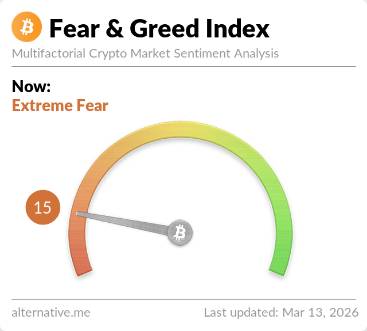
The divergence is stark: on-chain whales are buying the most ETH in weeks while retail sentiment reflects capitulation. This gap between smart money positioning and crowd psychology has historically preceded significant price moves.
BlackRock's ETHB Launch and ETF Flow Reversal Add an Institutional Layer
The timing of the whale's largest withdrawal aligned with a significant institutional milestone. On March 12, BlackRock launched the iShares Staked Ethereum Trust ETF (ETHB) on Nasdaq, its first crypto ETF to incorporate staking. The fund stakes 70-95% of its ETH holdings via Coinbase, distributing 82% of gross staking rewards to shareholders.
BlackRock offered a temporary fee cut to 0.12% on the first $2.5 billion in assets, half the standard 0.25% rate. The existing iShares Ethereum Trust (ETHA) already manages roughly $6.5 billion; ETHB could accelerate institutional demand for ETH that is both held and staked.
The launch follows a turning point in ETF flows. After months of persistent outflows that eroded cumulative net inflows from nearly $15 billion to $11.58 billion, Ethereum ETFs have recorded consecutive weeks of positive inflows. On a single day in early March, ETH ETFs absorbed $38.7 million, with BlackRock's ETHA leading at $26.5 million.
Three Signals Point to an ETH Supply Squeeze
The convergence of on-chain whale accumulation, record-low exchange reserves, and the arrival of a staked ETH ETF creates a specific setup. With 28.91% of all ETH already staked (35.86 million tokens) and 3.4 million additional ETH queued to enter validator sets, the liquid supply available for trading continues shrinking.
The broader ETF flow reversal in March adds another demand layer. If ETHB follows even a fraction of IBIT's trajectory, which manages over $55 billion, the combination of reduced exchange supply and new institutional buying channels could create meaningful supply pressure.
Related Developments
- BTC-to-ETH rotations accelerating: A separate high-profile wallet swapped 240 BTC ($16 million) for 8,152 ETH, then used borrowed USDT to buy an additional 17,284 ETH near $2,083, signaling cross-asset repositioning.
- Ethereum network activity at record highs: Despite the 57% drawdown from ATH, on-chain transaction volumes have hit all-time highs, suggesting the network's utility is expanding even as its token price compresses.
- BlackRock's ETHB fee waiver deadline: The 0.12% promotional rate expires in 12 months or at $2.5 billion AUM, whichever comes first, giving institutional allocators a concrete window to accumulate staked ETH exposure at discounted fees.
The pattern across these data points suggests that the entities with the largest positions and longest time horizons, from on-chain whales to the world's biggest asset manager, are positioning into ETH during a period of peak pessimism and contracting supply.
Disclaimer: This article is for informational purposes only and does not constitute financial advice. Cryptocurrency investments carry significant risk. Always conduct your own research before making investment decisions.