
A solo Bitcoin miner beat astronomical odds and mined block 938,092, collecting a total reward of 3.128 BTC worth approximately $222,012. The miner reportedly spent just 119,000 sats, roughly $75, on rented hashpower to pull off what amounts to a one-in-a-million lottery win on the Bitcoin network.
Solo Miner Lands a 3.128 BTC Bitcoin Block
The winning block, identified by hash 00000000…b95b90e4d, contained a coinbase transaction with outputs totaling 312,786,082 sats (3.12786082 BTC). That figure includes the standard 3.125 BTC block subsidy plus transaction fees collected from the block’s contents.
The coinbase script included ckpool/braiinssolo marker bytes, confirming the block was solved through a solo-mining setup routed via CKPool and Braiins. The miner used just 1 PH/s of rented hashrate, according to a statement from Braiins, spending only 119,000 sats to rent that capacity.
At Bitcoin’s current spot price of $70,773, the reward translates to roughly $221,400. The exact $222,012 figure cited in initial reports, according to unconfirmed reports, likely reflected a slightly higher BTC price at the moment the block was confirmed.
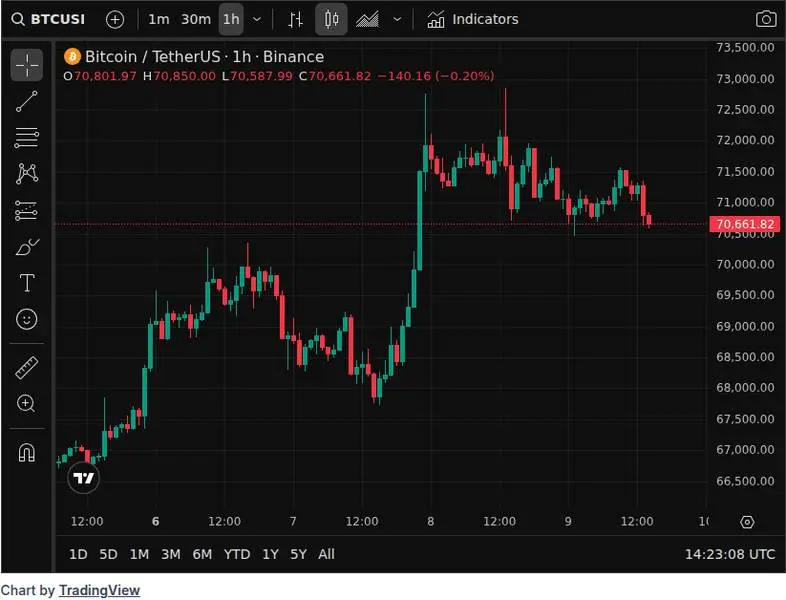
The broader market context adds color to the win. Bitcoin’s Fear & Greed Index sits at 14, deep in “Extreme Fear” territory, with BTC down roughly 1.1% over the past 24 hours. The timing suggests the miner’s $75-to-$222K windfall arrived during one of the more cautious stretches in recent market sentiment, a period where some analysts see a BTC stress cycle approaching its end.
How Rare Is This? The Odds for a 1 PH/s Solo Miner
Bitcoin block discovery is a probabilistic race. Every 10 minutes on average, the network’s combined hashrate competes to find a valid block hash. A miner’s chance of winning any given block is proportional to the share of total network hashpower they control.
At 1 PH/s, the solo miner held a tiny fraction of Bitcoin’s total network hashrate, which currently exceeds 800 EH/s. Decrypt reported that SoloChance-based estimates placed the odds of this setup solving a block at roughly 1 in 1.1 million blocks, equivalent to about 21 years of continuous mining at that capacity.
To put that in perspective, 1.1 million blocks at 10-minute intervals spans roughly two decades. The miner did not need to wait that long. Probability does not guarantee timing; it only describes long-run averages. A single block solve can happen on the first attempt or never.
Luck vs. Expected Value
This distinction matters. The miner’s expected return over any reasonable time horizon at 1 PH/s is deeply negative. The cost of renting hashpower would overwhelm the vanishingly small probability-weighted reward. But probability distributions have tails, and this miner landed squarely in the profitable one.
The $75 input versus the $222,012 output represents a return of roughly 296,000%. That ratio is why the story went viral, but it is important to recognize this as an extreme outlier rather than a repeatable strategy. Much like broader crypto market opportunities, the variance cuts both ways.
ON-CHAIN DATA
- Transaction hash: 8cc015e3…3ef75898
- Block: 938,092
- Reward: 3.12786082 BTC (312,786,082 sats)
- Mining setup: 1 PH/s rented via Braiins/CKPool
- Cost: 119,000 sats (~$75)
Solo vs. Pool: What Small Miners Should Consider
Pool mining exists precisely because of the variance problem this story illustrates. In a mining pool, participants combine hashpower and split block rewards proportionally. Payouts are smaller but predictable, smoothing out the lottery-like distribution of solo mining.
A miner contributing 1 PH/s to a pool would earn a tiny, steady trickle of sats, proportional to their share of the pool’s total hashrate. Over 21 years, their cumulative earnings would approximate one full block reward. The pool model trades away the jackpot upside for cash flow stability.
Decision Factors for Small-Scale Miners
Risk tolerance is the primary variable. Solo mining is rational only for operators who can afford to lose their entire hashrate rental cost with near-certainty. The expected value is negative for small miners on any reasonable time horizon.
Operating costs matter too. Renting 1 PH/s for $75 is a low absolute bet, which is partly why this story resonates. The miner risked pocket change. For miners running physical hardware with electricity bills, the calculus is harsher; ongoing costs accumulate whether blocks arrive or not.
Time horizon is the third factor. Pool miners optimize for monthly or weekly returns. Solo miners are implicitly betting on an indefinite timeline. For those watching exchange activity and market structure shifts on platforms like Binance, the predictability of pooled income often outweighs the fantasy of a solo win.
Block 938,092 will remain a compelling data point for the solo mining community. But the miner’s $75-to-$222K outcome was a statistical anomaly, not a blueprint. For every solo miner who hits a block, thousands more spend their sats and walk away with nothing.
Disclaimer: This article is for informational purposes only and does not constitute financial or investment advice. Cryptocurrency and digital asset markets carry significant risk. Always do your own research before making decisions.
Tracks corporations, public companies, and funds using Bitcoin as a treasury reserve or strategic balance-sheet asset.
Tracks tokenized stocks, real-world asset rails, issuer expansion, and the market structure behind on-chain financial products.


