
President Donald Trump announced on April 12, 2026 that the U.S. Navy would blockade ships entering and leaving the Strait of Hormuz after negotiations with Iran collapsed in Pakistan. Bitcoin fell 3.1% over 24 hours to $70,765 as the Fear & Greed Index dropped to 16, its lowest reading in months, signaling extreme fear across crypto markets.
What Is Confirmed About Trump’s Strait of Hormuz Blockade Order
Trump’s announcement came after face-to-face talks in Islamabad that lasted 21 hours before collapsing, with the president stating Tehran refused to abandon its nuclear ambitions. He said the Navy would interdict ships that had paid tolls to Iran and would destroy mines in the strait.
AP reported that U.S. Central Command said the blockade of Iranian ports would begin Monday at 10 a.m. EDT. Ships traveling between non-Iranian ports would still be allowed to transit the strait.
CENTCOM had already been preparing the operational ground. On April 11, the command confirmed that two U.S. Navy guided-missile destroyers had transited the Strait of Hormuz as part of a mission to clear mines previously laid by Iran’s Islamic Revolutionary Guards Corps.
Open Questions Around Enforcement
Trump claimed other countries would participate in the blockade. However, according to CBS News reporting, a U.K. source said Britain would not join the operation. No publicly documented legal order for the blockade was located in official repositories at the time of writing.
Trump also stated that any vessel that paid Iran’s toll would be denied safe passage, but the specific operational rules of engagement for that enforcement have not been confirmed through official military channels.
Why the Strait of Hormuz Matters for Oil, Inflation, and Global Markets
The Strait of Hormuz carried 20% of global oil shipping before the fighting. A military blockade of this chokepoint directly threatens the physical flow of crude to global buyers.
Markets reacted immediately. U.S. crude rose 8% to $104.24 a barrel after the blockade announcement, a sharp single-session move that reflects how seriously traders are pricing supply disruption risk.
How an Oil Shock Filters Into Broader Risk Sentiment
A sustained oil price spike feeds directly into inflation expectations. Higher energy costs raise input prices across the economy, which can force central banks to hold rates higher for longer. That tighter-for-longer outlook tends to push investors away from risk assets, including equities and crypto.
The 8% crude jump on a single announcement is a signal, not a forecast. But the direction of the pressure is clear: higher oil means tighter financial conditions, which historically correlates with risk-off positioning across speculative markets.
How Bitcoin and Crypto Sentiment Reacted to the Risk-Off Mood
Bitcoin was trading at $70,765 with a market cap of roughly $1.42 trillion at the time of the snapshot. The 3.1% decline over 24 hours came alongside elevated trading volume of $29.6 billion.
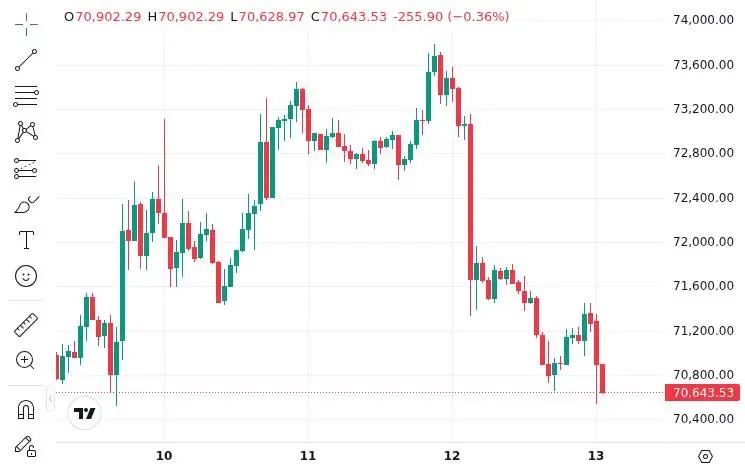
The Fear & Greed Index printed 16, classified as Extreme Fear. That reading suggests broad crypto market participants are positioned defensively, with sentiment well below the neutral 50 mark.
What Traders Should Watch Next
The blockade is scheduled to begin Monday at 10 a.m. EDT. If it proceeds as announced, traders should watch for a second leg of crude price movement and whether Bitcoin’s correlation with macro risk assets tightens further.
The combination of a geopolitical escalation, an oil supply shock, and an Extreme Fear reading at 16 marks a concrete cluster of risk signals. Whether the blockade holds, expands, or gets walked back through diplomacy will likely set the direction for crypto risk appetite in the days ahead.
Disclaimer: This article is for informational purposes only and does not constitute financial or investment advice. Cryptocurrency and digital asset markets carry significant risk. Always do your own research before making decisions.


