American Bitcoin Deploys Nearly 11,300 New Mining Rigs
American Bitcoin BTC +0.00% has completed the deployment of nearly 11,300 new mining rigs at its Drumheller site, adding roughly 3.05 exahashes per second to its operational fleet in one of the company’s largest single expansions to date.
The company said on April 22, 2026 that it finished energizing approximately 11,298 ASIC miners at the Drumheller facility. The newly activated machines operate at approximately 13.5 joules per terahash, making them among the more efficient units in the company’s fleet.
ASIC miners are purpose-built computers designed solely to process Bitcoin transactions and earn block rewards. A deployment of this size signals a deliberate push to capture a larger share of Bitcoin’s mining output.
Why the 11,300-Rig Figure Stands Out
The deployment completed a purchase first announced on March 3, 2026, when American Bitcoin said it had acquired the same 11,298 units for delivery to Drumheller. Turning a five-figure hardware order into an operational fleet in under two months reflects execution speed that matters in an industry where mining difficulty adjusts roughly every two weeks.
Following the energization, American Bitcoin’s owned fleet now totals approximately 89,242 miners producing roughly 28.1 EH/s at an average efficiency of approximately 16.0 J/TH. However, the company draws a distinction between owned and operational hardware.
Its operational fleet, the subset of machines actually hashing, stands at approximately 58,999 miners generating about 25.0 EH/s at 14.1 J/TH. That gap of roughly 30,000 miners between owned and operational capacity suggests additional rigs are staged, undergoing maintenance, or awaiting power infrastructure.
Cointelegraph independently confirmed the April 22 deployment and the post-energization fleet total of about 28.1 EH/s of computing power.
What More Rigs Mean for Output and Efficiency
Adding 3.05 EH/s represents roughly a 12% increase to the company’s operational hashrate. In practical terms, more hashrate means a proportionally larger probability of mining Bitcoin blocks, though actual output depends on network-wide difficulty and competing miners.
The new rigs run at 13.5 J/TH, which is meaningfully better than the fleet-wide average of 16.0 J/TH across all owned machines. Each batch of more efficient hardware pulls the overall average down, reducing the energy cost per bitcoin mined.
American Bitcoin reported in its fourth-quarter 2025 results that it mined Bitcoin at a 53% discount to spot prices during that period, with an installed capacity of approximately 25.0 EH/s across roughly 78,000 ASICs as of December 31, 2025. The latest expansion pushes total ownership well past that baseline.
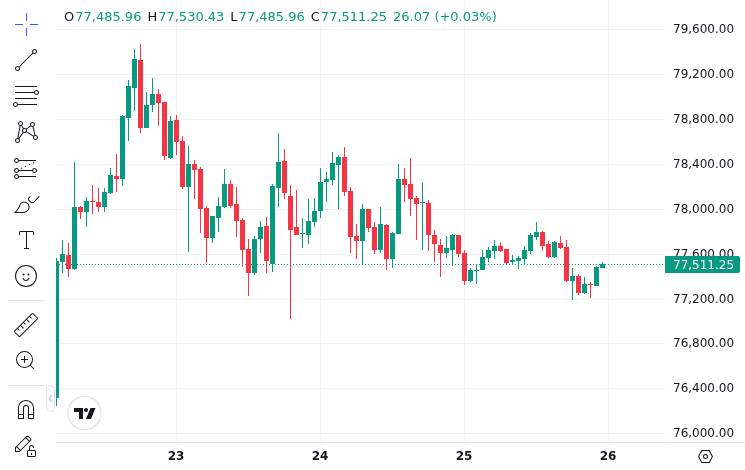
Bitcoin traded near $77,513 at the time of the announcement, with a market capitalization of approximately $1.55 trillion.
What This Expansion Could Signal for the Wider Bitcoin Sector
Large-scale mining fleet growth typically reflects confidence in long-term Bitcoin economics. Committing capital to thousands of machines that take months to reach payback only makes sense if the operator expects favorable price-to-difficulty ratios over an extended horizon.
American Bitcoin’s expansion comes at a time when the crypto Fear and Greed Index sits at 31, firmly in “Fear” territory. Deploying hardware during cautious market sentiment can position a miner to benefit disproportionately if conditions improve, a pattern familiar to observers who have tracked previous bull-run cycles in the sector.
The owned-versus-operational fleet split also hints at a staged rollout strategy. With roughly 30,000 miners owned but not yet online, American Bitcoin appears to have additional capacity it can activate as power and infrastructure allow, without needing new hardware purchases.
Mining fleet growth at this scale feeds into the broader question of how concentrated Bitcoin’s hashrate is becoming among publicly traded operators. As companies like American Bitcoin add exahashes, smaller miners face tighter margins, a dynamic that parallels the concentration trends visible in other parts of the crypto infrastructure market.
Why Mining Fleet Growth Draws Investor Attention
For market watchers, the distinction between owned and operational capacity is the detail competitors have largely missed. Most coverage highlighted the 11,298 figure and the 28.1 EH/s total. The operational reality of 58,999 machines actually running at 25.0 EH/s paints a more nuanced picture of where the company stands today versus where it is headed.
The deployment also validates the March 3 acquisition timeline. Announcing a purchase is one thing; completing energization at a named facility within weeks is a concrete operational milestone that investors can track against future disclosures.
Broader crypto infrastructure developments, from protocol-level recovery efforts to mining fleet buildouts, continue to shape how institutional capital evaluates the sector. Fleet-scale expansions like this one will likely remain a key metric for evaluating which operators are positioning for sustained competitiveness.
Disclaimer: This article is for informational purposes only and does not constitute financial or investment advice. Cryptocurrency and digital asset markets carry significant risk. Always do your own research before making decisions.