
Hibachi is a notable perpetual exchange if you want to access FX with stablecoins through an order book instead of trading only familiar crypto pairs. When I opened the interface on October 28, 2026, I could view EUR/USD and other pairs, charts, bid/ask quotes, and market depth without signing in; its clearest strength is the way it places FX data inside a familiar trading screen.
This review covers the live product, market selection, order-book reading, order types, fees, vaults, and the risks to consider before depositing assets. Hibachi currently offers FX perpetual contracts rather than spot foreign-exchange conversion, so the assessment focuses on the platform’s practical trading experience and on what public data still cannot confirm about execution or withdrawals.
What Is Hibachi?
Hibachi presents itself as a stablecoin-based FX exchange with a central limit order book (CLOB). According to the project’s description, orders are matched off-chain to reduce latency, while asset movement through the settlement layer is verified with zero-knowledge proofs. The design targets traders who want the speed of a centralized exchange while retaining a verification mechanism at settlement.
That is an architectural description, not independent proof of speed, privacy, or safety. The Hibachi homepage lists FX perpetuals as available, while FX spot, multiple collateral assets, and institutional connections remain on the roadmap. The exchange should therefore be judged on functions that are usable now rather than on features planned for later.
The market selector shows that Hibachi is not limited to FX: alongside EUR/USD, GBP/USD, AUD/USD, JPY/USD, CAD/USD, NZD/USD, and XAG/USD, it has a crypto tab with BTC, ETH, SOL, HYPE, SUI, BNB, XRP, and PAXG. Grouping pairs makes the list easier to scan, while the market list and leverage limits remain time-sensitive data.
Hibachi’s Standout Features
- Stablecoin-settled FX perpetuals: Hibachi focuses on FX contracts in an order-book environment, allowing traders to take a view on exchange-rate movements without holding the underlying currency. It remains a margined, funding-bearing derivative product; FX spot is a roadmap item rather than a current feature.
- Public market data before sign-in: The trading screen exposes TradingView charts, bid/ask quotes, spread, funding, volume, and open interest. That lets a new user inspect pairs before creating an account, although a snapshot cannot replace checking depth for a specific order size.
- A broad order toolkit: The trading documentation lists Market, Limit, Stop-Market, Stop-Limit, TWAP, and TP/SL orders. These controls help manage entries and exits, but conditional orders can still fill partially or remain unfilled during a fast move.
- Separate asset-group accounts: The FX subaccount rules keep FX positions separate from crypto positions. That can make risk management clearer, but traders still need to understand cross-margin inside each account.
- Options beyond self-directed trading: Curator-managed vaults, a leaderboard, and a referral program extend the product beyond order entry. Vaults can have their own fees, deposit limits, and withdrawal windows; displayed returns are not a promise of future performance.
Public Trading Experience
Market Selection: A Clear FX Focus
When I clicked a pair name on the trading page, a selector opened with a search box, FX/Crypto tabs, and All, Majors, EM, Commodities filters for FX. Each row placed price, 24-hour change, spread, funding, volume, and open interest side by side. This made it easy to compare pairs without opening several pages.
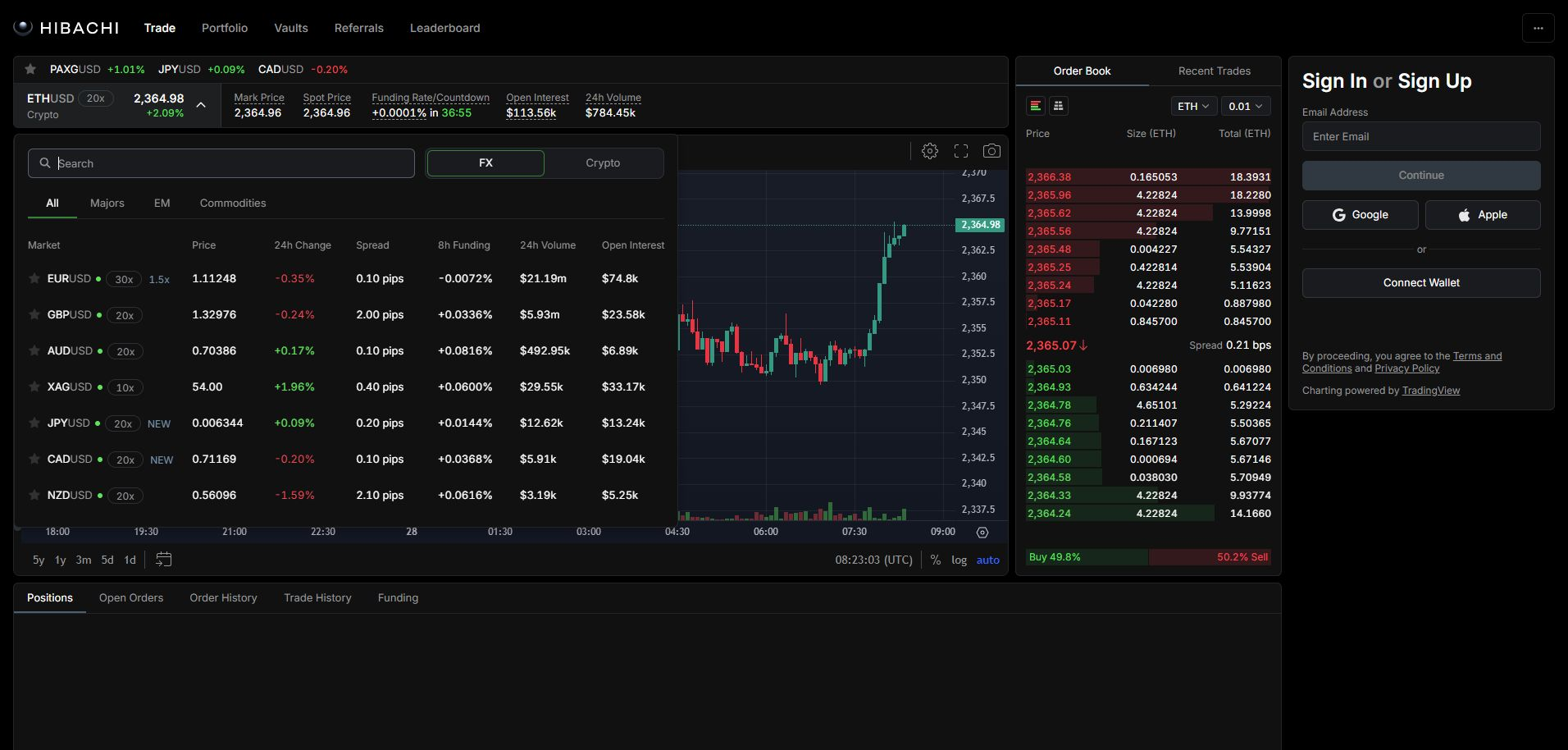
The capture showed roughly $21.19 million in 24-hour volume for EUR/USD and about $3,190 for NZD/USD. That is not enough to measure execution quality for every order size, but it is a signal to inspect depth before opening a position. Spread and volume change continuously, so one image cannot guarantee a large order will fill at its quoted level.
This liquidity snapshot was recorded during the October 28, 2026 observation: EUR/USD showed approximately $21.19 million in 24-hour volume, while NZD/USD showed approximately $3,190. It is a point-in-time reference rather than a live-stat feed. Readers should treat it as a prompt to inspect depth again immediately before placing an order.
Charts, Order Book, and Recent Trades
Selecting EUR/USD returned me to the trading screen with an FX, up to 30x label. The chart panel included mark price, spot price, funding, open interest, and 24-hour volume. TradingView supplied timeframes, indicators, and a screenshot button, making the interface familiar to crypto derivatives users.
The EUR/USD order book displayed bid/ask levels, cumulative depth, and a pip spread. At capture, the spread was 0.1 pip, but it changes continuously and is not a fixed trading cost. I also opened Recent Trades to read the latest prices, times, and trade sizes; this confirms a functioning market display, not that my own order would receive good execution.
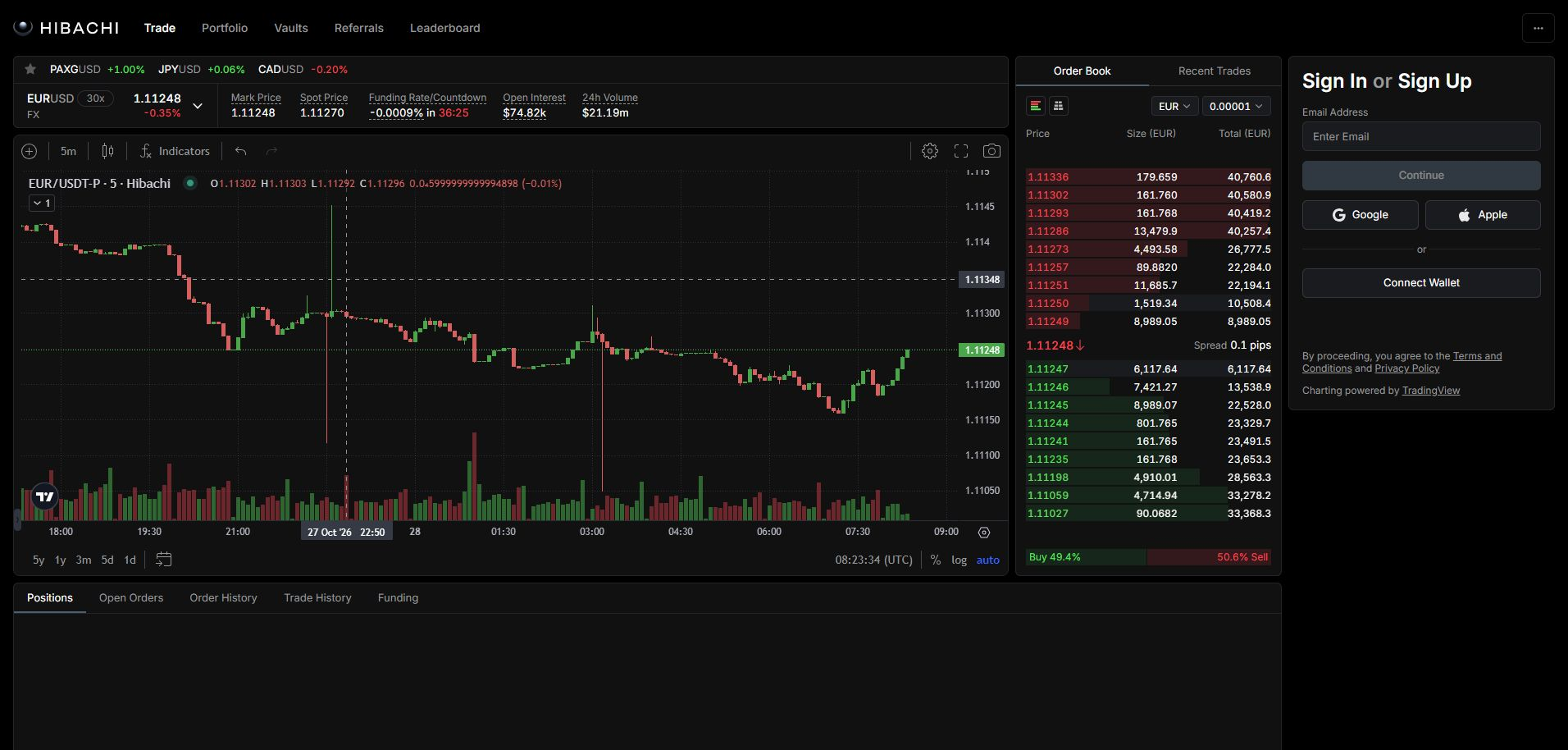
The limit of the public session appeared in the right-hand panel: the order form was replaced with sign-in choices through email, Google, Apple, or a wallet. Selecting Connect Wallet moved to a WalletConnect step and showed a note about RFC 6979 deterministic signing. The supported-wallet documentation warns that an incompatible wallet can create access problems before a deposit.
Portfolio includes Equity, Volume, PnL, and Liquidation Risk fields, but it does not show personal figures before sign-in. The public session therefore proves data presentation rather than a completed account workflow. Slippage, fill speed, withdrawal handling, and support quality still require a separate controlled test with a live account.
Trading Fees and Real-World Cost
The official fee schedule uses perpetual volume over the previous 14 days. At the first tier, maker fees are 0% and taker fees are 0.045%; the published lowest taker tier is 0.020% above $500 million in volume. Fees are paid in USDT, while subaccount fee tiers are calculated with the main account.
For a $10,000 notional taker order at the first tier, the entry fee is approximately 4.50 USDT. If both entry and exit remove liquidity, trading fees alone are about 9 USDT, before spread, funding, and slippage. This is a fee-schedule calculation rather than an invoice from a completed fill.
The 0% maker rate benefits traders willing to leave resting orders, but it does not guarantee a fill. The order-type documentation covers Market, Limit, Stop-Market, Stop-Limit, TWAP, and TP/SL. An activated TP/SL creates a limit order, so it can still fill partially or remain unfilled during a fast move.
In addition to execution fees, crypto-perpetual funding is settled hourly and can be paid or received depending on the side of the position. Holding a position is therefore different from opening and closing immediately. One funding reading cannot predict future funding, especially when market positioning changes quickly. A short holding-period calculation should be separated from any multi-day estimate.
Risks That Are Easy to Miss Behind a Polished Interface
- Leverage and cross-margin. The capture shows up to 30x on EUR/USD. Under the cross-margin rules, positions in one account share collateral; FX accounts are separated from crypto, but isolated exposure still requires careful subaccount organization.
- FX trading hours. The homepage refers to continuous settlement, while the FX rules specify 24/5 trading, closing from Friday at 17:00 ET until Sunday at 17:00 ET.
- Inconsistent deposit and withdrawal guidance. The sign-up page mentions USDT on Arbitrum and USDC on Base or Arc; the FAQ lists only Base and Arbitrum, while the withdrawal guide describes an Arbitrum address. Confirm the network and asset on the live account screen.
- Architecture still needs independent verification. Hibachi describes zero-knowledge verification and lists two audits. The original reports and smart-contract behavior were not independently reviewed here, so these claims are not a guarantee of capital safety.
- Regional access. The Hibachi terms restrict users in the United States, the United Kingdom, and other listed regions, and prohibit using a VPN to bypass the rules.
Vaults and Leaderboard: More Depth, Not a Substitute for Risk Analysis
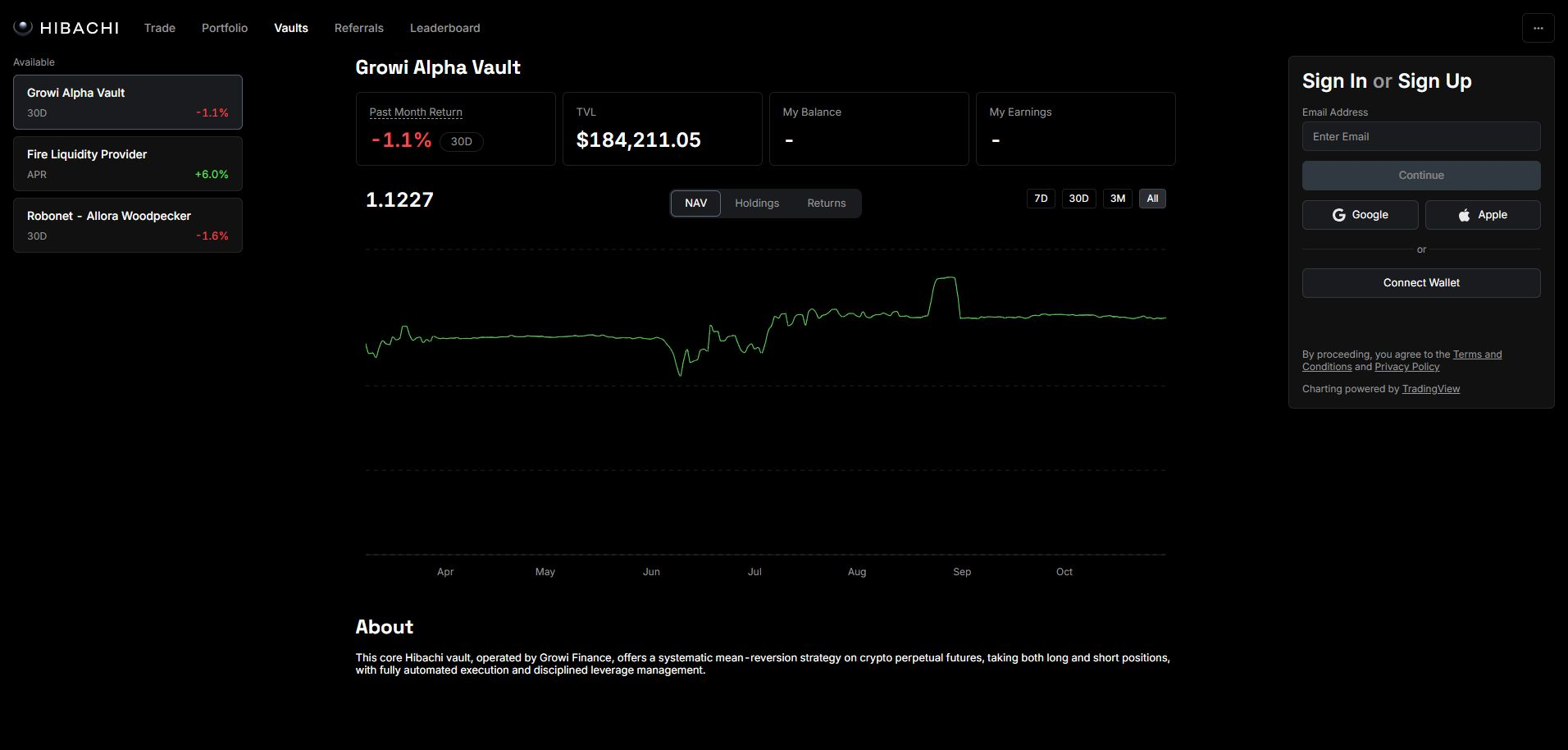
The Vaults page showed Growi Alpha Vault, Fire Liquidity Provider, and Robonet – Allora Woodpecker. The capture recorded 30-day returns of -1.1% for Growi and -1.6% for Robonet, while Fire showed +6.0% APR. These figures use different periods and methods, so Fire cannot be ranked higher simply by comparing the percentages.
According to the vault documentation, assets are managed by curators and each vault can have its own performance fee, deposit cap, or withdrawal delay. Fire Liquidity Provider also has capital-allocation rules. Showing negative returns is useful for transparency, but past results do not guarantee that a later deposit will profit.
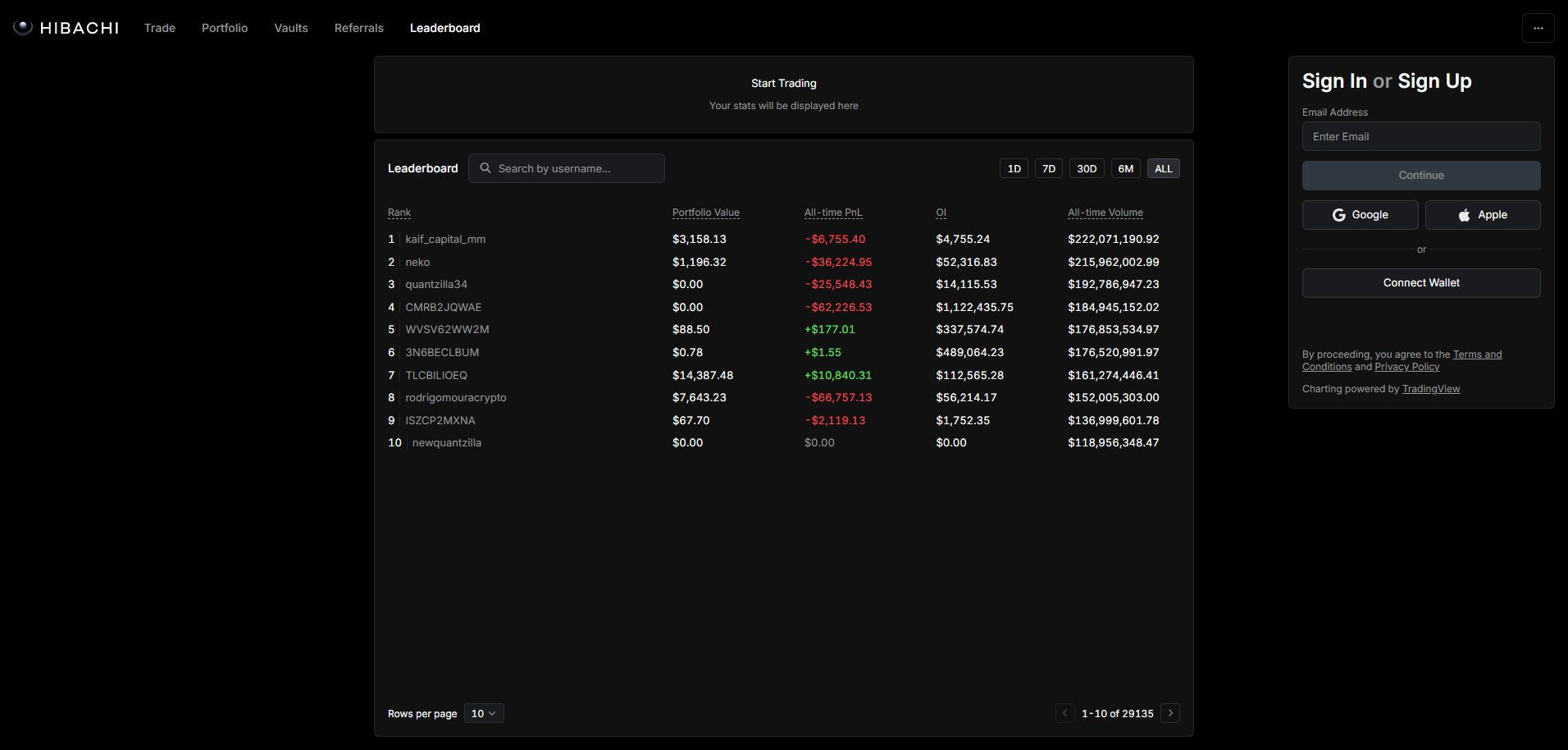
The Leaderboard can be filtered by 1D, 7D, 30D, 6M, or all time, while portfolio value, PnL, open interest, and volume appear side by side. In the capture, very high volume appeared alongside negative PnL in the top row; the leaderboard is activity data, not a list of strategies to copy. The combination is useful for spotting how volume and outcomes can diverge, but it says nothing about a trader’s future risk-adjusted return.
Who Is Hibachi For?
Hibachi suits traders who want to read an FX order book, pip spread, and funding data before deciding whether to trade a stablecoin-settled perpetual. It also fits users who want to inspect the market before signing in or manage FX and crypto exposure in separate account groups. The public screen gives this audience a useful first filter before they commit wallet access or collateral.
Hibachi is less suitable for anyone who needs EUR/USD spot conversion, weekend FX trading, a broad list of small altcoins, or already-tested evidence of execution and withdrawals. Beginners who are not comfortable with leverage, funding, cross-margin, and self-custody should start by observing public data rather than depositing immediately.
A Safer Way to Get Started
- Choose the pair before depositing: Open the market selector and start with EUR/USD or a pair that has visible volume and order-book depth.
- Read the spread and depth: Check bid/ask, pip spread, nearby liquidity levels, and Recent Trades. Compare the intended order size with the depth displayed.
- Check funding and trading hours: Record the current funding rate, the next payment time, and the 24/5 schedule. One funding reading is not a fixed cost for the entire position.
- Reduce leverage for a first test: EUR/USD displays up to 30x, but the maximum is not a sensible default. Cross-margin can make several positions share collateral.
- Confirm the deposit network and token: Compare the live deposit screen with the sign-up documentation and FAQ, because the pages are not completely aligned on Base, Arbitrum, and Arc.
- Check regional eligibility: Read the Hibachi terms before connecting a wallet; do not use a VPN to bypass geographic restrictions.
Hibachi Compared With Other Platforms
| Criterion | Hibachi | Ostium | Hyperliquid |
|---|---|---|---|
| Product focus | Stablecoin FX perpetuals, plus crypto and vaults; FX spot remains on the roadmap | Global forex, equities, indices, commodities, and crypto | Fully on-chain spot and perpetual order books on HyperCore |
| Published operating model | CLOB, off-chain matching, settlement verified with proofs | USDC-settled on-chain trading using market-data partners | Orders, cancellations, trades, and liquidations recorded on-chain |
| Main attraction | FX screen with order-book depth, pip spreads, and clear pair grouping | Broader traditional-asset coverage | On-chain visibility of order and market state |
| Main trade-off | Execution and withdrawals were not verified in the public session; deposit guidance is inconsistent | Pricing and risk model differ from a CLOB | On-chain model differs from Hibachi’s stated privacy and settlement goal |
Hibachi’s clearest differentiator is the FX order-book experience: users can see bid/ask, pip spread, and depth before placing an order. Ostium covers more traditional asset classes, while Hyperliquid puts order and market state on-chain. These are product-model differences, not proof that one venue will execute better in every situation.
Cost Reference for the Same Pair and Size
The table below uses EUR/USD, $10,000 notional, one open and one close, using the Hibachi snapshot from October 28, 2026 and current Ostium fee documentation. It compares listed costs before spread, funding, or rollover; it does not prove identical execution. The purpose is to put each venue’s published charging model on the same notional so that the missing variables remain visible.
| Platform | Cost for $10,000 notional | Components not included |
|---|---|---|
| Hibachi | About $9 if both entry and exit are first-tier taker trades at 0.045%; the capture showed a 0.1-pip spread | Hourly funding, changing spread, and slippage |
| Ostium | $3 opening fee for EUR/USD under the fee documentation; the $0.10 oracle fee on opening is charged, while the oracle fee on a successful full close is refunded | Bid/ask spread, continuous rollover, and early-close conditions |
| Hyperliquid | No valid comparable figure in this table | An equivalent EUR/USD market was not confirmed, so BTC/USD is not used as a substitute |
Ostium lists EUR/USD with a 3 bps opening fee in its market reference, while its fee documentation explains that rollover differs from the funding model used by many crypto-perpetual venues. The listed commission alone cannot establish which platform is cheaper; a fair test would capture bid/ask at the same time, use the same notional, and include holding cost.
Conclusion
Hibachi is worth watching for traders who want stablecoin-based FX perpetuals through an order book. The market selector, spread, funding, open-interest data, and EUR/USD screen show a functioning product rather than a concept page. Vaults and the leaderboard add depth, but the strongest part of this review is the ability to read an FX market inside a familiar trading interface.
The limits are equally clear: before sign-in, the session did not establish a completed order form, a real paid fee, an actual fill, or a withdrawal path, and the network guidance is not fully consistent. Anyone trying Hibachi should confirm regional access, deposit asset, network, and position size first. If Hibachi clarifies those documents and demonstrates execution quality, its FX experience will become more convincing.
FAQ
Does Hibachi offer EUR/USD spot trading?
According to the Hibachi homepage, FX perpetuals are available while FX spot remains on the roadmap. Opening EUR/USD exposure gives exposure to exchange-rate movement; it does not mean the account receives EUR or USD for transfer. A perpetual position is subject to margin and funding rules, so it is a derivative rather than a normal currency exchange.
What are Hibachi’s trading fees?
The fee schedule starts at 0% maker and 0.045% taker, with lower taker tiers based on 14-day volume. A $10,000 first-tier taker order costs about $4.50 in one direction. Total cost also depends on spread, funding, and execution price; a 0% maker fee does not guarantee a fill. Traders should therefore compare the final fill and holding cost rather than quote the headline commission alone.
Can I trade FX on weekends?
No. The FX documentation says that pairs trade 24/5 and stop from Friday at 17:00 ET until Sunday at 17:00 ET. Continuous stablecoin settlement does not make FX order matching 24/7. Anyone holding a position across the weekend should account for the closure and reopening risk.
How does Hibachi handle sign-in and deposits?
The interface offers email, Google, Apple, or WalletConnect sign-in. The sign-up documentation lists USDT on Arbitrum and USDC on Base or Arc, while the official FAQ is not fully aligned on Arc. Check the token and network shown on the live deposit screen before transferring funds, and make a small test transfer only after the account confirms the destination details.
Are Hibachi vault returns guaranteed?
No. The vault documentation identifies risks from trading, leverage, curator strategy, and withdrawal timing; past results do not guarantee future returns. In the interface capture, two vaults showed negative 30-day returns. Read the vault’s fees and withdrawal rules before depositing assets.

Disclaimer: This article is for informational purposes only and does not constitute financial or investment advice. Cryptocurrency and digital asset markets carry significant risk. Always do your own research before making decisions.