
infiniFi Review 2026: On-Chain Banking for Stablecoins, Complete Guide + Points Program and Q4 2026 TGE
A complete beginner-friendly review of infiniFi, the on-chain yield protocol bringing fractional reserve banking to DeFi. Learn how to deposit stablecoins, earn 8%+ APY via iUSD/siUSD/liUSD, and accumulate points for the confirmed Q4 2026 token launch.
infiniFi Review 2026: Complete Beginner's Guide: Earn 8%+ APY on Stablecoins + Points for the Q4 2026 Token Launch
Who this guide is for: Anyone who holds USDC or other stablecoins and wants to earn meaningfully higher interest than a bank or centralised exchange offers, and anyone who wants to position for infiniFi's confirmed Q4 2026 token launch. You do not need DeFi experience. If you have used a savings account with different notice periods for higher interest, you already understand the core idea.
Key news: infiniFi has confirmed a Q4 2026 Token Generation Event (TGE). The protocol currently runs a live points programme that is expected to influence token distribution. This makes October 2026 a particularly relevant time to participate.
We tested this on three real devices (screenshots throughout are taken live, not stock photos):
- Desktop, 1440px wide screen (Windows laptop / iMac)
- Tablet, iPad at 1024px
- Phone, iPhone 16 Pro Max at 430px
What Is infiniFi? (Plain English)
infiniFi is a stablecoin yield protocol that replicates the logic of fractional reserve banking, on-chain, transparently, without a central company controlling your funds.
Here is the core model in plain terms: You deposit USDC (or other stablecoins). infiniFi pools your deposit with others and deploys it across multiple DeFi yield strategies (Aave, Pendle, Ethena, and others). In exchange, you receive iUSD, a receipt token that represents your deposit. Depending on how long you are willing to lock your capital, you can earn from approximately 5% APY (no lock, liquid) up to notably higher yields (with a lock period).
The innovation is how risk is structured across depositor types. Just like a bank prioritises certain depositors differently, infiniFi has three tiers of deposit receipts, each with different yield, liquidity, and risk exposure:
- iUSD: No yield, maximum safety, fully liquid (the base layer)
- siUSD: Moderate yield, liquid (can exit at any time), shielded from losses
- liUSD: Highest yield, locked (you set your own duration), first-loss capital
In plain terms: infiniFi is like a high-yield savings account system where you choose between a regular account (liquid, lower interest), a notice account (liquid but a bit restricted, medium interest), and a fixed-term deposit (locked, highest interest). All three hold the same underlying USDC, only the access rules and risk ranking differ.
Key facts (29 October 2026):
- Platform URL: https://infinifi.xyz (app: https://app.infinifi.xyz)
- Chain: Ethereum (93.5%), Base, Monad
- Total Value Locked (TVL): approximately $65.2 million (rising +40.5% over past 30 days)
- ATH TVL: $190.49 million (January 7, 2026)
- Average APY across pools: 8.12%
- Yield sources: Aave, Pendle, Ethena, and other DeFi protocols
- Points programme: Live, earn points via staking, voting, and referrals
- Token status: TGE confirmed for Q4 2026
- Pre-seed investors: Electric Capital, New Form Capital, Axiom, DeFi Dad, Sam Kazemian
- Seed raise ($3M, September 23, 2026): Electric Capital, New Form Capital, Generative Ventures, Fasanara Capital
- Audits: Available in official docs; integrated with audited protocols (Aave, Pendle)
How infiniFi Looks on Your Device
On a Laptop or Desktop Computer (1440px wide)
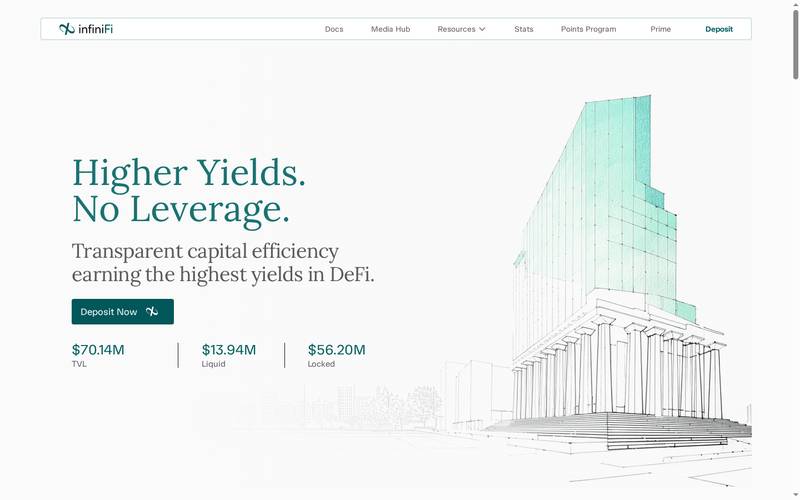
The infiniFi app on a 1440px desktop screen, showing the deposit panel, your iUSD/siUSD/liUSD balances, the points dashboard, and yield strategy breakdown.
Best for: Setting up deposits, choosing lock durations for liUSD, and monitoring your points. Recommended for initial setup.
On a Tablet: iPad (1024px wide)
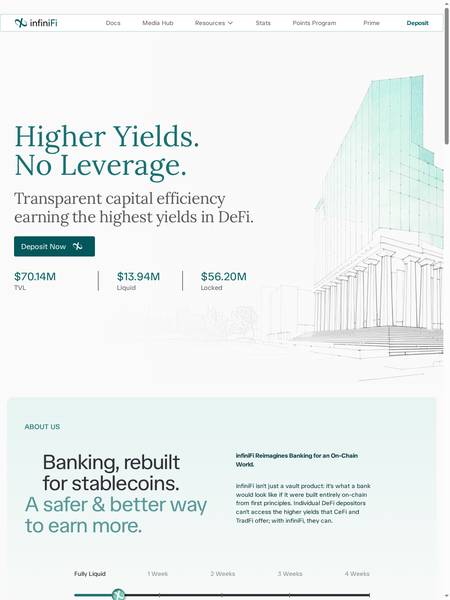
infiniFi on an iPad at 1024px. The three deposit tiers and your portfolio view adapt cleanly to the tablet layout.
Best for: Monitoring yields and points on the go.
On a Phone: iPhone 16 Pro Max (430px wide)
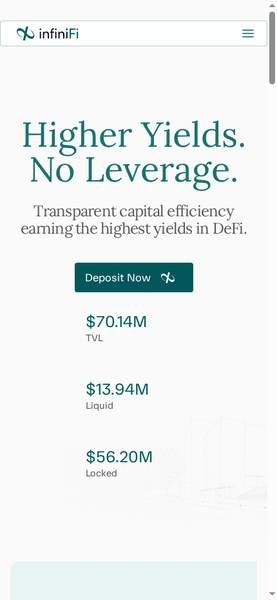
infiniFi on an iPhone 16 Pro Max at 430px. Deposit, lock, and points sections are accessible in a single-column scroll.
Best for: Checking your yield and points balance. For selecting a liUSD lock duration and reviewing yield strategy allocations, a desktop view provides more detail.
Core Products: The Three iUSD Tiers Explained
iUSD, The Base Receipt Token
When you deposit any amount of USDC (or supported stablecoins) into infiniFi, you receive iUSD. This is a standard ERC-20 token representing your claim on the protocol.
- Yield: None directly (iUSD does not earn yield by itself)
- Liquidity: Fully liquid, you can enter the redemption queue and exit with no lock up
- Risk position: Last loss, in the event of a loss in any underlying yield strategy, iUSD holders are the last to be affected (losses first hit liUSD, then siUSD holders)
- Use cases: You can use iUSD in DeFi protocols (Fluid, Curve, Balancer pools) to earn yield separately, or hold it as a safe on-chain dollar equivalent
siUSD, Staked iUSD (Liquid Yield)
Stake your iUSD to receive siUSD. This is the recommended option for most users, it earns yield while remaining liquid.
- Yield: A portion of all protocol yields, shared among siUSD holders, approximately 5-8% APY in current conditions
- Liquidity: Liquid, exit at any time without a mandatory lock period. If the protocol experiences temporary illiquidity, you can exit through secondary markets (Fluid, Curve, Balancer)
- Risk position: Shielded from losses as long as liUSD holders can absorb them
- Use cases: Competitive stablecoin yield without lock-up risk. Compare to Aave USDC supply rates (~3.8-5.2%), siUSD is designed to offer better net yields
liUSD, Locked iUSD (Maximum Yield)
Lock your iUSD for a chosen duration to receive liUSD. The longer the lock, the higher the yield premium.
- Yield: Highest yield in the system, directly proportional to lock duration. A 2-week lock earns more than a 1-week lock; an 8-week lock earns more than a 4-week lock
- Liquidity: Locked for your chosen duration. You trigger an "exit timer" when you want to start unlocking, then wait out the period you originally chose
- Risk position: First-loss capital, if any underlying yield strategy experiences a loss, liUSD holders are the first to absorb it before siUSD or iUSD are affected
- Use cases: Maximum stablecoin yield for capital you do not need for a defined period. Best for users who can commit funds with a specific time horizon
The "exit timer" system:
Rather than a traditional re-locking schedule (where you must actively lock each week), liUSD uses a perpetual lock with an exit timer. Your funds stay locked until you explicitly trigger the countdown. Once triggered, you wait out your chosen lock period, then withdraw. This prevents accidental expiry and ensures continuous yield without administrative overhead.
How infiniFi Generates Yield
infiniFi deploys deposited capital across multiple DeFi strategies, including:
- Aave, supplying stablecoins to earn lending yield
- Pendle, yield tokenization strategies for fixed and variable rate exposure
- Ethena, USDe-related yield strategies
- Additional protocols added and removed via governance
The protocol uses transparent fractional reserves, a portion of deposits is kept liquid for immediate withdrawals, while the rest is deployed for yield. The allocation between liquid and illiquid strategies is a key protocol parameter governed by the infiniFi team and eventually by token holders.
How 8%+ APY is achieved: By pooling deposits and deploying across multiple yield sources simultaneously, infiniFi can access yield opportunities that individual users could not access at the same efficiency or scale. The liUSD tier additionally benefits from priority access to the highest-yielding illiquid strategies, since those depositors have committed their capital for a fixed period.
How to Deposit and Start Earning (Step by Step)
What you need:
- A Web3 wallet (MetaMask, Coinbase Wallet, or similar) on Ethereum mainnet
- USDC or supported stablecoins (DAI, USDT may also be supported, check the app)
- A small amount of ETH for gas (Ethereum mainnet; consider using Base for lower fees)
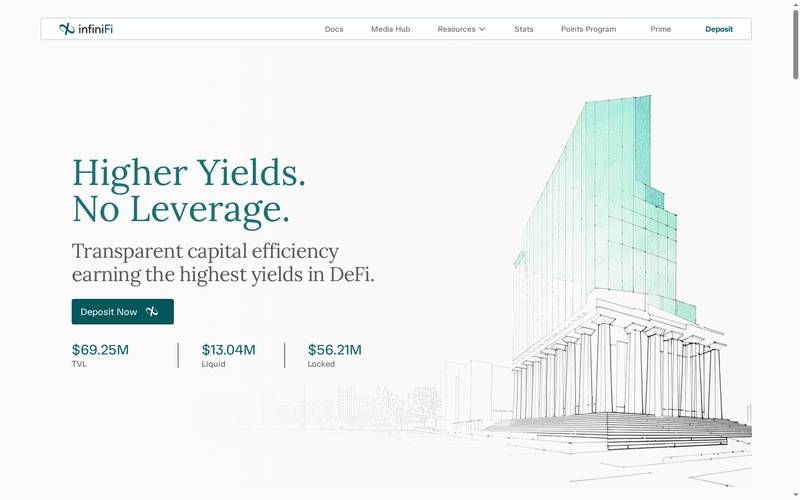
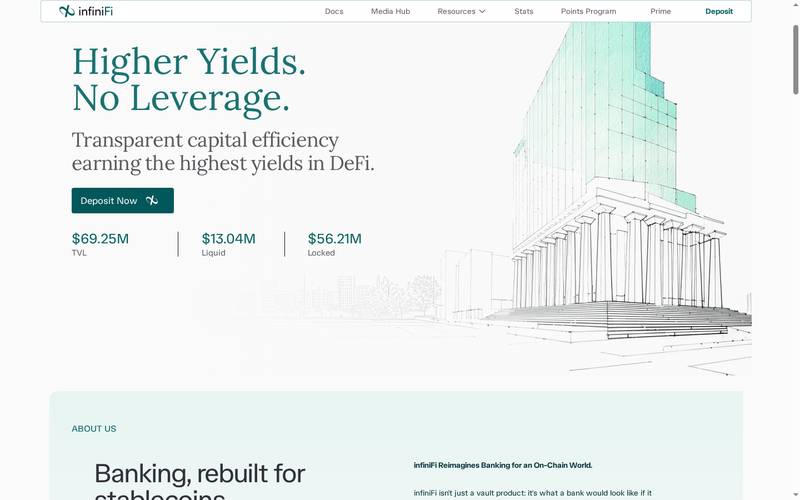
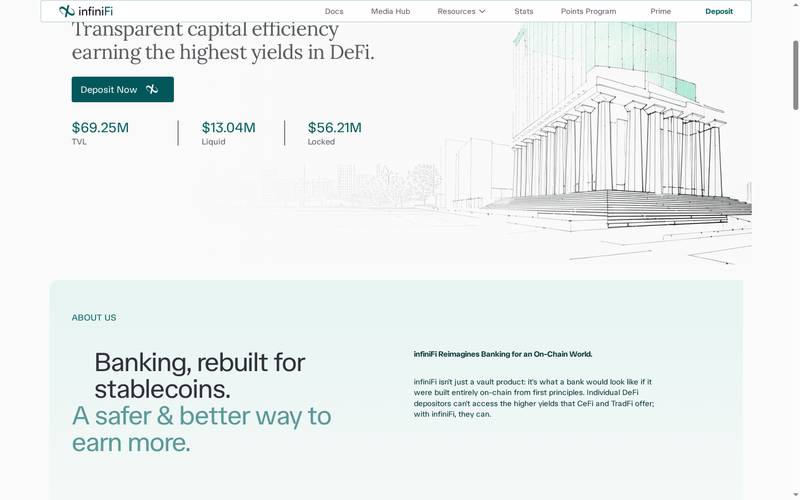
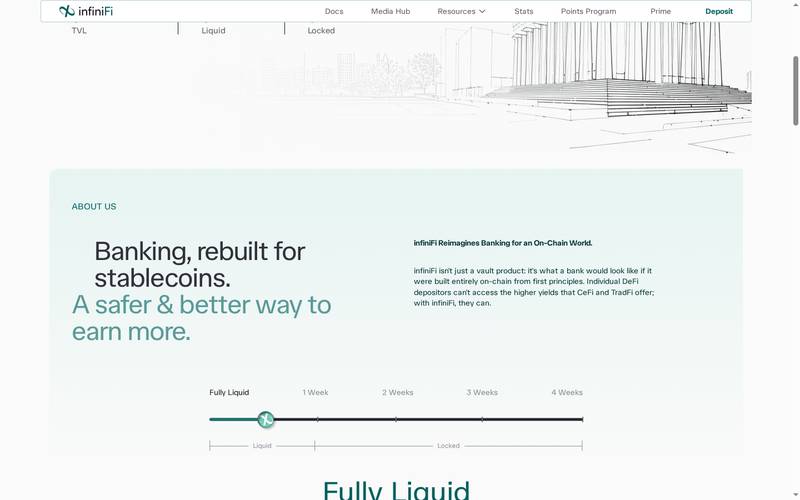
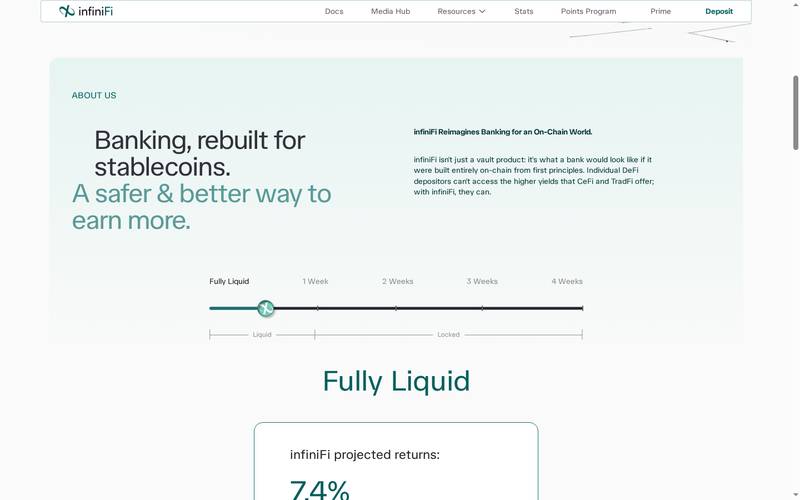
The infiniFi homepage, click Deposit to enter the yield optimisation app.
Step 1, Go to infiniFi and Connect Your Wallet
Go to https://app.infinifi.xyz. Click "Connect Wallet" and approve the connection. If you prefer lower gas costs, check whether the Base version of the app is available.
Connect your wallet and review the current APY before depositing.
Step 2, Deposit USDC and Receive iUSD
Navigate to the Deposit tab. Enter the amount of USDC you want to deposit. Click "Deposit" and confirm in your wallet. You receive iUSD at a 1:1 rate.
Select the deposit amount, infiniFi automatically routes to the highest-yielding strategy.
Step 3, Choose Your iUSD Tier
After receiving iUSD, decide which tier best suits your needs:
- Keep iUSD, if you want maximum safety and plan to use iUSD in secondary DeFi markets (Fluid, Curve, Balancer) independently
- Stake for siUSD, if you want liquid yield without any lock-up commitment. Navigate to the Stake section and convert iUSD -> siUSD
- Lock for liUSD, if you want the highest yield and can commit capital for a period. Navigate to the Lock section, choose your duration (1 week, 2 weeks, 4 weeks, 8 weeks, etc.), and convert iUSD -> liUSD
Approve the token and confirm the deposit transaction in MetaMask.
Step 4, Monitor Your Yield
Your siUSD or liUSD balance grows in real time as yield is distributed. Return to the app dashboard to see your current balance, accrued yield, and the underlying strategies your capital is deployed in.
Your position appears on the dashboard with real-time yield accumulation.
Step 5, Exit When Ready
- siUSD: Enter the redemption queue. Your USDC returns with no mandatory wait time under normal liquidity conditions.
- liUSD: Trigger the exit timer. Wait for your lock duration to count down, then withdraw.
In both cases, if there is a temporary liquidity squeeze, Fluid, Curve, and Balancer pools offer secondary market exit options at potentially slightly different prices.
infiniFi Points Programme: Q4 2026 TGE Positioning
infiniFi has confirmed a Q4 2026 Token Generation Event. The live points programme at https://app.infinifi.xyz/points is the primary mechanism through which early participants are expected to qualify for token distribution.
How to earn points:
- Staking (siUSD): Hold siUSD, the longer and larger, the more points
- Locking (liUSD): Lock iUSD, longer locks earn a larger points multiplier
- Voting: Participate in governance votes or signal preferences in the protocol
- Referrals: Refer new depositors using your unique referral link
Why this matters now: With the TGE confirmed for Q4 2026 and TVL recently turning around (+40.5% over 30 days), this is a time-sensitive window. Points programmes typically weight early participation heavily, and the current TVL ($65M) is well below the January 2026 peak ($190M), meaning fewer competitors for the same point pool.
Estimated points value: Historical prediction market estimates for infiniFi airdrop value have ranged from $2,000-$20,000 for users who held meaningful balances over multiple months before TGE. This is speculative, actual distribution depends on the protocol's tokenomics, which have not been fully disclosed.
Key Metrics
| Metric | Figure (October 2026) |
|---|---|
| Chain | Ethereum (93.5%), Base, Monad |
| Current TVL | ~$65.2M (Oct 17, 2026) |
| ATH TVL | $190.49M (Jan 7, 2026) |
| TVL trend (30 days) | +40.5%, recovering |
| Average APY | 8.12% |
| Active yield pools | 9 |
| 30-day protocol fees | $292K |
| Token status | TGE confirmed Q4 2026 |
| Seed funding | $3M (Sep 23, 2026) |
| Lead investor | Electric Capital |
| Chains | Ethereum, Base, Monad |
Connecting Your Wallet (Live Screenshot)
We opened infiniFi on 29 October 2026 and clicked "Connect Wallet" to test the connection flow live.
the infiniFi app interface: wallet connection unlocks your yield dashboard.
How to connect:
- Go to https://infinifi.xyz/app
- Click "Connect Wallet" (or "Connect" / "Sign In" depending on the site)
- Select MetaMask from the wallet picker
- In the MetaMask popup, click "Connect"
- Sign the message if prompted (confirms wallet ownership: no transaction authorised)
Once connected, the top-right corner shows your shortened wallet address and your balances appear in the interface.
Security: What You Need to Know
infiniFi has been audited and integrates with audited protocols (Aave, Pendle, Ethena). However, several risk factors deserve attention:
- Underlying protocol risk: infiniFi's yield comes from deploying capital in Aave, Pendle, Ethena, and other protocols. A failure or exploit in any of those protocols could trigger losses in infiniFi's pools. liUSD holders absorb these losses first.
- Liquidity risk: During periods of high withdrawal demand, redemptions may be delayed. liUSD holders face this most acutely, they must wait for their exit timer regardless. siUSD holders can use secondary markets as an alternative exit.
- Smart contract risk: infiniFi's own contracts carry their own risk surface. Review audit reports at the official documentation site before depositing large amounts.
- TVL decline risk: infiniFi's TVL has declined significantly from its January 2026 ATH ($190M -> $65M). A continued decline could compress yields as fewer depositors share the same fixed costs.
- TGE uncertainty: Even with a confirmed Q4 2026 TGE, the token distribution methodology, vesting schedules, and whether points are the primary allocation mechanism have not been fully disclosed.
- Front-end phishing: Only use https://app.infinifi.xyz, verify the URL before connecting.
infiniFi vs Competitors
| Feature | infiniFi | Aave (USDC supply) | Morpho (USDC vaults) | Spark / sDAI |
|---|---|---|---|---|
| Yield type | Variable + tiered (iUSD/siUSD/liUSD) | Variable | Variable via curators | Variable (DAI savings rate) |
| Average APY | 8.12% | 3.8-5.2% | 5-10%+ (varies by vault) | 4-6% |
| Lock option | Yes (liUSD, choose duration) | No | No (withdraw anytime) | No |
| Liquidity | Tiered (instant / queued / locked) | Instant | Instant | Instant |
| Risk isolation | Tiered (liUSD = first loss) | Pooled | Per market (Morpho Blue) | Protocol-level |
| Points / airdrop | Yes, confirmed Q4 2026 TGE | No | No | No |
| Protocol fee | ~10% of yield | ~13% of yield | 0% currently | Varies |
| Chains | Ethereum, Base, Monad | 23 chains | 45 chains | Ethereum mainly |
infiniFi's structural advantage is the tiered risk system, if you choose siUSD, your yield is protected by liUSD holders who have committed capital in exchange for higher yields. This is a novel risk tranching mechanism that doesn't exist in Aave or basic Morpho vaults.
Pros and Cons
Pros
- 8%+ average APY on stablecoins, beats most liquid stablecoin yield options
- Confirmed Q4 2026 TGE, live points programme is actively rewarding depositors
- TVL recovering (+40.5% in 30 days), momentum building into TGE
- Tiered risk system (iUSD/siUSD/liUSD), choose your own risk/yield tradeoff
- liUSD exit timer is more user-friendly than weekly re-locking systems
- Backed by Electric Capital, one of the most reputable DeFi investors
- Integrated with secondary liquidity on Fluid, Curve, Balancer for emergency exits
- Ethereum-native, audited, established infrastructure
Cons
- TVL is 66% below ATH, significant capital has exited since January 2026
- liUSD holders face first-loss risk from underlying DeFi protocol failures
- TGE tokenomics not fully disclosed, points allocation methodology uncertain
- Ethereum mainnet gas fees make small deposits ($100-$500) inefficient
- Protocol revenue ($722K annualised) is modest, sustainable only if TVL recovers
- Smart contract complexity of the fractional reserve model adds audit surface area
Verdict
Who infiniFi is for:
- Stablecoin holders who want 6-10% APY and are comfortable with moderate DeFi risk, siUSD compares favourably to Aave USDC rates.
- Capital-efficient DeFi users who want to choose their own lock duration for higher yield, liUSD's exit timer system is more flexible than traditional ve-locking.
- Airdrop hunters looking for a confirmed TGE with a live points programme, Q4 2026 means the window is narrow and now is the time.
- Ethereum DeFi users who want a yield product with clear risk tranching rather than opaque pooled exposure.
Who should look elsewhere:
- Users on L2s only (Arbitrum, Optimism) without Ethereum mainnet access, gas costs on mainnet make small deposits uneconomical.
- Yield maximisers who want the absolute highest APY regardless of risk, Pendle and Morpho's highest-yield isolated markets may offer higher rates for users who can actively manage their positions.
- Users who cannot tolerate any capital lockup risk, choose siUSD if you go with infiniFi; avoid liUSD entirely if you need instant access to all funds.
Rating: 3.9 / 5
infiniFi's fractional reserve banking model for DeFi stablecoins is genuinely innovative, the tiered iUSD/siUSD/liUSD structure is more sophisticated than simply pooling deposits. The Q4 2026 TGE with an active points programme makes the timing compelling. The TVL decline from ATH is the primary concern: at $65M and falling from $190M, the protocol needs to attract and retain capital at scale to prove the model is sustainable beyond the initial hype cycle. For users comfortable with moderate DeFi risk and a confirmed TGE around the corner, this is a low-friction, high-upside opportunity.
Quick Links
- Main app: https://app.infinifi.xyz
- Protocol information: https://infinifi.xyz
- Points programme: https://app.infinifi.xyz/points
- Official documentation: https://docs.infinifi.xyz
- Protocol data (DefiLlama): https://defillama.com/protocol/infinifi
- Secondary liquidity (iUSD/siUSD): Fluid, Curve, Balancer (check app for links)
Last verified: October 29, 2026. Data sourced from DefiLlama, infiniFi official documentation (docs.infinifi.xyz), IQ.wiki, Blockworks, and LinkedIn.