
Bitcoin treasury companies are rising because public companies can use BTC as a reserve asset and combine it with equity, debt or preferred financing. The model gives shareholders a listed route to Bitcoin exposure, but it also adds dilution, leverage, valuation and operating-business risk that direct BTC ownership does not have.
The impact is broader than any single purchase. Treasury companies can create new demand for Bitcoin, expand the market for BTC-linked securities and change how investors compare corporate balance sheets. The analysis below explains that growth first, then follows the risk path from the reserve to common shareholders.

Key Takeaways
- Bitcoin treasury companies turn BTC from a passive balance-sheet holding into an active capital-allocation strategy.
- Their growth expands access to Bitcoin-linked equities and financing, but it also creates dilution, leverage and valuation risk.
- Market impact depends on completed purchases and recurring capital allocation, not announcements alone.
- The most important shareholder test is BTC exposure per diluted share after debt, preferred claims and operating cash needs are included.
Drivers of Bitcoin Treasury Company Growth
Strategy’s 2020 treasury shift made Bitcoin a capital-allocation strategy for a public company rather than a niche corporate holding. The model became easier to copy as public markets offered more ways to raise common equity, convertible debt and preferred capital. The Bitcoin treasury companies ranking shows how the model now spans treasury-led issuers, operating companies and miners.
Several forces support the expansion:
- Public-market access: Investors can obtain BTC-linked exposure through a listed equity instead of holding coins directly.
- Capital-raising flexibility: Companies can use common shares, convertibles or preferred securities to fund purchases.
- Institutional familiarity: Custody, brokerage and reporting infrastructure make corporate ownership easier to evaluate.
- Strategic positioning: Some issuers use Bitcoin to differentiate their balance sheet, attract capital or support a broader digital-asset strategy.
The model is not uniform. A pure-play treasury company depends mainly on financing and BTC performance, while a miner or operating company must also fund power, payroll, product development or other business costs.
The expansion is not limited to the largest issuers. Smaller listed companies can add Bitcoin alongside an existing operating business, but that makes disclosure quality, liquidity and operating cash flow more important than the headline reserve.
Corporate Bitcoin Treasury Timeline
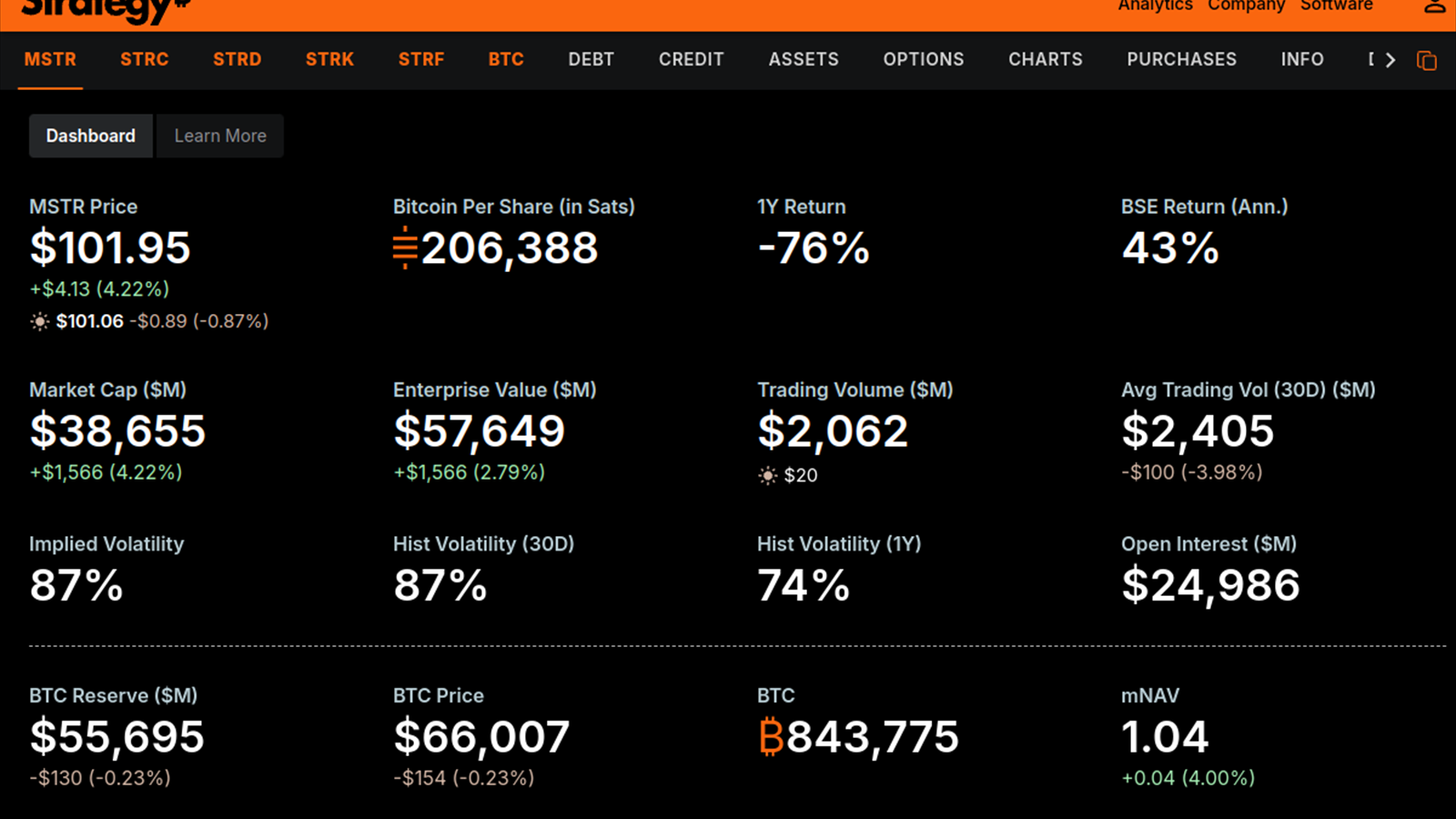
The rise is easier to measure through completed milestones than through announcement counts:
- August 10, 2020: Strategy’s purchase ledger records an initial acquisition of 21,454 BTC for $250 million. This made Bitcoin a stated treasury allocation for a public operating company rather than a one-off balance-sheet experiment. (Strategy purchase ledger)
- January 10-11, 2024: The SEC approved the listing and trading of spot Bitcoin ETP shares on January 10, and trading began on January 11. That created a liquid exchange-traded alternative for investors comparing treasury stocks with direct market exposure. (SEC statement)
- June 22, 2026: Strategy reported 847,363 BTC and a $1.4 billion USD reserve, showing how the model can scale through repeated capital-market transactions. (Strategy disclosure)
These milestones measure different things: the first is a treasury-policy change, the second is an access change for investors, and the third is a holdings-and-liquidity disclosure. They should not be added together as a single adoption statistic.
Adoption Snapshot With Evidence Dates
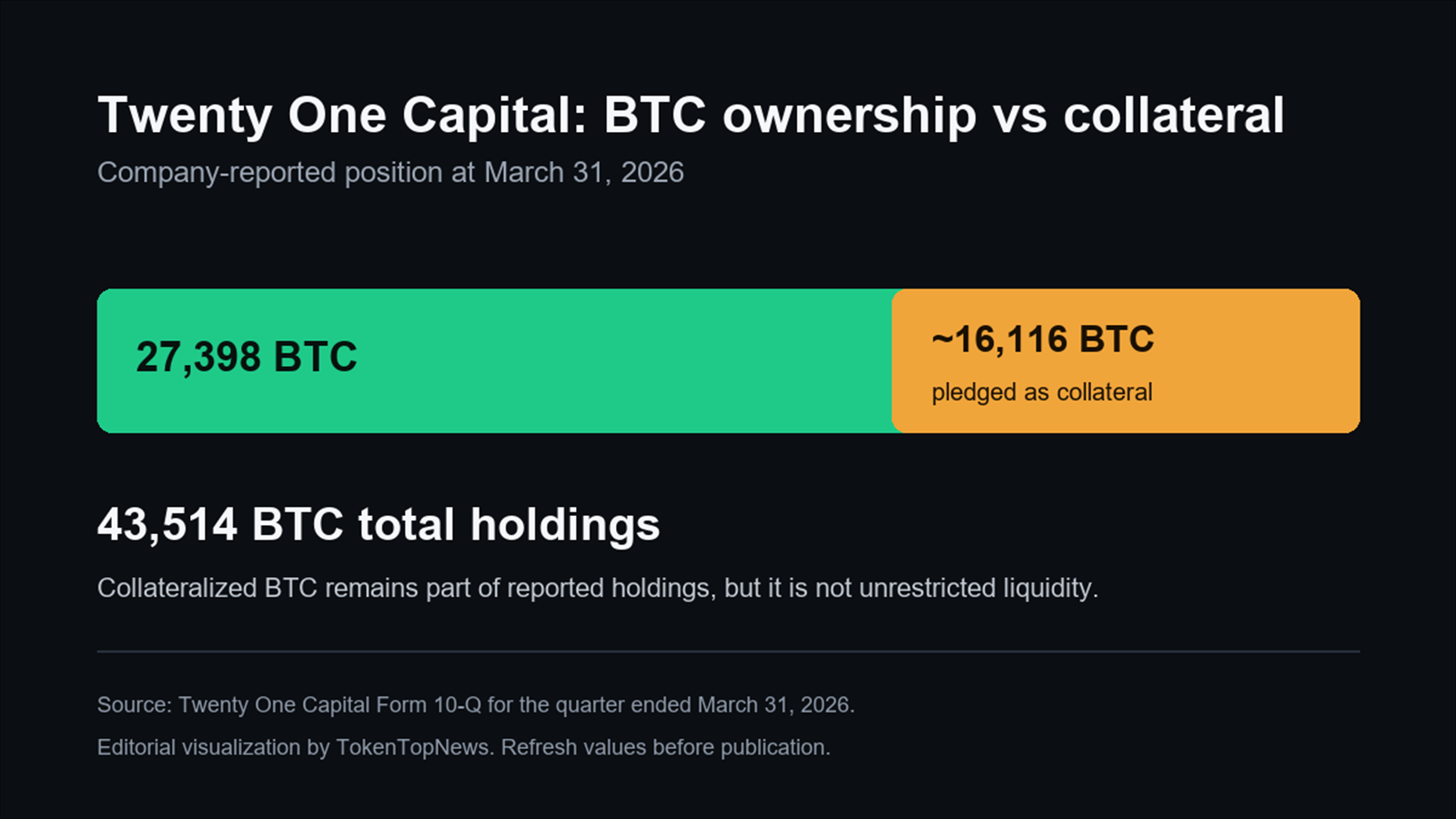
The market is not reported on one synchronized date. A useful snapshot keeps each company at its latest identified evidence point:
- Strategy: 847,363 BTC reported on June 22, 2026, plus a $1.4 billion USD reserve.
- Twenty One Capital: 43,514 BTC reported at March 31, 2026; its filing also identified approximately 16,116 BTC pledged as collateral for convertible notes. (SEC filing)
- Metaplanet: 43,000 BTC displayed on the company homepage when observed on July 22, 2026. The figure requires a same-date check of JPY share count, warrants and FX before valuation.
- Rumble: 210.82 BTC reported at March 31, 2026, with a $19.1 million cost basis and $14.38 million quarter-end fair value. (SEC filing)
This snapshot demonstrates the adoption range without implying that every number is current to the same day. For risk analysis, the evidence date is part of the number: an older filing cannot be compared with a fresh homepage counter without a refresh note.
Strategy Case Study: Scale, Financing and Shareholder Exposure
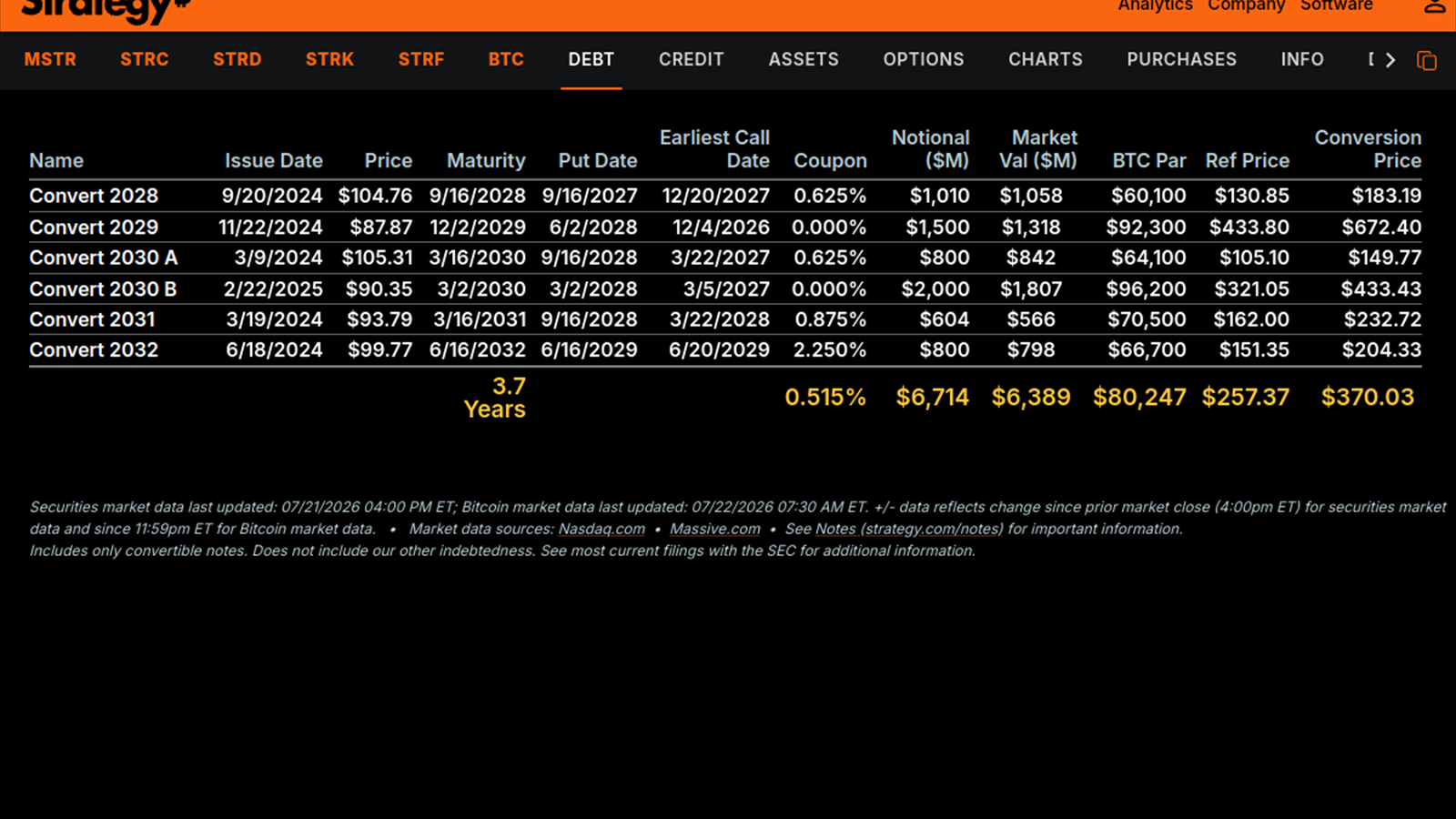
Strategy shows both why the model attracts capital and why scale does not remove risk. Its initial 2020 allocation was $250 million for 21,454 BTC; by June 22, 2026, its reported balance had reached 847,363 BTC. The change came through a repeatable treasury and financing program, not a single purchase. The case study should be read through four linked measures:
- Holdings: The reserve grew substantially, but total BTC is only the starting point.
- Financing: Common equity, convertibles and preferred securities create different costs and priority levels ahead of common shareholders.
- Per-share exposure: The relevant shareholder KPI is BTC per diluted share after new issuance, warrants and conversion claims.
- Failure path: If mNAV compresses, issuance becomes less attractive while dividends, interest and maturities remain. The strategy then depends more heavily on cash reserves, refinancing or asset sales. Strategy’s own risk disclosures identify this broader financing and market-risk context.
Strategy is therefore a useful case study in operating leverage to Bitcoin, not proof that the largest treasury company is the safest. Its scale can improve access to capital while also making the common-equity claim more dependent on the full capital stack.
Market Impact, Retail and ETF Effects
Spot Bitcoin ETFs changed the comparison set for retail investors. An ETF offers direct market exposure without company-specific dilution, debt, preferred dividends or operating cash-flow risk. A treasury stock can still be attractive when investors value financing access, corporate execution or a differentiated capital structure, but it is not a substitute for the ETF’s underlying claim.
For a dated liquidity reference, BlackRock’s iShares Bitcoin Trust page listed $44.15 billion in net assets on July 1, 2026, with 59.0 million shares of daily volume on June 30, 2026 and a 0.29% premium/discount measure for that date. (iShares IBIT data) These figures show why retail investors can compare treasury stocks against a highly liquid exchange-traded route rather than evaluating them in isolation.
The effect on the market runs in both directions:
- Access: Treasury stocks extend BTC-linked exposure into ordinary equity accounts, while ETFs offer a simpler reserve claim.
- Pricing: ETF availability can reduce the scarcity value of a treasury stock’s premium, especially when the stock adds financing and operating risk without improving BTC per diluted share.
- Demand: Treasury companies can create recurring corporate demand for BTC, but ETF flows and stock issuance compete for the same investor capital.
- Risk transfer: Retail buyers of a treasury stock inherit debt, preferred claims, dilution, custody and business execution risk that an ETF investor does not inherit in the same form.
The rise of these companies affects four parts of the market:
- Bitcoin demand: Large purchases can add visible, recurring demand, although one company announcement does not prove a lasting price effect.
- Equity-market access: Treasury stocks let investors trade BTC exposure during stock-market hours, but the equity can carry a premium or discount to the underlying reserve.
- New security design: Debt, preferred shares, warrants and convertibles create separate claims on the same BTC treasury and broaden the market for BTC-linked financing.
- Corporate reporting: Holdings, BTC per share, fair-value accounting, mNAV and financing terms are becoming important balance-sheet disclosures.
The market impact therefore has two sides. Treasury companies can deepen access and improve disclosure, but complex capital stacks can make a stock move differently from Bitcoin. A company may buy more BTC while common-share exposure falls if dilution or senior claims grow faster than the reserve.
Shareholder Risk Framework
The main risks below are grouped under one framework so the analysis stays focused on how the treasury model reaches common shareholders.
Risk 1: Bitcoin can dominate the equity story
A treasury-led company can make Bitcoin the dominant economic variable in its equity. The stock may still move more than Bitcoin because financing access, dilution, liquidity and the operating business are repriced alongside the reserve.
Measure concentration through three figures:
- Reserve weight: BTC value as a share of total assets and equity value.
- Claim coverage: BTC value compared with debt, preferred claims and other senior obligations.
- Cash runway: Months of operating and financing costs that can be covered without selling BTC.
A large reserve with little fixed debt can be more resilient than a smaller reserve facing an urgent maturity. The reserve size alone does not establish the risk level.
The Bitcoin treasury market map is useful here only when it includes evidence date, pledged units and share count. A headline holdings number hides the difference between unencumbered BTC, collateralized BTC and announced purchases that have not settled.
Test the same pressure points for every company so the comparison does not depend on labels such as “safe” or “high risk.” Record the reserve value after a BTC decline, BTC per diluted share after new issuance, financing capacity after mNAV compression and cash runway while fixed claims remain unchanged.
Risk 2: Dilution can reduce BTC per share
Dilution is the risk most often missed by a holdings-only comparison. If a company issues common shares to buy Bitcoin, total BTC can rise while BTC per diluted share falls. The calculation is straightforward: divide verified settled BTC by the fully diluted common-share denominator, then test what happens after options, warrants, converts and planned issuance are included.
The main financing events create different trade-offs:
- ATM equity above BTC NAV: Can add cash and BTC per share, but increases the share count and future dilution.
- Convertible issuance: May reduce the cash coupon, but creates future conversion or settlement claims.
- Stock-funded acquisition: Can add operating assets or BTC, but expands the denominator and creates integration risk.
- Warrant exercise: Brings in cash, but increases fully diluted shares.
- Preferred financing: Adds immediate purchasing capacity, but creates senior dividends and reduces common priority.
The BTC-per-share ranking keeps this metric separate from total holdings. Investors should also check whether the company’s own KPI uses basic shares, diluted shares or an assumed period-end denominator.
Risk 3: Debt creates fixed claims and timing risk
Debt changes the risk from “Bitcoin went down” to “Bitcoin went down while a payment was due.” Interest, principal, covenants and collateral can force management to choose between issuing equity, selling assets, refinancing or reducing spending. A treasury company with a long maturity runway has more options than one that must raise capital during a market drawdown.
The relevant fields are principal, coupon, maturity, conversion terms, collateral, covenants, permitted asset sales and cash coverage. A debt balance alone is not enough. Two companies with the same debt may have very different risk because one has operating cash flow and the other depends entirely on market access.
The mNAV and financing analysis explains how debt treatment changes the ratio. The risk test is whether debt can remain outstanding through a Bitcoin drawdown without forcing a transaction at the worst time.
Risk 4: mNAV compression can close the financing loop
Many treasury strategies depend on issuing securities while the stock trades at a premium to the value of its Bitcoin and other assets. That premium can support accretive issuance. If the premium compresses to par or a discount, the same issuance may become dilutive or impossible.
Compression can happen for several reasons: Bitcoin volatility, a change in investor preference, higher funding costs, a weak operating business, new senior claims, poor disclosure or a broad market de-risking event. The company may still hold more BTC than before, but the capital-markets flywheel can stop.
This is why mNAV is a risk input rather than a quality score. A high premium can be valuable optionality, but it also creates a higher expectation for continued execution. A discount can be attractive only if the balance sheet, liquidity and governance explain why the market is wrong.
Risk 5: Preferred claims can make common equity look safer than it is
Preferred securities can finance Bitcoin purchases without immediately issuing common stock, but they are not free capital. Dividends, conversion rights, redemption provisions and seniority change the amount left for common shareholders. Perpetual preferreds may avoid a maturity date while still requiring cash distributions or ranking ahead of common equity in a liquidation.
The correct comparison records each instrument separately: common equity, convertible notes, secured debt, unsecured debt, preferred stock and warrants. The Bitcoin treasury market map shows why a company can have several different public claims on one Bitcoin treasury.
Risk 6: Forced selling is a pathway, not a headline
“Forced selling” is often used too loosely. A company may sell BTC because collateral terms require it, because a maturity is due, because operating cash is insufficient, or because management chooses to rebalance. Those are different events with different evidence.
To verify a forced-sale risk, identify the trigger, the asset subject to the trigger, the cure period, the lender’s rights, the company’s alternative liquidity and the reporting date. A collateralized loan with a large cash reserve is not equivalent to an unsecured maturity with no refinancing plan. The Bitcoin treasury adoption framework explains the funding mechanics without treating every debt instrument as an immediate sale threat.
Risk 7: Custody and control risks are operational risks
Bitcoin can be economically valuable and still expose a company to custody, cybersecurity, counterparty and access risks. A filing should identify who controls the assets, whether a third-party custodian is used, what insurance or segregation exists, and whether any coins are pledged or restricted.
The accounting question is control; the investor question is recoverability and availability. A company may report BTC at fair value while a legal dispute, custodian failure or transfer restriction complicates the common-equity thesis. These risks are not solved by a market-price dashboard.
Risk 8: Operating cash flow can support or drain the reserve
The operating business matters even when the company presents itself as a Bitcoin treasury. Payroll, rent, data-center costs, acquisitions, taxes and interest must be paid in cash or liquid securities. If the operating business consumes cash, management may need to issue shares, borrow, sell BTC or reduce purchases.
This is especially important for small-cap treasury companies. Their BTC holdings may be large relative to market capitalization, but their operating revenue and cash conversion can be weak. The best-stock scorecard therefore includes operating support and downside resilience rather than ranking BTC exposure alone.
Risk scorecard for a dated review
A useful risk review should leave the reader with a comparable record rather than a list of warnings. Score each field only after the underlying input has been dated; use unknown when a filing does not disclose it.
| Risk area | Measurement | Higher-risk signal | Evidence to attach |
|---|---|---|---|
| Dilution | BTC per fully diluted share before and after financing | Shares grow faster than settled BTC | Offering, warrant, convert and share-count disclosure |
| Debt | Debt-to-BTC value, coupon and maturity runway | Large fixed claim due before reliable refinancing | Debt note, terms and maturity schedule |
| Preferred claims | Annual distributions and seniority | Dividends consume cash before common equity | Preferred prospectus or filing terms |
| mNAV compression | Current mNAV versus issuance break-even | Premium falls below the level needed for accretive funding | Market cap, debt, cash, preferred and BTC price |
| Forced selling | Collateral, cure period and alternative liquidity | BTC is pledged and cash cannot cover the trigger | Credit agreement, collateral note and cash balance |
| Operating support | Cash flow versus fixed costs | Less than one year of cash coverage without BTC sales | Filing cash-flow statement and obligations |
The scorecard separates likelihood from severity. A high mNAV can make dilution likely without making it immediately severe if cash and maturities are long. A smaller collateralized loan can be low probability but severe when the cure period is short.
Risk profile by company type
The same risk label has a different trigger across company models. Large treasury companies may have better market access, but layered debt and preferred claims can make common equity sensitive to mNAV compression. Japan-listed vehicles add currency and local-market liquidity risk. Smaller companies can show rapid holdings growth from a low base, yet depend on the next financing to keep that growth alive. Mining-plus-treasury models add power, fleet, hash-rate and production-cost risk before the reserve analysis begins.
The first risk to test depends on the company model:
- Pure-play treasury such as BSTR: Check financing access, premium compression, settled BTC, diluted shares and the next funding event.
- Large financed treasury such as Strategy: Check senior claims, cash reserves, preferred terms and refinancing runway.
- Japan-listed treasury such as Metaplanet: Check the same-date JPY share price, FX rate, diluted shares, warrants and filings.
- Operating company plus reserve such as Rumble: Check settled BTC, funding source and operating cash flow.
- Mining plus treasury such as American Bitcoin: Check hash rate, power cost, BTC produced, BTC sold and BTC held.
This classification prevents a false comparison. A company with the highest BTC balance may still have the greatest concentration risk. A company with the lowest debt may have weak custody or operating cash flow. A company with the strongest BTC-per-share growth may be using a denominator that excludes future dilution.
Use a simple evidence hierarchy: a filed balance sheet and debt note outrank a presentation; a company release outranks an unverified social post; and a tracker should lead the reader back to primary evidence. Label every transaction as completed, authorized, announced or proposed. When sources disagree, publish the disagreement rather than selecting the number that makes the company look strongest.
Risk findings that change the investment case
The most decision-relevant finding is the interaction between the reserve and the claims ahead of common equity. A 20% BTC decline is not equivalent across companies: one may have cash and a long maturity runway, while another may need to refinance, issue shares or sell collateral. The Bitcoin treasury financing analysis measures the valuation context; this page asks whether the balance sheet can survive the path from one valuation to the next.
| Observable finding | Immediate implication | Evidence needed before calling it a risk |
|---|---|---|
| BTC per diluted share falls after financing | New capital did not improve common exposure | Offering terms, settled BTC and fully diluted shares |
| Fixed claims mature before cash runway ends | Refinancing becomes part of the BTC thesis | Debt schedule, cash balance and covenant terms |
| Pledged BTC rises while liquidity falls | A price drawdown can activate a collateral decision | Collateral agreement, cure period and alternative liquidity |
| mNAV falls below issuance break-even | New common equity may become destructive dilution | Synchronized price, debt, preferred and BTC inputs |
| Operating cash flow cannot cover fixed costs | Reserve sales or new financing may be required | Cash-flow statement and recurring obligations |
These are findings, not generic warnings. A reader can test each row against a filing and update the conclusion when the company changes its capital stack.
Conclusion
Bitcoin treasury companies are changing corporate finance by making BTC a reserve asset, a source of market identity and a basis for new securities. Their growth can increase access and demand, but it does not remove the risks of volatility, dilution, debt, custody or weak operating cash flow.
The model is strongest when the company reports settled holdings, grows BTC per diluted share and maintains enough liquidity to avoid forced financing. Readers should therefore judge the rise of Bitcoin treasury companies through completed transactions and shareholder exposure, not through headline holdings or promotional announcements.
Frequently asked questions
Is Bitcoin price risk the biggest risk?
It is the most visible risk, but dilution, debt, mNAV compression and operating cash needs can magnify the result. The company’s capital structure determines how a Bitcoin move reaches common shareholders.
Can BTC per share rise while shareholders still lose money?
Yes. BTC per share is an exposure metric, not total return. The stock can trade at a lower mNAV, debt can absorb value, or the market can reprice the operating business.
Does pledged Bitcoin mean a company must sell it?
No. Pledging creates a potential claim or trigger. The filing must be checked for collateral terms, cure periods, maturity and lender rights before calling a sale forced.
Is a Bitcoin treasury company safer than holding Bitcoin directly?
Not automatically. The stock adds equity, financing, operating, governance and custody layers. It can offer market access or leverage, but it is not the same claim as directly held BTC.
Disclaimer: This article is for informational purposes only and does not constitute financial or investment advice. Cryptocurrency and digital asset markets carry significant risk. Always do your own research before making decisions.


