Ethereum Quantum-Resistant Account Protection Could Cost Users Just $0.07
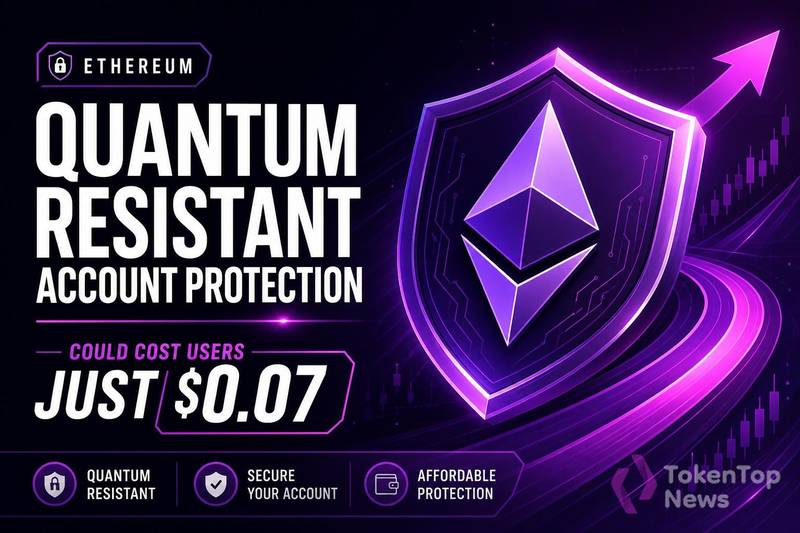
Ethereum ETH +0.00% researchers have proposed a method for adding quantum-resistant protection to user accounts that could cost as little as $0.07 per account, potentially offering a low-cost path to securing the network against future quantum computing threats.
The proposal, published on the Ethereum Research forum, centers on SPHINCS+, a stateless post-quantum signature scheme that can be verified on the Ethereum Virtual Machine. The approach would allow users to upgrade their account security without requiring a hard fork or sweeping protocol changes.
Why the $0.07 Estimate Changes the Conversation
The $0.07 figure refers to the estimated gas cost of verifying a quantum-resistant signature on-chain. At that price point, upgrading account protection becomes economically trivial for individual users, removing one of the biggest barriers to widespread adoption of post-quantum cryptography on Ethereum.
Cost has historically been a central obstacle. Post-quantum signature schemes tend to produce larger signatures and require more computation to verify, which translates directly into higher gas fees on Ethereum. The SPHINCS+ implementation described in the research forum post aims to minimize that overhead through optimized EVM verification.
If the estimate holds under real-world conditions, even users with modest holdings could afford to protect their accounts. That could accelerate network-wide quantum readiness far ahead of any actual quantum threat materializing, a meaningful shift given the volatility that has rattled crypto markets and heightened focus on long-term security.
How the Protection Would Work at the Account Level
The proposal targets signature verification, the cryptographic step that proves a transaction was authorized by the account holder. Current Ethereum accounts rely on elliptic curve cryptography (ECDSA), which is theoretically vulnerable to sufficiently powerful quantum computers.
Under this scheme, users would add a quantum-resistant signature layer to their accounts. The SPHINCS+ algorithm is “stateless,” meaning it does not require users or wallets to track internal state between signatures, simplifying wallet integration compared to other post-quantum alternatives. NIST has recognized SPHINCS+ as one of its recommended post-quantum signature standards, lending additional credibility to the choice of algorithm.
Wallet providers would need to support the new signing method, and users would need to opt in by migrating their accounts. The research post suggests this could work through smart account upgrades rather than changes to the base protocol, though specific wallet implementation details remain an open question.
What This Means for Ethereum’s Security Roadmap
Quantum computing capable of breaking current cryptographic standards does not yet exist, and most estimates place that milestone years or decades away. But the blockchain security community has increasingly treated quantum preparedness as a matter of when, not if.
A low-cost, opt-in protection mechanism could let Ethereum get ahead of the problem without forcing disruptive network upgrades. As Bitcoin continues to attract institutional momentum, Ethereum’s ability to offer concrete security upgrades at negligible user cost could strengthen its competitive position among major blockchains.
Several caveats remain. The $0.07 estimate depends on current gas pricing and network conditions, both of which fluctuate. The proposal has not yet moved beyond the research stage, and real-world gas costs could differ from theoretical projections. Wallet adoption timelines and user migration friction are also unresolved.
The research represents an early but concrete step toward quantum-resistant Ethereum accounts. Whether it advances to an Ethereum Improvement Proposal will depend on further peer review and community support, factors that could prove decisive as institutional players continue positioning in crypto and the broader ecosystem weighs long-term resilience.
Disclaimer: This article is for informational purposes only and does not constitute financial or investment advice. Cryptocurrency and digital asset markets carry significant risk. Always do your own research before making decisions.