
MSTR is Strategy’s common stock. Strategy raises money through public markets and uses part of that capital to hold Bitcoin. BTC Yield measures whether the amount of Bitcoin assigned to each assumed diluted share increased during a stated period.
BTC Yield is not the return of MSTR stock. A positive result can appear while the share price falls, debt grows or preferred investors receive value before common shareholders. Read the metric as one part of the capital structure, not as a complete investment score.

What MSTR Actually Represents
Owning MSTR means owning common equity in a company, not owning a fixed amount of Bitcoin. Unlike direct BTC or a spot ETF, MSTR adds company financing, dilution and operating-business risk to the Bitcoin exposure. The company has a software business, a Bitcoin treasury, debt, preferred securities and common shares, so the value reaching MSTR depends on all of those pieces.
Bitcoin changes the value of the reserve, but financing determines how that reserve is built. Debt and preferred securities have claims ahead of common equity, while new shares and conversions can reduce each share’s Bitcoin exposure. Software revenue and cash also affect how easily fixed obligations can be paid.
The Strategy dashboard displayed MSTR at $101.95, 843,775 BTC held, 206,388 sats per share, $55,695M in BTC reserve value, $6,754M in debt, $15,464M in preferred value and an mNAV of 1.04 on the July 23, 2026 reference capture. These are dated dashboard figures, not a live market feed.
The figures must be read together. BTC held shows reserve size, sats per share shows common-share exposure, and debt, preferred value and mNAV show why reserve size alone cannot explain the stock.
How the Bitcoin Treasury Flywheel Works
Strategy’s model begins with a capital raise. The company issues common stock, convertible debt or preferred securities, receives the proceeds and uses them to buy Bitcoin. The purchase becomes part of the reserve only after settlement, and the resulting BTC balance must be measured against the assumed diluted share count.
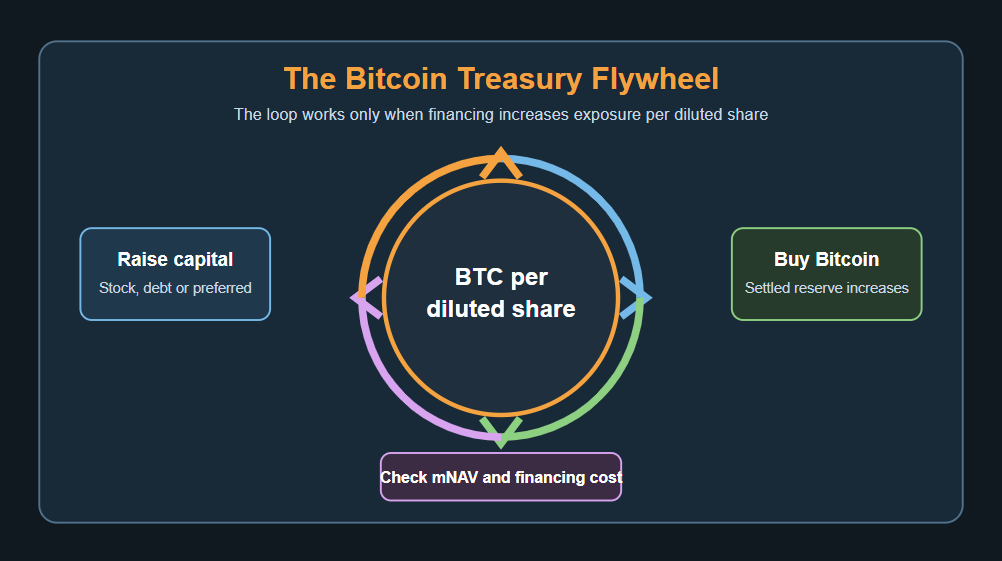
The loop works when the value of the Bitcoin acquired and the resulting increase in BTC per share justify fees, interest, preferred distributions and future dilution. A premium mNAV can make new issuance more attractive; when that premium compresses, the same financing can become less accretive or stop altogether.
The Metrics Behind Strategy BTC Yield
Strategy’s official notes define BTC Yield as the percentage change in Bitcoin per assumed diluted share from the beginning to the end of a stated period.
Start with BTC held, the settled Bitcoin balance at a stated date. Divide that balance by the selected share denominator to obtain BTC per share. BTC Yield then measures the percentage change in that per-share exposure between the beginning and end of the period. BTC Gain translates the percentage into Bitcoin units, while BTC $ Gain translates those units into dollars at the stated Bitcoin price.
| Metric | Reader’s takeaway | Do not confuse it with |
|---|---|---|
| BTC held | Reserve size | Common-equity value after senior claims |
| BTC per diluted share | Exposure assigned to the assumed denominator | MSTR share-price return |
| BTC Yield | Period change in that exposure | Dividend yield or profit |
| BTC Gain / BTC $ Gain | Unit or dollar translation of the KPI | Guaranteed shareholder return |
The Diluted Denominator Defines Common-Share Exposure
BTC per share can rise when Strategy buys BTC, retains more of its reserve, repurchases shares or reduces the denominator. It can fall when new common shares, warrants, converts or preferred conversions grow faster than the Bitcoin balance. This is why a large purchase can produce a weaker common-share result if the financing creates an even larger claim on the reserve.
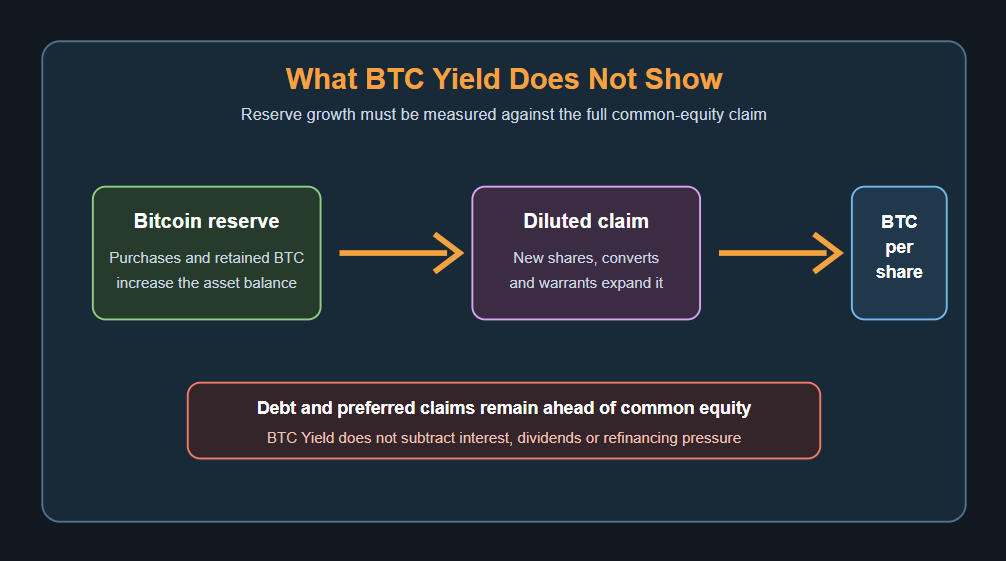
The denominator is therefore part of the result, not a footnote. Before comparing periods, record whether the calculation uses basic shares, period-end shares or Strategy’s assumed diluted shares, and identify how convertibles, warrants and preferred conversions are treated. The same convention must be used across both periods or the apparent yield will not be comparable.
MSTR’s Capital Stack Explained
Debt terms determine the interest burden, maturity risk, conversion potential, collateral and covenants that come before common equity. Preferred securities add dividend, seniority, redemption and conversion rights that also rank ahead of MSTR common. MSTR receives the residual value after those claims.
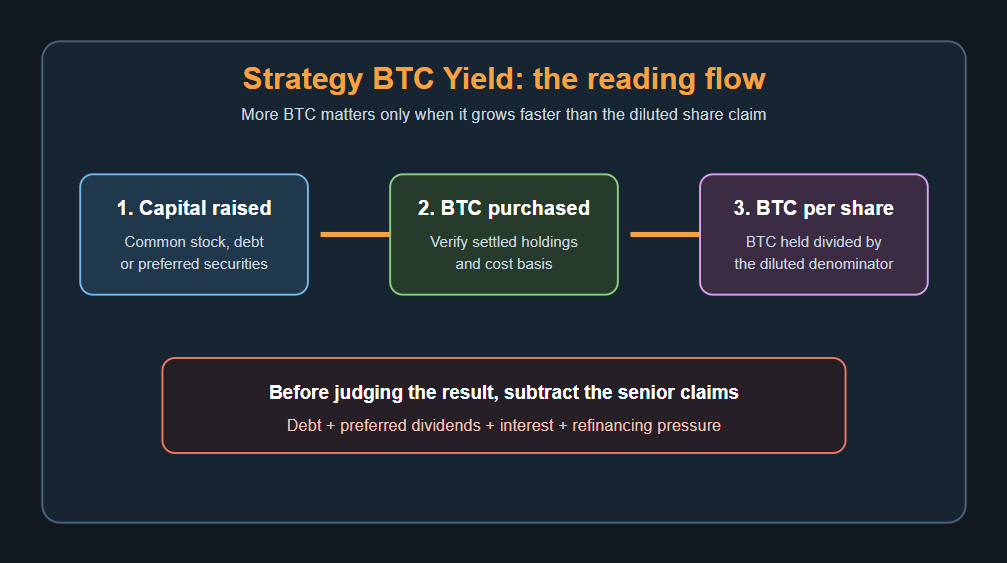
Preferred issuance may avoid immediate MSTR share dilution, but it creates dividends ahead of common equity. Debt may delay dilution, but it creates interest and refinancing pressure. The effect depends on the terms, the issuance price and the Bitcoin purchased with the proceeds.
Strategy’s June 2026 capital framework shows why liquidity belongs in the same analysis. The company reported a USD Reserve of about $2.55 billion against approximately $1.76 billion of expected annual preferred dividends and interest, or about 17.4 months of coverage at that point. The reserve supports fixed claims; it is not additional BTC available to MSTR common.
How to Read a Financing Event
Authorization, issuance, settlement and disclosure are separate events. An authorization describes a possible transaction; issuance makes the security and its terms binding; settlement confirms that cash was used for a Bitcoin purchase or sale; and disclosure updates the public holdings, shares or obligations. Treating these events as one date can turn a target into a false balance-sheet figure.
For each financing event, record the security, proceeds, fees, BTC purchased, settlement status and change in assumed diluted shares. Then compare BTC per share before and after the transaction. The Bitcoin treasury adoption framework provides additional context for this accretion test.
Strategy’s Q1 2026 release provides a concrete reading case. Through May 3, the company reported $11.68 billion raised, 818,334 BTC held and a 9.4% year-to-date BTC Yield. It also reported $5.58 billion raised through STRC and $692.5 million in cumulative preferred dividends paid.
The BTC Yield shows improved per-share BTC exposure under Strategy’s definition, while the financing and dividend figures show the senior claims that the KPI does not subtract. The Q1 results disclosure is the source for those figures.
What BTC Yield Leaves Out
A higher BTC Yield does not remove mNAV compression, fixed claims, liquidity risk, stock repricing or operating-business risk. A falling mNAV can make future issuance less accretive and slow the flywheel. Debt interest and preferred distributions reduce the residual value available to common equity, while cash and operating revenue determine how obligations are met during a Bitcoin drawdown.
MSTR can trade above or below the value of its Bitcoin holdings because investors price financing access, management decisions, future dilution and volatility. The software business adds another layer of company risk that a BTC-only metric cannot measure.
An investor discussion about Strategy’s February 3, 2026 results, linked preferred dividends, issuance and BTC Yield. That discussion is useful as a reader-comprehension signal only; Strategy’s filings and KPI definitions remain the financial authority.
The Full MSTR Reading Framework
Read the figures in one sequence: establish the beginning and ending periods, confirm settled BTC, identify the assumed diluted share count and calculate BTC per diluted share before interpreting BTC Yield. Then inspect debt, interest, maturity, conversion terms, preferred dividends, priority, redemption terms, cash, refinancing capacity and mNAV. The final comparison is the price Strategy paid for new capital versus the increase in Bitcoin exposure assigned to common equity.
If a figure is unavailable, mark it as unavailable. Do not combine an old holdings balance with a live market price and label the result a current snapshot. This process keeps a reported KPI separate from a valuation conclusion and makes the analysis reproducible after the next financing event.
Conclusion
BTC Yield is useful because it measures whether Strategy’s Bitcoin exposure grew on a per-assumed-diluted-share basis. The reading starts with settled holdings and a correctly identified denominator.
It does not answer whether MSTR is cheap, whether the stock will outperform Bitcoin or whether common shareholders captured the added value. Those conclusions require the full capital stack, financing cost, mNAV, liquidity and operating-business context.
Frequently asked questions
Which inputs determine Strategy BTC Yield?
Use the company-defined period, beginning and ending BTC, assumed diluted share count and stated BTC Gain method. A target or announcement is not a settled holdings figure and should not be used as the ending balance.
Is Strategy BTC Yield the same as return?
No. BTC Yield is a company-defined KPI about Bitcoin holdings and an assumed share denominator. It is not stock return, income, dividend yield or a promise of outperformance.
Does a higher Strategy BTC balance always benefit MSTR holders?
No. The effect depends on the purchase price, financing cost, dilution, senior claims, mNAV and the resulting BTC per diluted share.
Where should investors check Strategy debt and preferreds?
Use Strategy filings, prospectuses and investor-relations disclosures. The Strategy preferred securities page provides the issuer’s product context, while filings provide the binding terms.
Disclaimer: This article is for informational purposes only and does not constitute financial or investment advice. Cryptocurrency and digital asset markets carry significant risk. Always do your own research before making decisions.


