
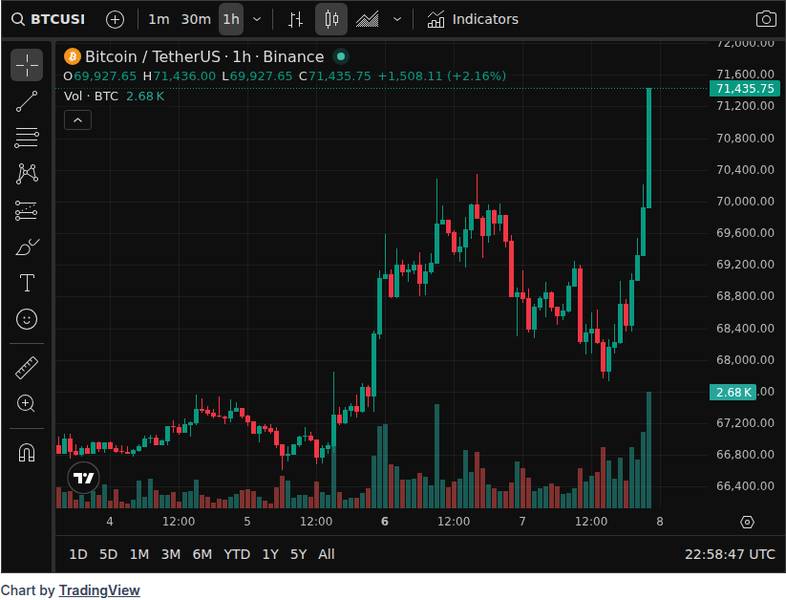
Bitcoin slid as much as 2.5% on April 7, falling below $68,000 as escalating Iran-US diplomatic tensions triggered a broad selloff across risk assets. The drop came just one day after US spot Bitcoin ETFs recorded $471.3 million in net inflows, exposing a sharp divide between institutional accumulation and retail panic.
Bitcoin Falls as Iran-US Diplomatic Standoff Hits Risk Appetite
Bitcoin had briefly topped $70,000 on April 6 before reversing sharply. The catalyst: President Trump set a Tuesday deadline threatening to strike civilian infrastructure in Iran unless the Strait of Hormuz was opened, an ultimatum Tehran rejected before the deadline expired.
The selloff was not limited to Bitcoin. Ethereum fell 3.5% to roughly $2,000, while XRP and Solana each dropped approximately 4%. Total crypto market capitalization declined 2% to $2.4 trillion during the tensions.
Crude oil surged above $114 per barrel as the standoff intensified, adding inflation pressure and reducing expectations for near-term rate cuts from the Federal Reserve.
By April 8, Bitcoin had partially recovered to $71,171, posting a +3.30% gain over the previous 24 hours. Market cap stood at $1.424 trillion with $50.7 billion in daily trading volume.
Why Geopolitical Risk Sends Bitcoin Lower, Not Higher
Bitcoin is often positioned as a hedge against instability, but acute geopolitical shocks consistently trigger risk-off selling. The pattern repeated during Russia's invasion of Ukraine in February 2022, when Bitcoin dropped more than 8% in the initial days despite its "digital gold" narrative.
The Fear & Greed Index sat at 11 on April 8, deep in "Extreme Fear" territory. That reading reflects heightened retail anxiety aligned with the geopolitical risk environment.
Yet institutional behavior told a different story. US spot Bitcoin ETFs drew $471.3 million in net inflows on April 6, the largest single-day figure in recent weeks, even as the ultimatum deadline loomed. That divergence between retail fear and institutional accumulation is the defining tension of this market moment.
James Butterfill, head of research at CoinShares, offered context on Bitcoin's dual nature during crisis periods.
"Geopolitics has been an important driver in recent months, which helps explain Bitcoin's outperformance relative to equities, even though it still exhibits clear risk-on characteristics."
— James Butterfill, via DL News
What to Watch: Key Levels and Escalation Triggers Ahead
Bitcoin has been rangebound between roughly $60,000 and $75,000 since late February, with an all-time high of $126,080 set in October 2025 now firmly in the rearview. The $68,000 level that held during the April 7 dip is the immediate support traders are watching. According to unconfirmed reports, Bitcoin may have touched a 2026 low of $65,834 on April 3 when Trump first threatened to strike Iran.
The geopolitical calendar is now the primary driver. Trump's operation, branded "Epic Fury," and his warning of "complete and total regime change" in Iran leave little room for de-escalation in the near term. Any further military action or breakdown in back-channel diplomacy could push Bitcoin back below $68,000.
Arthur Hayes, co-founder of BitMEX, offered a contrarian long-term view.
"The longer Trump engages in the extremely costly activity of Iranian nation-building, the higher the likelihood that the Fed lowers the price and increases the quantity of money to support Pax Americana's latest bout of Middle Eastern adventurism."
— Arthur Hayes, via Yahoo Finance
Hayes' thesis: prolonged conflict forces Fed money printing, which historically benefits hard assets like Bitcoin. Whether that dynamic materializes depends on how far the Iran standoff escalates and whether oil above $114 per barrel forces the Fed's hand on monetary policy before any scheduled rate decisions.
For now, the $60,000 to $75,000 range holds. The broader bull cycle thesis remains intact, but the next move likely depends more on the Strait of Hormuz than on any chart pattern.
Disclaimer: This article is for informational purposes only and does not constitute financial or investment advice. Cryptocurrency and digital asset markets carry significant risk. Always do your own research before making decisions.