
Bitcoin treasury mNAV shows how the market values a company compared with the Bitcoin and other assets behind its shares. Above 1.0x means a premium; below 1.0x means a discount. The result is meaningful only when the BTC balance, share count, liabilities and market prices are matched to the same date.
There are two versions because investors may be measuring different claims. Equity mNAV looks at common shareholders. Enterprise mNAV looks at the wider financing structure, including debt and preferred claims. The BitcoinTreasuries mNAV methodology is a useful reference for separating market capitalization, debt, preferred claims, cash and Bitcoin NAV.

What Is mNAV?
For most Bitcoin treasury comparisons, mNAV means enterprise value divided by Bitcoin NAV. Bitcoin NAV is the company’s settled BTC multiplied by the BTC price.
Bitcoin NAV = Settled BTC x BTC price
Enterprise mNAV = (Common market cap + debt + preferred claims - cash) / Bitcoin NAV
This version measures what the whole capital structure is paying for each dollar of Bitcoin held. A result of 1.0x means enterprise value roughly matches Bitcoin NAV. Above 1.0x is a premium; below 1.0x is a discount. BitcoinTreasuries uses this enterprise-value convention for Bitcoin treasury comparisons.
Equity mNAV is a separate view for common shareholders:
Equity mNAV = Common market capitalization / (BTC value + cash + defensible operating assets - debt - preferred claims - other net liabilities)
The two ratios are not interchangeable. Enterprise mNAV emphasizes the full financing structure; equity mNAV estimates what remains for common equity after senior claims. Preferred stock may be measured at liquidation preference or market value, while convertibles may be treated as debt or potential equity. State the treatment instead of presenting one unexplained ratio.
The main inputs must meet three conditions:
- BTC holdings: Use a filing and reconciled settled purchases; record the latest effective balance.
- BTC price: Name the liquid venue or index and match its timestamp to the stock price.
- Common shares: Use the filing plus later issuances, showing basic and diluted shares separately.
- Debt: Check the latest filing and later redemptions; label principal and carrying value.
- Preferred claims: Use the terms and outstanding units, and disclose the valuation method.
- Cash: Start with the latest filing and adjust for known financing; note stale figures.
- FX: Use a named institutional rate from the same timestamp as market prices.
Our Bitcoin treasury companies analysis provides the market context for the event-level inputs. An mNAV calculation should use a reconciled dataset, not a copied holdings leaderboard.
Data Behind the mNAV Calculation
Treat mNAV as a dated worksheet, not a number copied from a dashboard. Start with settled BTC, then record the stock price, BTC price, FX rate, shares and capital claims at one observation point. If one input comes from a later filing, label the output unsynchronized.
| Worksheet line | Calculation or evidence | Validation before publication |
|---|---|---|
| Bitcoin value | Settled BTC x named BTC price | Confirm ownership; an announced target is not enough |
| Common market cap | Share price x basic shares | Add later issuance and repurchases |
| Diluted market cap | Share price x fully diluted shares | State treatment of warrants, converts and options |
| Common-equity NAV | BTC, cash and accepted assets less debt, preferred and other claims | Do not assign operating value without evidence |
| Enterprise value | Common market cap + debt + preferred – cash | Keep notional, carrying and market values separate |
| Equity mNAV | Common market cap / common-equity NAV | Label the denominator and claim being measured |
| Enterprise mNAV | Enterprise value / Bitcoin and accepted operating NAV | Do not compare it with equity mNAV |
The output should carry three labels: equity or enterprise, basic or fully diluted, and synchronized or unsynchronized. Those labels prevent a common error in which a favorable basic-share equity ratio is compared with a conservative fully diluted enterprise ratio from another company.
Do not publish mNAV when the numerator and denominator cannot be reconciled. Mark it not calculable when BTC is only a target, preferred terms are missing, a material financing closed after the filing, or an international share price and FX rate use different sessions. A missing value is better than false precision.
mNAV Across Bitcoin Treasury Companies
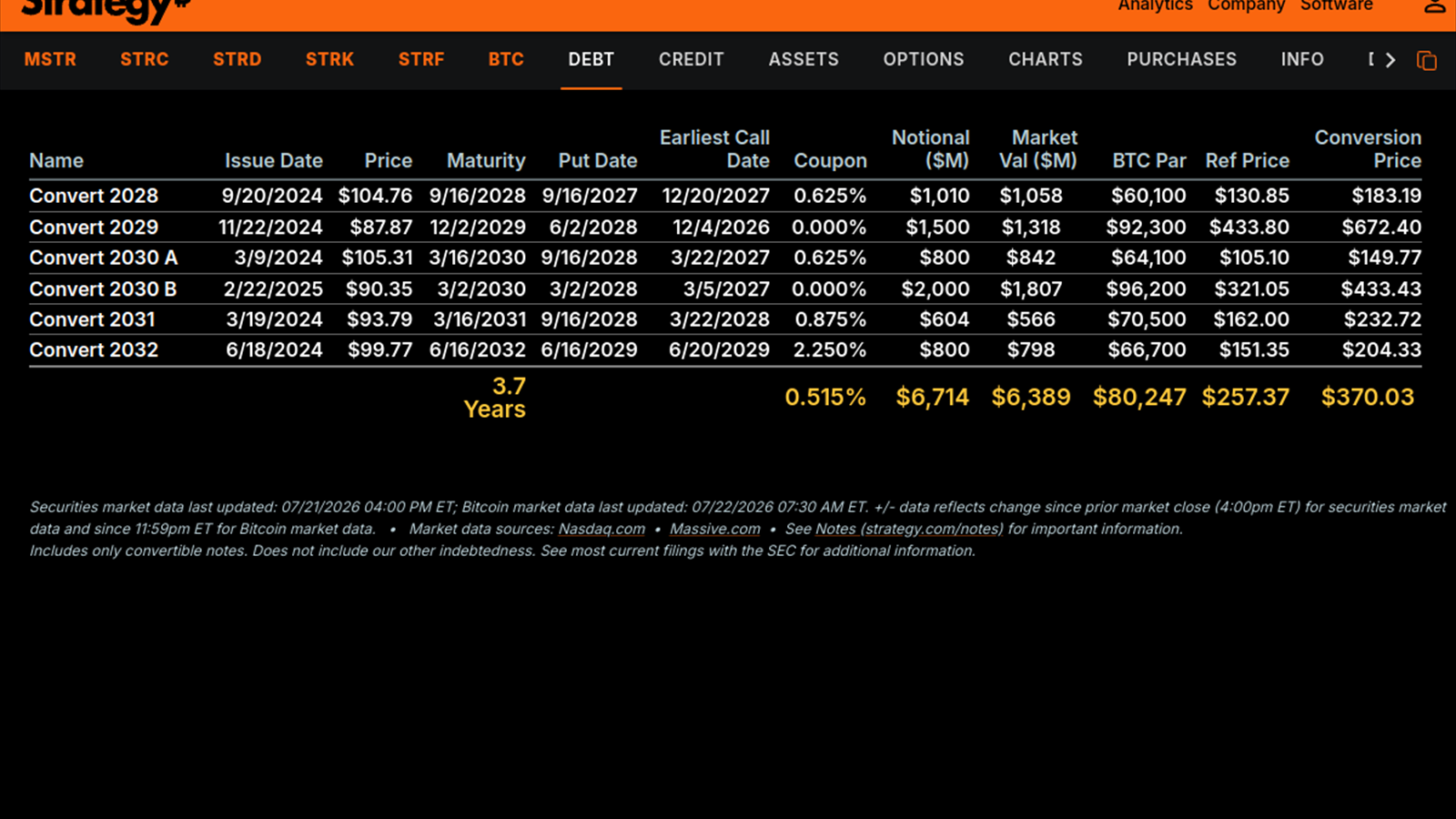
Strategy shows why the full capital stack matters. Its debt and preferred securities sit ahead of common equity, so the Strategy investor discussion on mNAV and BTC per share is useful context for separating net BTC per share from senior claims. The discussion is not a valuation source; the latest filing must control the inputs.
Metaplanet adds a currency and dilution check. Match its JPY share price, USD/JPY rate, holdings date and diluted share count before comparing it with a U.S.-listed company. A Metaplanet investor discussion about mNAV and dilution reinforces that more BTC is not automatically accretive when new shares are issued.

DigitalX demonstrates the operating-asset boundary. Its treasury sits alongside digital-asset and market-access activity, so BTC, cash, debt, shares and ETF exposure must be listed separately. The DigitalX investor discussion on HotCopper highlights the timing gap between ASX price moves and balance-sheet updates; the latest filing remains the numerical authority.
Why mNAV Results Differ
The first source of disagreement is the share denominator. Basic shares exclude potential dilution; fully diluted shares can include options, warrants, convertibles and preferred conversion under different assumptions. A tracker that uses basic shares will usually show a lower market capitalization and a more favorable mNAV.
The second is liability treatment. Some dashboards compare market capitalization directly with gross BTC value. Others subtract debt but ignore preferred claims, or use enterprise value while leaving cash in both numerator and denominator. Each may be internally consistent, but the numbers are not comparable until the formula is normalized.
The third is timing. Company BTC balances update after purchase releases, while debt and cash may remain anchored to the prior quarter. Share prices and Bitcoin trade continuously, and international comparisons add FX movement. False precision grows as those timestamps drift apart.
The most common calculation differences come from five choices:
- Shares: Basic outstanding shares produce a lower-looking ratio; fully diluted shares are more conservative.
- BTC: Including an announced target lowers the ratio; settled verified holdings are safer for publication.
- Preferreds: Ignoring them or using market price can lower the ratio; disclose the liquidation or notional method.
- Operating assets: An optimistic multiple lowers the ratio; standalone evidence provides the stronger basis.
- Prices: Mixed closing prices create false precision; one synchronized timestamp is more reliable.
Premiums, Discounts, and Sensitivity
Premium: A premium can represent useful corporate optionality. A liquid issuer may raise equity above NAV, buy Bitcoin and increase BTC per diluted share. Management, market access, options liquidity and index eligibility can therefore have real value beyond current assets.
The premium is not an asset already owned. It depends on future transactions and investor demand. Paying 2.0x NAV requires enough future accretion or non-Bitcoin value to justify paying twice the current net asset backing. If capital-market access closes, the option can lose value before holdings change.
Use a premium bridge instead of a narrative label. Separate value attributed to operating assets, tax attributes, liquidity and expected accretion. Anything left is an unexplained market premium and should be stressed aggressively.
Discount: A discount may reflect expensive liabilities, governance, weak liquidity, expected dilution or doubt that reported assets are accessible to common equity. It can also signal a time mismatch: a stale holdings balance or an unrecorded financing can make the apparent discount disappear after reconciliation.
Buying below gross BTC value does not guarantee a bargain. If debt and preferred claims absorb the difference, common-equity NAV may be lower than gross asset value. A company may also need cash for operations, coupons or maturities, reducing the amount effectively backing common shares.
The Bitcoin treasury companies analysis combines NAV with liquidity and refinancing analysis. Discount alone should never replace that work.
Sensitivity: Re-run mNAV after a BTC price move, financing event, preferred issuance or change in diluted shares. If the premium compresses while senior claims remain fixed, the common-equity result can deteriorate faster than the reserve value alone suggests.
Use five steps:
- Fix one timestamp: Record the stock price, BTC price, FX rate and latest settled BTC balance at the same observation point.
- Build Bitcoin NAV: Multiply settled BTC by the named BTC price; exclude announced but unsettled targets.
- Build enterprise value: Add common market capitalization, debt and preferred claims, then subtract cash.
- Choose the share treatment: Show basic and fully diluted figures when warrants, options, converts or preferred conversions are material.
- Label the result: Mark the ratio as enterprise or equity, and synchronized or unsynchronized.
Re-run the result after a BTC purchase, share issuance, debt amendment, preferred offering or material change in price. Compare the output with direct BTC or a spot ETF only after checking that the company carries different financing and operating risks.
What an mNAV Result Shows
A useful mNAV result reports the ratio, the numerator, the denominator and the claim being measured. It should also fail visibly when the inputs are incompatible. The BitcoinTreasuries glossary describes mNAV as an enterprise-value-to-Bitcoin-NAV ratio; this article keeps that version separate from common-equity mNAV rather than silently mixing them.
| Output | Minimum result | Reject the calculation when |
|---|---|---|
| Equity mNAV | Common market cap / common-equity NAV | Debt, preferred claims or diluted shares are missing from the chosen perimeter |
| Enterprise mNAV | Enterprise value / Bitcoin NAV | Market cap, debt, preferred claims, cash and BTC use different timestamps |
| Diluted mNAV | Ratio using the assumed diluted denominator | Warrants, converts or preferred conversion terms are omitted without a note |
| Sensitivity range | Base, BTC-downside and premium-compression cases | Only one precise-looking headline ratio is shown |
| Data status | Verified, estimated or unavailable for each input | A dashboard or target is treated as a filed balance |
The page is strongest when the reader can change BTC price, share count, debt or preferred claims and see which assumption moves the ratio most. That makes the tool useful for comparing a live financing event, not merely explaining the acronym.
Frequently asked questions
Is mNAV the same as price-to-book value?
No. Book value uses accounting carrying amounts, while treasury mNAV usually marks Bitcoin and market capitalization to current prices and applies analyst adjustments to liabilities and other assets.
Should preferred stock be included at market value or liquidation preference?
It depends on the question. Market value describes the current enterprise-value stack; liquidation preference describes a contractual senior claim. A strong analysis calculates both when the difference is material.
Can a company deserve a permanent mNAV premium?
No premium is guaranteed. Financing access and per-share accretion can justify value above current assets, but that value changes with market demand, execution and the cost of capital.
Why does fully diluted mNAV look worse?
Potential shares increase the common-equity denominator and may transfer value to option, warrant or convertible holders. The diluted version usually gives a more conservative picture of each current share’s future claim.
Disclaimer: This article is for informational purposes only and does not constitute financial or investment advice. Cryptocurrency and digital asset markets carry significant risk. Always do your own research before making decisions.
Tracks corporations, public companies, and funds using Bitcoin as a treasury reserve or strategic balance-sheet asset.
Tracks AI-agent tokens, compute and data infrastructure, and where crypto markets are pricing AI-linked narratives.


