
A Bitcoin treasury company, a spot Bitcoin ETF and directly held BTC are three different claims, not interchangeable ways to own Bitcoin exposure. MSTR is common equity in a company with Bitcoin, debt, preferred securities and an operating history.
IBIT is a share in an investment vehicle designed to track Bitcoin before fees. Direct BTC is the asset itself, with the owner responsible for custody and transaction operations. The right choice depends on the constraint the investor is solving.
A brokerage account may favor an ETF or treasury stock. A user who wants direct control may prefer self-custody. A reader seeking leverage or corporate capital-markets optionality may accept the extra layers of MSTR. Comparing them by one-year price return alone hides the legal claim, fee drag, dilution, custody and failure mode behind the chart.

How the three Bitcoin exposures differ
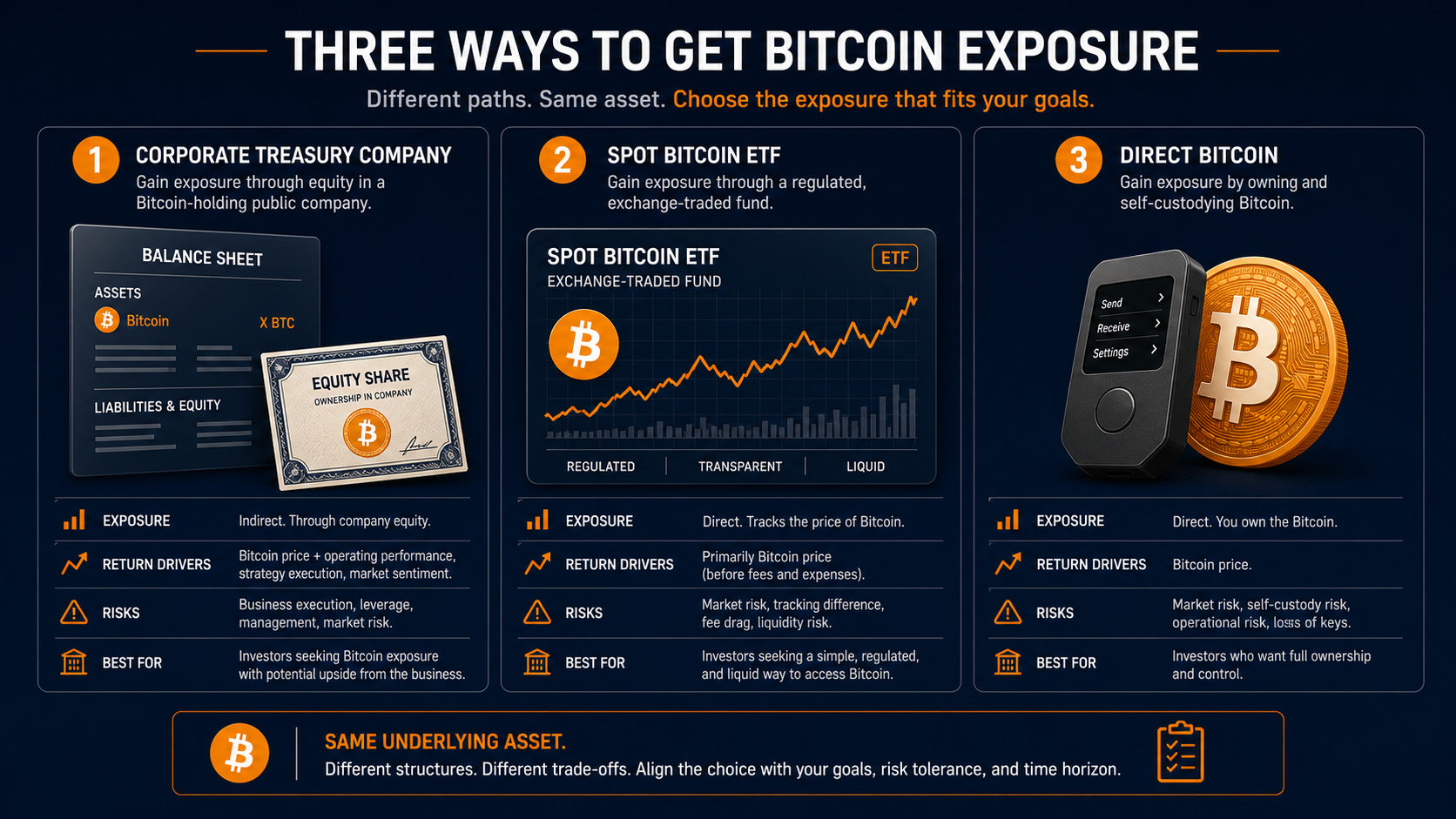
The correct comparison is the claim the investor owns, not whether the three price charts move together. The Bitcoin treasury adoption framework explains why a corporate balance sheet is not the same as a Bitcoin wallet, while the Bitcoin treasury market map shows why financing and dilution matter for treasury stocks.
| Exposure | What the holder owns | How Bitcoin drives the result | Fees and capital structure | Trading and control | Main risks |
|---|---|---|---|---|---|
| Treasury company stock | Common equity in a corporation such as MSTR | BTC holdings, BTC per share, operating results and market repricing through mNAV | No fund expense ratio; debt, preferred securities, issuance and operating costs affect common equity | Bought and sold during stock-market hours; the holder cannot withdraw the company’s BTC | mNAV compression, dilution, debt, preferred claims and operating risk |
| Spot Bitcoin ETF | Shares in a trust holding custodial Bitcoin, such as IBIT | Fund NAV follows custodial BTC after expenses, cash effects and tracking friction | 0.25% sponsor fee in the dated IBIT snapshot; no corporate debt claim on the investor’s share | Bought and sold during exchange hours; the holder cannot transfer the trust’s BTC on-chain | Fee drag, NAV premium/discount, tracking, custodian and fund-structure risk |
| Direct BTC | Bitcoin itself or a custodial claim to specific BTC | Spot Bitcoin price, less the holder’s trading, network and custody costs | No sponsor fee, debt or share dilution; the holder bears execution and security costs directly | BTC can be transferred 24/7 subject to venue and network rules; control depends on private keys or custodian | Key loss, theft, wrong-address transfer, exchange failure and custody risk |
The SEC spot Bitcoin ETP statement and the BlackRock IBIT product page establish the ETF wrapper and its limits. Strategy’s investor-relations materials establish the separate corporate balance-sheet claim.
MSTR: equity with Bitcoin-linked economics
MSTR gives the investor common equity in Strategy. The company can buy Bitcoin, issue common stock, sell preferred securities, borrow, operate a software business and report company-defined Bitcoin KPIs. That flexibility can create periods when MSTR outperforms Bitcoin, but it can also produce substantial underperformance.
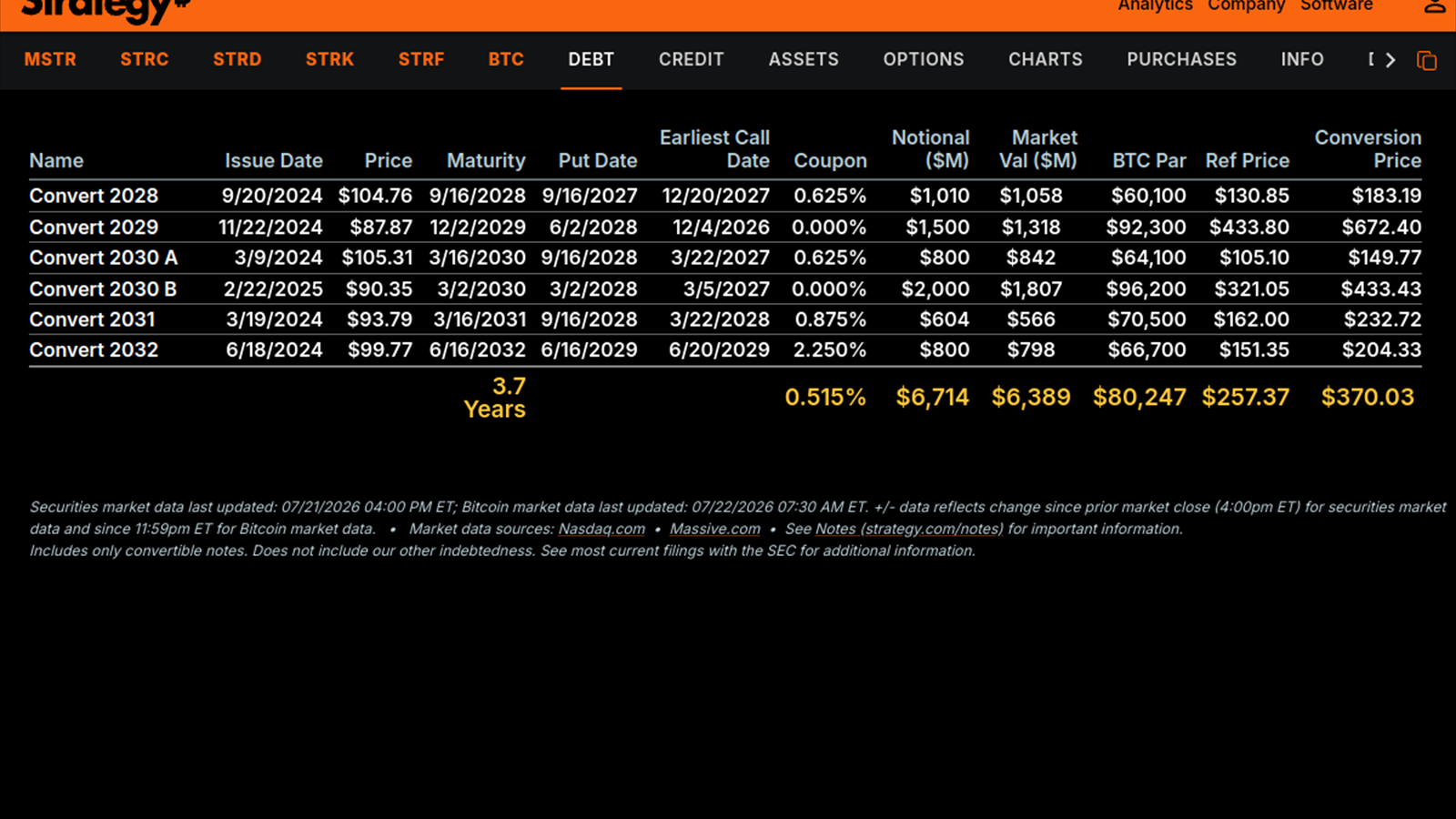
The core difference is the capital stack. Common shareholders sit behind debt, preferred claims and operating liabilities. The stock can trade at a premium or discount to the value of the Bitcoin and other assets. The Bitcoin treasury market map provides the corporate context rather than treating MSTR as a pass-through fund.
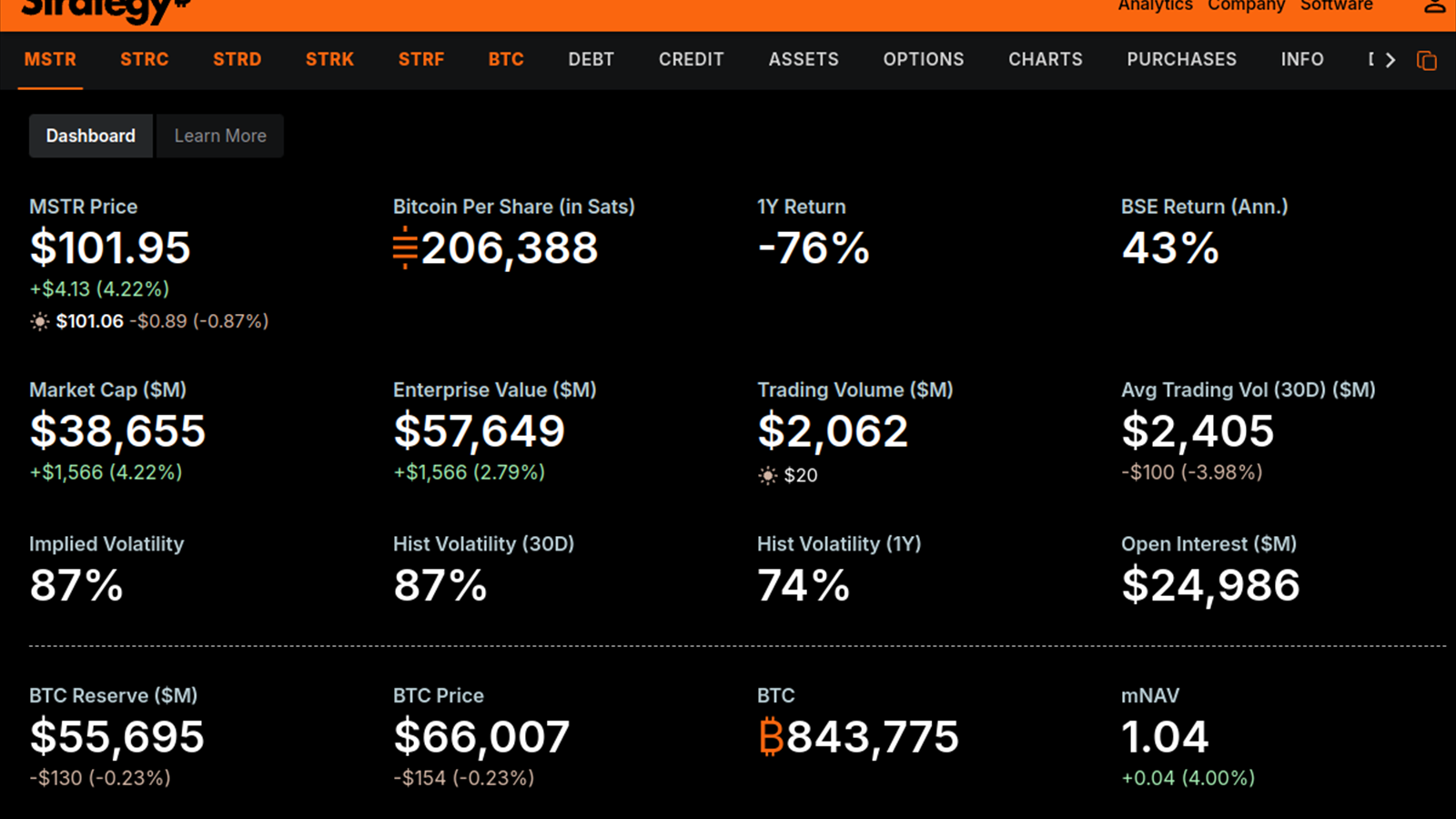
MSTR can also create financing optionality. When the equity trades at a premium and capital markets are open, issuing securities may allow the company to purchase Bitcoin or fund obligations. That is a corporate strategy, not a guaranteed tracking mechanism.
The MSTR fields to refresh are:
- Settled BTC: Measures reserve size, not the common-share claim by itself.
- BTC per diluted share: Shows whether financing increased exposure for the denominator.
- Debt and preferred claims: Shows what ranks ahead of MSTR common equity.
- mNAV: Shows the premium or discount that can expand or compress.
- Cash and operating support: Shows how long obligations can be paid without a BTC sale.
IBIT: an ETF designed to track Bitcoin
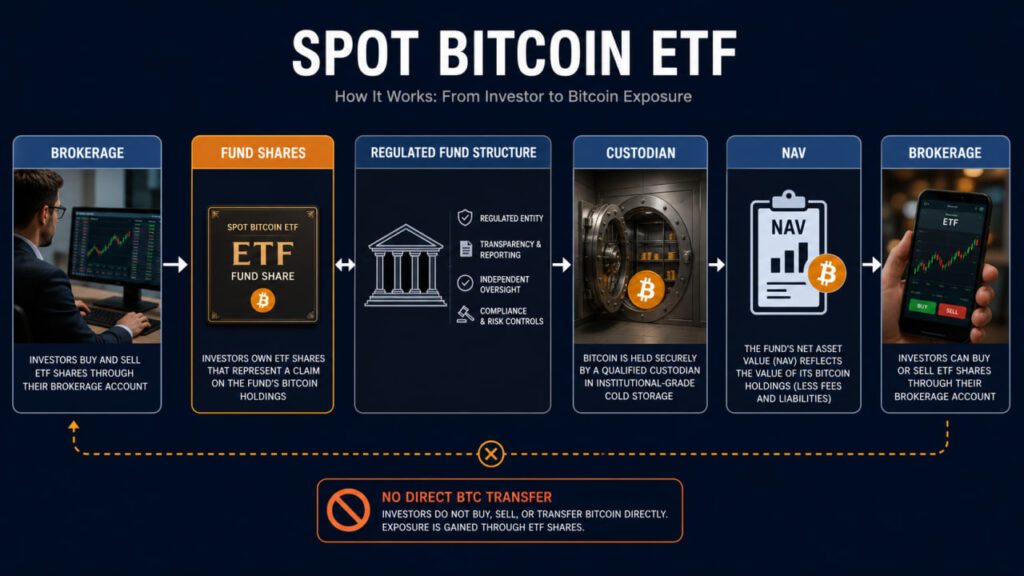
IBIT gives the investor a listed fund share, not a wallet balance. The fund’s custodian holds the Bitcoin; the investor receives price exposure without managing keys or moving coins. Its return mechanism is specific and measurable:
- Underlying asset: The fund’s NAV is primarily driven by the market value of its Bitcoin holdings.
- Fund cost: The 0.25% sponsor fee is deducted from the fund over time, so the share should lag the Bitcoin reference return even when tracking is efficient.
- Trading price: IBIT trades on an exchange. Its market price can sit slightly above or below NAV because buyers and sellers set the price during market hours.
- Creation and redemption: Authorized participants can create or redeem large blocks of shares for cash under the fund’s process. This mechanism helps keep the trading price close to NAV, but it does not make the share identical to spot Bitcoin.
- Investor control: The holder can sell the share through a brokerage, but cannot withdraw the fund’s Bitcoin or use the share to make an on-chain payment.
This structure removes private-key management but adds fund fees, custodian dependence and market-hour limits. The BlackRock iShares Bitcoin Trust page provides the primary fee, holdings and operational disclosures.
Direct BTC: the cleanest asset claim and the largest operational burden
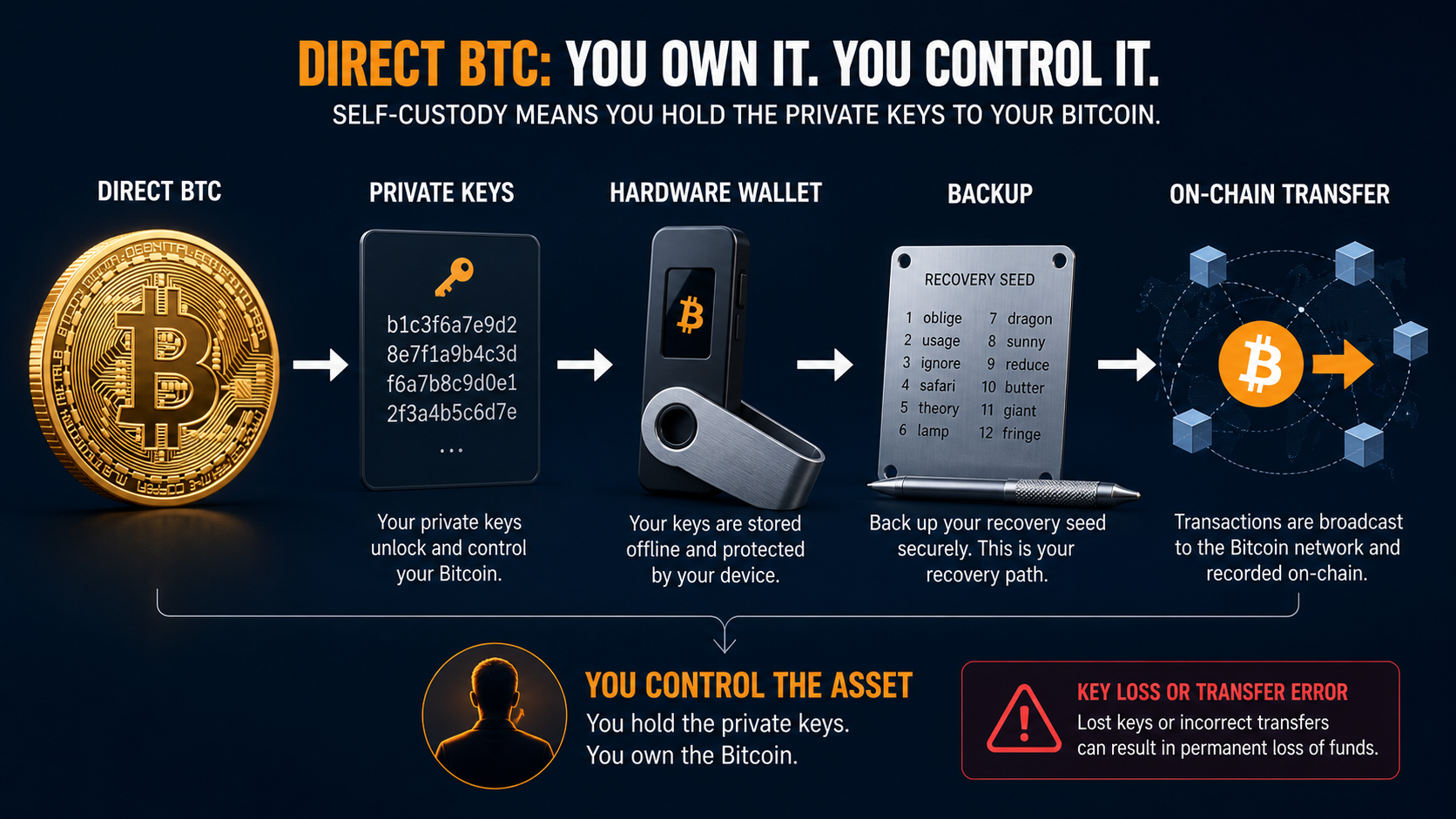
Direct BTC means owning the Bitcoin itself rather than owning shares in a company or fund. The holder’s economic result follows the amount of BTC held and the price at which it is bought or sold. There is no corporate balance sheet, fund NAV or share-price premium to insert another layer between the holder and the asset.
The ownership test is operational:
- Control: The holder controls the private keys directly, or appoints a third-party custodian to control them on the holder’s behalf.
- Transfer: The BTC can be sent to another on-chain address, subject to network fees, confirmation time and any platform withdrawal limits.
- Cost: There is no sponsor expense ratio, but the holder still pays trading spreads, network fees and any custody or security costs.
- Risk location: The main risks are key loss, theft, wrong-address transfers, exchange failure and poor backup procedures rather than corporate debt or fund operations.
- Return exposure: The holder does not face mNAV expansion or compression, preferred dividends or share dilution. The result is therefore closest to the Bitcoin spot return after the holder’s own transaction and custody costs.
Self-custody offers the strongest transfer rights but makes the holder responsible for key security, backups, inheritance and tax records. Third-party custody can reduce that operational burden, but it replaces private-key risk with counterparty, account-access and withdrawal risk. Direct BTC is simpler financially than MSTR or IBIT, but it requires the investor to manage the part that a company or fund normally manages for them.
Why the returns can diverge
The three exposures can diverge for structural reasons. MSTR can trade above or below Bitcoin net asset value. IBIT can experience small tracking differences because of fees, trading, cash and fund operations. Direct BTC reflects the selected venue, custody arrangement, transaction cost and timing.
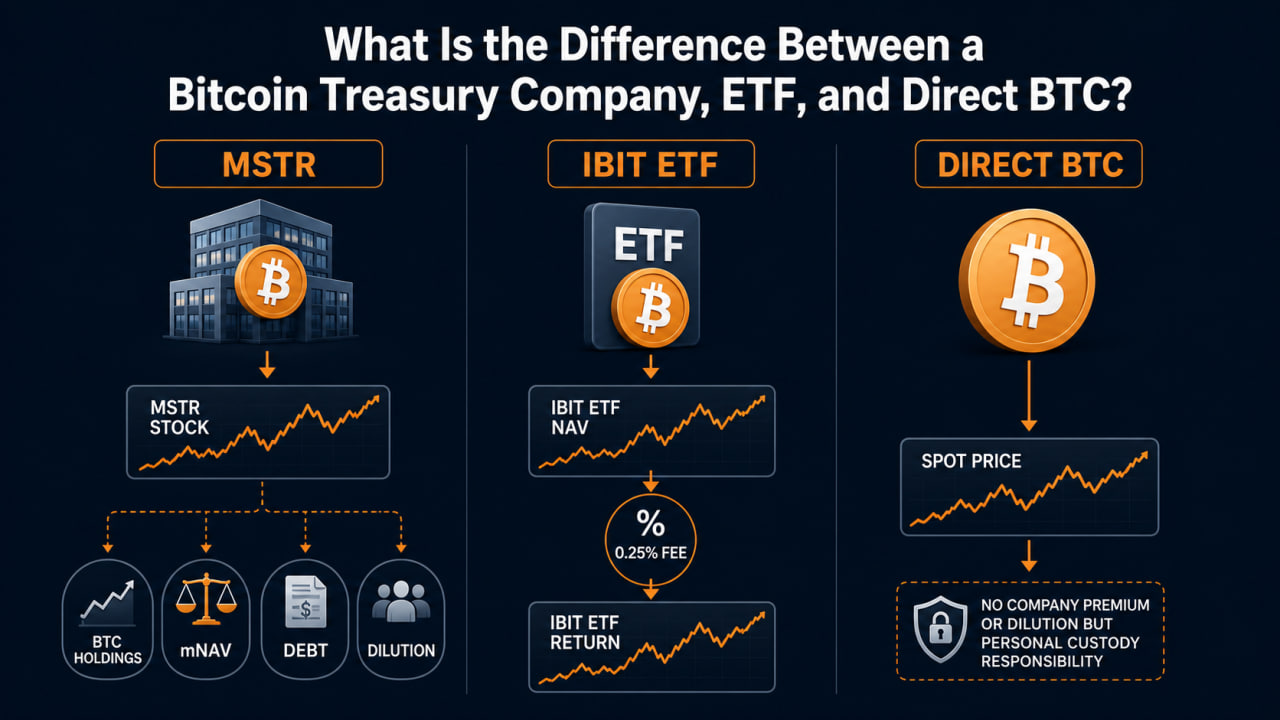
The Bitcoin treasury market map explains why a treasury stock can move independently of the value of its BTC holdings. A premium can expand when investors value financing access or scarcity, then compress when risk appetite changes. That behavior is not a tracking error; it is equity repricing.
Market hours also matter. Bitcoin trades continuously, while a stock or ETF trades on an exchange schedule. An ETF may show a premium or discount during periods when its market is open but the underlying reference market is moving quickly. MSTR can move even further because its operating and financing narratives change with the market.
Fees, dilution and leverage are different costs
An ETF charges an expense ratio and passes custody and operational costs through the fund. Direct BTC has trading, withdrawal, custody and security costs that may be explicit or hidden. MSTR does not charge a simple fund fee, but shareholders absorb corporate expenses, financing costs, preferred distributions, issuance and operating risk through the equity valuation.
Leverage is also different. Direct BTC is not a leveraged corporate claim unless the owner borrows. An ETF generally seeks unlevered spot exposure before fees. MSTR may have debt, preferred securities and common-stock issuance that magnify both upside and downside. The Bitcoin treasury market map shows why different claims on the same treasury can have different priorities and payout structures.
Custody and access comparison
- Coin control: The company and its custodians control MSTR’s BTC; the fund and its custodians control IBIT’s BTC; the investor or chosen custodian controls direct BTC.
- Transferability: MSTR and ordinary IBIT shares do not transfer the underlying BTC; direct BTC can be transferred subject to access and fees.
- Brokerage access: MSTR and IBIT are usually available through a brokerage; direct BTC depends on the venue or custody setup.
- Share denominator: MSTR has basic and diluted-share effects; IBIT uses fund shares and NAV; direct BTC has no corporate denominator.
- Senior claims: MSTR has debt and preferred claims; IBIT has fund liabilities and expenses; direct BTC has no corporate claims.
Reporting and tax treatment are separate layers
The accounting and tax result can differ across a company, fund and individual holder. A company reports Bitcoin, debt and fair-value changes under its financial-reporting framework. An ETF reports fund assets, expenses, creations and redemptions.
A direct holder records transactions, basis and taxable events under the rules that apply to that holder and jurisdiction. The fact that all three reference Bitcoin does not make their statements interchangeable.
A reader should also distinguish market liquidity from underlying liquidity. MSTR and IBIT can be traded during exchange hours, but that does not mean a shareholder can redeem common stock or ETF shares for Bitcoin directly.
Direct BTC can move at any time, but the transfer may be delayed by a custodian, network fee, exchange limit or security procedure. The most convenient screen is not always the most direct claim.
A decision matrix without a universal winner
- Direct transfer control: Investigate direct BTC first, accepting key, wallet and custody responsibility.
- Brokerage simplicity: Investigate a spot Bitcoin ETF first, accepting sponsor, fee and tracking structure.
- Corporate leverage or optionality: Investigate treasury company stock, accepting dilution, debt, mNAV and operating risk.
- Simple Bitcoin sensitivity: Investigate direct BTC or an ETF, accepting less corporate upside from financing execution.
- Public-company research exposure: Investigate treasury company stock, accepting more variables than the Bitcoin price alone.
This matrix is intentionally conditional. It does not say one exposure is superior; it identifies which risks the holder is choosing. The comparison becomes misleading only when a corporate stock is presented as a fund, or a fund is presented as direct self-custody.
The comparison should be read as three different claims
MSTR, IBIT and direct BTC can all rise when Bitcoin rises, but the holder does not own the same thing. MSTR is a residual corporate claim; IBIT is a fund share designed to follow its Bitcoin holdings after expenses; direct BTC is the asset or a custodial claim that can be transferred under the holder’s control. This distinction is more useful than treating all three as interchangeable Bitcoin exposure.
The cost and failure path also differ. IBIT’s official product materials identify a 0.25% sponsor fee and a fund structure; MSTR adds financing, senior claims and a variable mNAV; direct BTC adds wallet, exchange and key-management responsibility. The Bitcoin treasury market map is the relevant next read when the reader chooses the corporate route and needs to understand what ranks ahead of common equity.
The practical choices are:
- Lowest corporate complexity: IBIT or direct BTC, with ETF expenses or direct-custody responsibility.
- Transfer and settlement control: Direct BTC, with key management, network fees and operational-error risk.
- Financing optionality: MSTR, with dilution, debt, preferred distributions and mNAV compression.
- Brokerage-only access: IBIT or MSTR, without ordinary holder-level transfer of the underlying BTC.
Frequently asked questions
Is MSTR the same as a Bitcoin ETF?
No. MSTR is common equity in a company with debt, preferred securities, operating assets and a Bitcoin policy. An ETF is a fund share designed to track Bitcoin through its holdings and expenses.
Does an ETF give direct ownership of Bitcoin?
No. The ETF owns or has rights to custodial Bitcoin for the fund. The shareholder owns ETF shares and receives the economic result of those shares, not ordinary transfer control over individual coins.
Is direct Bitcoin always safer?
It removes corporate dilution and senior-claim risk, but it adds private-key, custody, exchange and operational responsibility. Safety depends on the threat and the control model being considered.
Can MSTR outperform Bitcoin?
Yes, but it can also underperform. Equity premiums, discounts, financing, dilution, preferred claims, operating performance and market sentiment can all move the stock independently of BTC.
Disclaimer: This article is for informational purposes only and does not constitute financial or investment advice. Cryptocurrency and digital asset markets carry significant risk. Always do your own research before making decisions.


