Why Stablecoin Payment Rails Are Repricing The Crypto Gateway Market
The gateways best positioned for the stablecoin-led repricing of crypto payments are Stripe, BVNK, Coinbase Commerce, CoinGate, Triple-A, and MoonPay Commerce. The market is repricing them because stablecoin settlement is becoming more useful to merchants than generic Bitcoin BTC +0.00% acceptance and broad long-tail token support.
That shift is changing what “best crypto payment gateway” even means. The stronger players now are not only the ones that can process a crypto transaction. They are the ones that can turn stablecoin flows into cleaner business settlement, better API logic, and less treasury volatility.

Which Gateway Is Best Positioned For The Stablecoin Shift?
Stripe is the strongest public-facing stablecoin gateway for businesses already inside mainstream payments infrastructure. BVNK is the strongest enterprise stablecoin infrastructure play, while Coinbase Commerce is one of the clearest crypto-native expressions of USDC-centered settlement.
Why Stablecoins Changed The Category
Stablecoins made crypto payments easier to explain to businesses. The merchant no longer has to choose between accepting crypto and preserving revenue predictability. If the gateway can support USDC or USDT on the right chains and settle effectively into dollars or stablecoin balances, the payment flow becomes much easier to operationalize.
That is why the platforms below matter. They are not just accepting crypto. They are reshaping how merchants treat digital-dollar movement.
The same shift runs through how crypto payment gateways are changing merchant settlement and top crypto payment gateways for businesses. One looks at cash-flow mechanics directly. The other shows how those mechanics change B2B buying decisions.
Stablecoin Positioning Table
| Gateway | Stablecoin strength | Main business fit |
|---|---|---|
| Stripe | mainstream fiat-settled stablecoin checkout | Stripe-native businesses |
| BVNK | enterprise stablecoin infrastructure | larger businesses and platforms |
| Coinbase Commerce | crypto-native USDC payment logic | crypto-native merchants |
| CoinGate | flexible merchant settlement | broad business use |
| Triple-A | compliance-first stablecoin processing | processor-led businesses |
| MoonPay Commerce | embedded product-led stablecoin flows | creators and app commerce |
1. Stripe
Introduction
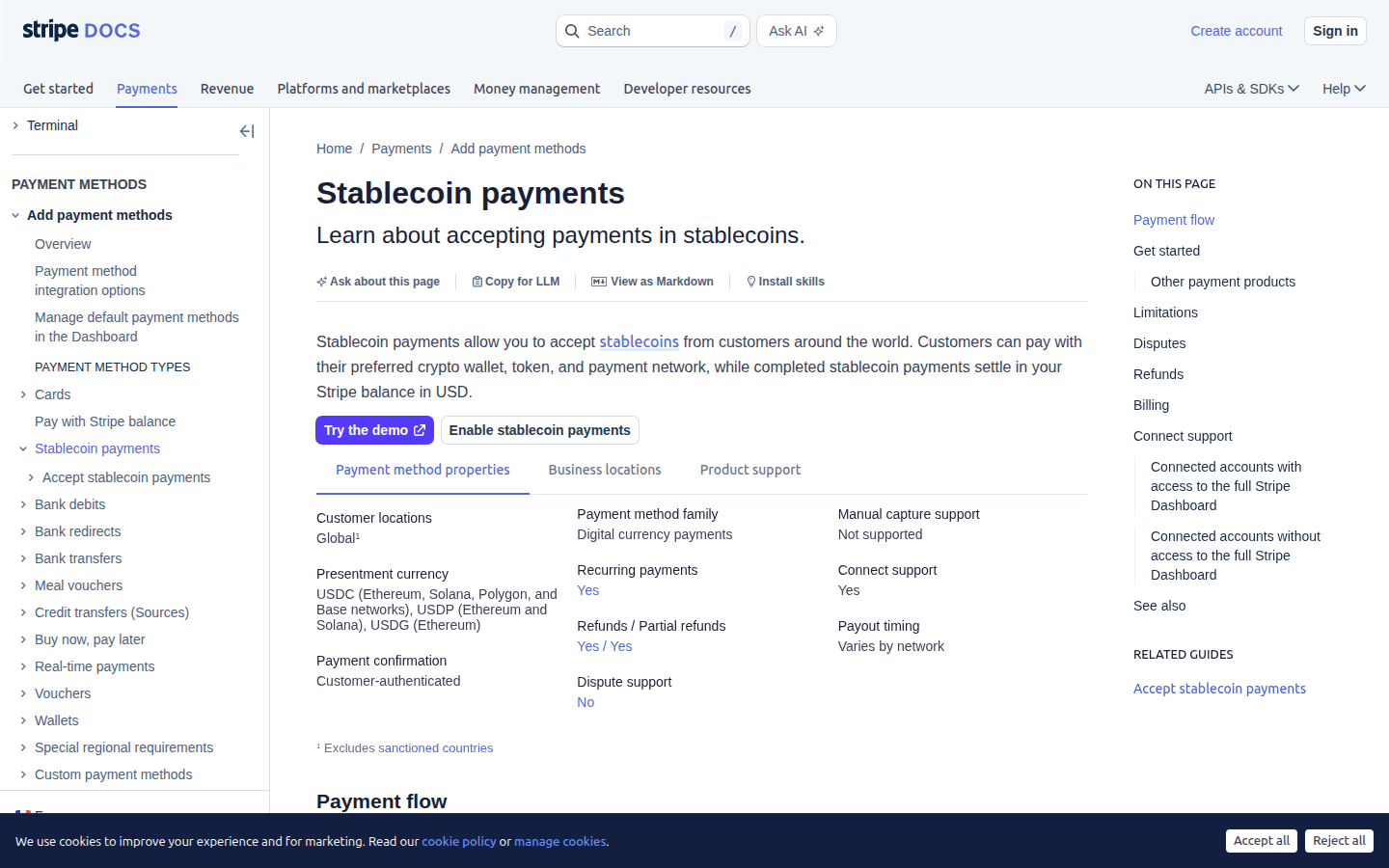
Stripe leads this ranking because it translates stablecoin payments into mainstream business language. Instead of asking a merchant to bolt on a separate crypto processor, it lets stablecoin acceptance sit inside the same billing and checkout environment many businesses already use.
Pros and Cons
| Pros | Cons |
|---|---|
| 1.5% pricing | availability is still limited |
| fiat settlement through the Stripe balance | stablecoin-specific rather than broad-crypto |
| supports USDC, USDP, and USDG | not designed for self-custody-first operations |
| clean fit for subscriptions, payment links, and invoicing | weaker choice if the merchant wants long-tail token support |
Quick Specs
- Fee: 1.5%
- Assets: USDC, USDP, USDG
- Networks: Ethereum ETH +0.00% , Solana, Polygon, Base
- Integration: Checkout, Elements, Payment Links, Invoicing, API
2. BVNK
Introduction
BVNK ranks second because the stablecoin payment market is not only moving toward easier checkout. It is also moving toward deeper infrastructure. BVNK speaks directly to that layer.
Pros and Cons
| Pros | Cons |
|---|---|
| strong stablecoin infrastructure positioning | public pricing is not transparent |
| managed compliance | less suitable for smaller merchants |
| API-first settlement logic | not a simple plugin-first stack |
| good fit for higher-volume business payment operations | less self-serve than SMB-focused rivals |
Quick Specs
- Fee: custom / not publicly disclosed
- Settlement: fiat and stablecoin flows
- Model: managed or hybrid
- Integration: API, hosted pages, payment portal
3. Coinbase Commerce
Introduction
Coinbase Commerce matters here because the stablecoin shift is not only a mainstream payments story. It is also an onchain payments story. Coinbase keeps that side of the market visible by centering USDC settlement logic instead of treating stablecoins only as a backend conversion layer.
Pros and Cons
| Pros | Cons |
|---|---|
| 1% fee | less mainstream than Stripe |
| customers can pay in hundreds of currencies with USDC-centered settlement logic | not the easiest plugin-first choice |
| strong onchain payment design | less enterprise-managed than BVNK |
| useful for crypto-native merchant environments | narrower fit for businesses wanting a conservative processor model |
Quick Specs
- Fee: 1%
- Settlement: USDC-centered
- Networks: Ethereum, Base, Arbitrum, Optimism, Polygon
- Integration: API and hosted checkout
4. CoinGate
Introduction
CoinGate stays relevant because the stablecoin shift still has to pass through ordinary merchant reality. A gateway that can pay out in fiat, stablecoins, or crypto while keeping pricing public still has strong commercial appeal.
Pros and Cons
| Pros | Cons |
|---|---|
| 1% public pricing | weekly standard-plan settlement is not the fastest |
| flexible settlement choices | compliance burden is real |
| practical plugins and API support | not the most advanced API-first infrastructure play |
| useful bridge between crypto and ordinary merchant operations | less self-custody-oriented than NOWPayments or PayRam |
Quick Specs
- Fee: 1%
- Settlement: EUR, USD, stablecoins, crypto
- Integration: plugins, API, buttons, billing
- Model: managed
5. Triple-A
Introduction
Triple-A rounds out the list because stablecoin payments are also a compliance story. Businesses that want USDT or USDC support inside a stricter processor frame still need providers like Triple-A.
Pros and Cons
| Pros | Cons |
|---|---|
| strong USDT and USDC support across multiple chains | public pricing is not simple |
| fiat or crypto settlement | KYB is mandatory |
| compliance-first operating model | less flexible for smaller self-serve merchants |
| good fit for processor-led businesses | less appealing for businesses that want wallet-first control |
Quick Specs
- Fee: not publicly disclosed
- Settlement: fiat or crypto
- Assets: USDT, USDC, BTC, ETH, PYUSD and others
- Model: managed processor
6. MoonPay Commerce
Introduction
MoonPay Commerce belongs in the list because stablecoin rails are not only about merchant settlement. They are also about embedded digital commerce. MoonPay’s product surface makes it relevant wherever stablecoin checkout needs to fit inside a broader product experience.
Pros and Cons
| Pros | Cons |
|---|---|
| strong SDK and widget surface | standard fee is not low |
| optional fiat offramp | extra service layers raise total cost |
| flexible creator and app-commerce logic | less conservative than processor-first rivals |
| strong embedded-commerce potential | heavier stack than a basic checkout use case may need |
Quick Specs
- Fee: 2%, or 1% with HelioX
- Extra fees: swaps 0.25%; auto-offramp 0.50%
- Model: managed commerce platform
- Integration: SDKs, API, widgets, Shopify, charges
Final Take
Stablecoin payment rails are repricing the gateway market because they reduce the gap between crypto acceptance and ordinary business settlement. That gap used to be one of the category’s biggest weaknesses. It is now one of its strongest growth drivers.
That is why Stripe, BVNK, Coinbase Commerce, CoinGate, Triple-A, and MoonPay Commerce are the names to watch. Each one is approaching the shift differently, but all of them are benefiting from the same trend: stablecoins are turning crypto payments into a more practical commercial rail.
References
- Stripe. Stablecoin Payments
- BVNK. Payments
- Coinbase. Commerce Onchain Payments
- CoinGate. Pricing
- Triple-A. What Currencies Can I Use To Pay An Invoice
- MoonPay Commerce. Pricing & Fees
Disclaimer: This article is for informational and editorial purposes only and does not constitute legal, tax, or financial advice. Payment features, supported countries, and settlement terms should be confirmed directly with each provider before production use.