XRP Ripple and Kyobo Advance Tokenized Bond Settlements
Ripple, the company associated with XRP, said it is collaborating with Kyobo Life Insurance on a Korean tokenized government bond settlement proof of concept aimed at modernizing how institutional bond trades are completed. The official framing is narrower than some social posts suggested: both companies describe a regulated feasibility project rather than a live rollout, and neither statement confirms that XRP itself will be the settlement asset.
What Ripple and Kyobo are doing in Korea
On April 15, 2026, Ripple said it had formed a strategic partnership with Kyobo Life Insurance to pursue Korea’s first tokenized government bond settlement on blockchain, placing the project squarely in the country’s institutional market rather than a retail token launch.
Ripple said the feasibility work will use Ripple Custody as the settlement and transfer foundation inside a regulated institutional environment. That detail is the clearest supported link between Ripple coverage and the bond project, because the company named custody infrastructure and possible payment rails, not XRP token settlement.
“institutional-grade digital asset infrastructure is no longer a future aspiration; it is available, proven, and ready to deploy in Korea today.”
Fiona Murray in Ripple’s announcement
Kyobo said in its newsroom post that the firms had already signed the partnership in September 2025 and, by April 2026, had moved into a practical testnet proof-of-concept stage. The insurer also referenced an April 14, 2026 review meeting, which reinforces that the current phase is technical validation rather than a production launch.
Jin Ho Park of Kyobo noted the effort is a test of whether traditional financial assets can run on blockchain-based financial systems, a framing that fits the official PoC language more than the idea of an immediate consumer-facing product.
Why tokenized bond settlement matters for Ripple
Ripple’s own announcement said simultaneous on-chain settlement could move Korea’s typical two-day government-bond settlement timeline toward near real-time execution. That is the most concrete operational upside in the brief, and it explains why the story belongs in a Ripple category even without confirmed XRP token usage.
Ripple also said Kyobo will explore stablecoin-based payment rails alongside the bond-settlement workflow. That makes the project more comparable to TokenTopNews coverage of Circle’s Singapore payout expansion, quietly expanding AI stablecoin adoption, and Paxos Labs’ recent funding round than to any confirmed XRP payments rollout.
The broader real-world-asset backdrop matters too. TokenTopNews recently noted that Ethereum still hosts most tokenized assets, which shows how early the cross-chain race for institutional settlement remains; Ripple and Kyobo are trying to prove a narrower workflow in Korea’s bond market, not declare a nationwide standard.
Both official statements lean on regulation as much as technology. Ripple said the workflow sits in a regulated institutional environment, while Kyobo said it reviewed Korean regulatory conditions before advancing the project. That makes compliance feasibility part of the test itself, not a box to check after launch.
That caution matters because some unconfirmed posts have implied XRP itself will be used in settlement. The official materials linked above stop short of that claim, referring instead to Ripple Custody and stablecoin-based rails.
What this could signal for Korea’s tokenized asset market
At the time of the brief’s market-data fetch, XRP changed hands at $1.35, down 1.27% over 24 hours. That soft price action suggests traders did not treat the Kyobo announcement as confirmation of immediate token utility.
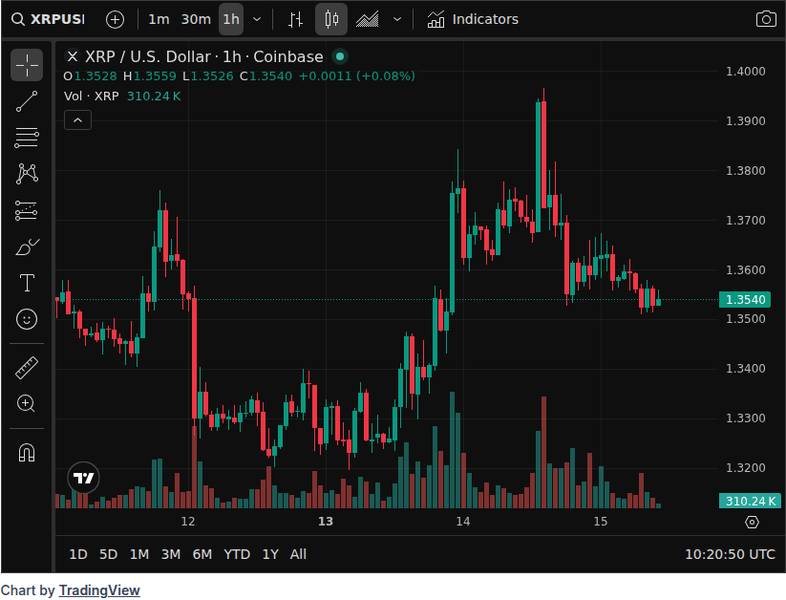
XRP’s market cap stood near $83.22 billion, and its 24-hour volume was about $2.48 billion at the same snapshot. Those figures show XRP remained a heavily traded large-cap asset even as the official Korean story stayed focused on infrastructure testing, custody, and settlement design.
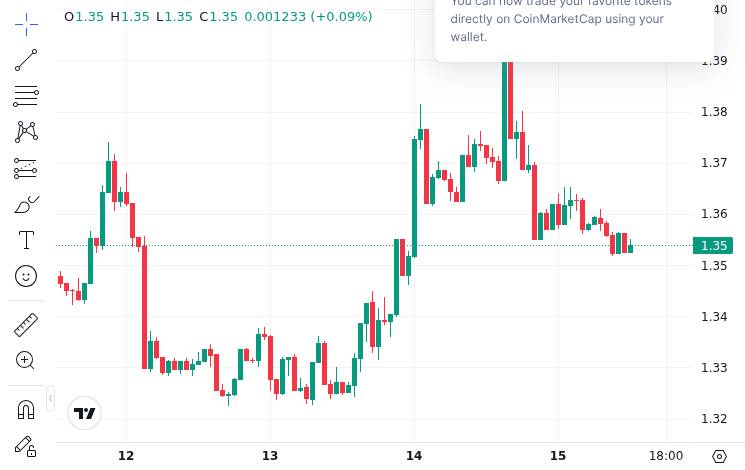
The broader Fear and Greed Index sat at 23, classified as Extreme Fear, when the brief was compiled. In that context, the partnership reads more like a medium-term institutional market-structure story than a short-term sentiment shock.
For Korea’s tokenized asset market, the main signal is that a major insurer and a global crypto infrastructure firm are testing whether government-bond settlement can be compressed and better controlled on-chain. The main limitation is equally clear: until the PoC moves beyond testnet and the cash leg is specified, claims about live XRP settlement or a broader national rollout remain ahead of the evidence.
Disclaimer: This article is for informational purposes only and does not constitute financial or investment advice. Cryptocurrency and digital asset markets carry significant risk. Always do your own research before making decisions.