


$180 Million in Crypto Shorts Liquidated in 30 Minutes — What Just Happened
Over $180 million in short positions were wiped out across the crypto market in a 30-minute window. Here's what triggered the mass liquidation and what it means for traders.
The figure, first reported by Bitcoin Magazine, cites CoinGlass liquidation data. While the specific 30-minute window has not been independently confirmed by a second source, the scale is consistent with a pattern of short squeezes that has repeated throughout April and May 2026.
Short Liquidations — 30 Min Window
Shorts liquidated across crypto derivatives markets in 30 minutes — May 23, 2026. Source: CoinGlass
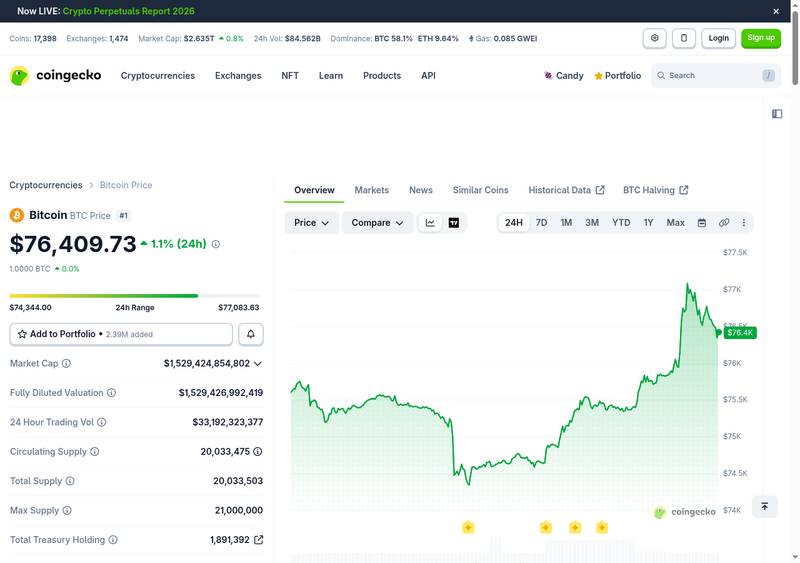
Bitcoin was trading at $76,464 with a 24-hour gain of roughly 1% at press time, on volume of $32.96 billion and a market cap of $1.531 trillion. Ethereum held at $2,108.
Why This Squeeze Fits a Larger Pattern
Short liquidations force exchanges to buy the underlying asset on behalf of liquidated traders, creating a feedback loop that amplifies upward price moves. When $180 million in shorts unwind in half an hour, that forced buying pressure can turn a modest rally into a violent spike.
This event is the third major short squeeze in under two months. On April 22, Bitcoin’s breakout to $78,000 triggered $286 million in short liquidations against only $132 million in long liquidations. Crypto futures open interest rose over 4% to $126 billion in 24 hours during that event.
Then on May 4, a rally to $80,039 wiped out $301.93 million in short positions out of $370 million total liquidations across 97,235 traders. Shorts represented roughly four times the long liquidations that day.
The structural setup behind these repeated squeezes is clear in the data. Entering the May 4 session, the long/short ratio on Binance futures stood at 37.2% long versus 62.8% short, with the funding rate at -0.0051%, both signaling heavy bearish overcrowding.
Bloomberg reported that BTC perpetual futures funding rates remained negative for approximately 46 consecutive days through April 2026. Sustained negative funding means shorts are paying longs to hold their positions, a condition that historically precedes violent upward squeezes when price moves against the crowded side.
What Traders Should Watch After the Flush
Despite the short squeeze rewarding long positions, the Crypto Fear & Greed Index sits at 28 (Fear). That divergence between sentiment and price action suggests the broader market remains skeptical of the rally’s durability, which paradoxically keeps the short side crowded and vulnerable to further squeezes.
Key levels to monitor: the $78,000 resistance zone that triggered the April 22 squeeze, and $80,000 where the May 4 event peaked. A sustained move above either level with elevated open interest could trigger another cascade of forced short covering.
On the downside, if the rally fades and BTC drops back below $75,000, the dynamic reverses. Leveraged longs opened during the squeeze become vulnerable, and a long liquidation flush becomes the risk. Traders who survived the short squeeze may find themselves on the wrong side of the next move if they flip long with high leverage at current levels.
Disclaimer: This article is for informational purposes only and does not constitute financial or investment advice. Cryptocurrency and digital asset markets carry significant risk. Always do your own research before making decisions.